
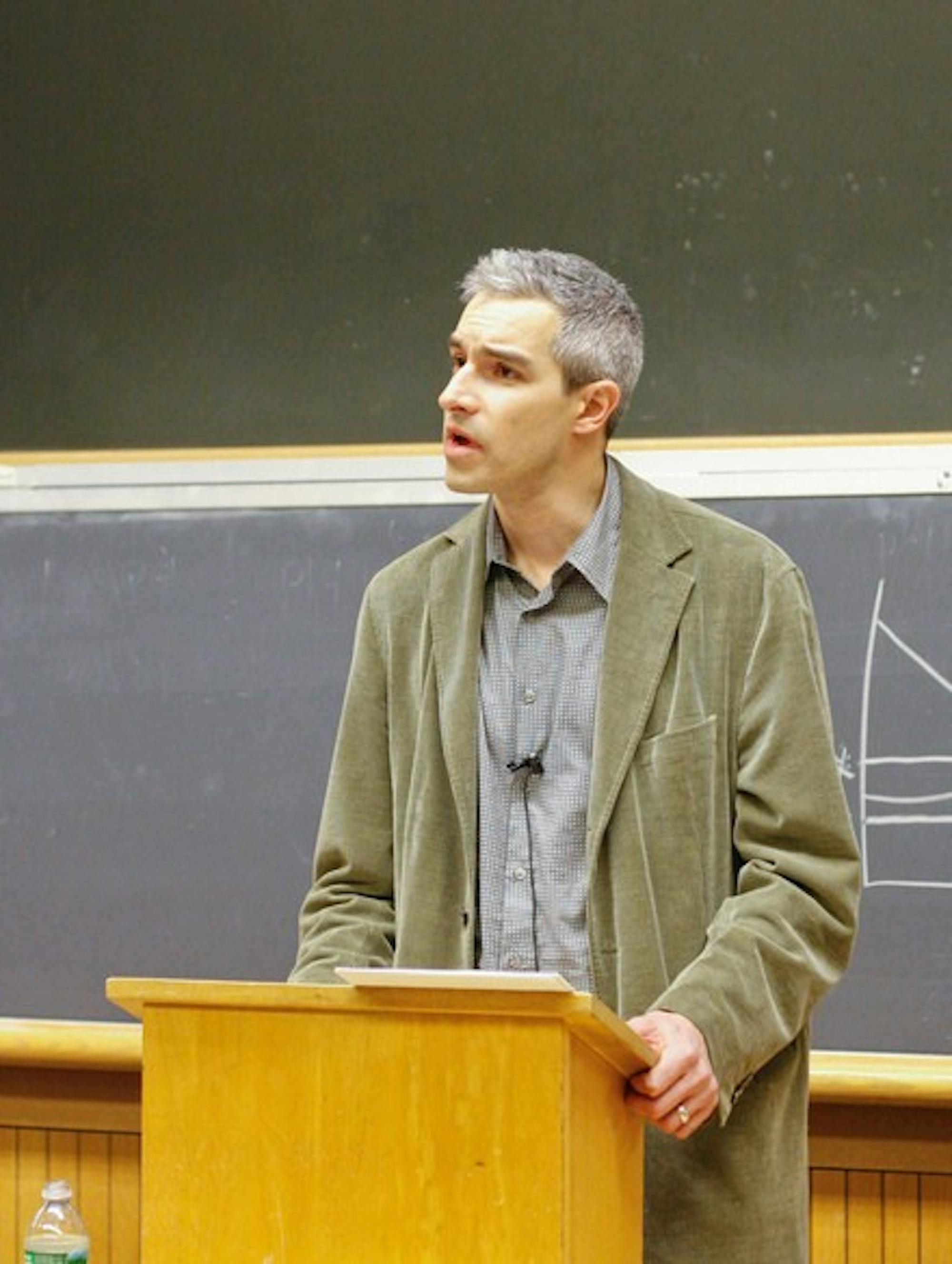
Itzkovitz, an English professor at Stonehill College and the author of a number of articles on popular Jewish-American culture, used this story and several others to color his lecture on the changing Jewish identity in contemporary society.
Itzkovitz emphasized the importance American cultural views about minority groups have had in shaping how Jews have approached their own culture, citing evolving trends throughout the late 20th century.
"The 1950s saw the rise of religious pluralism," he said. "This ultimately gave way to racialism and multiculturalism. I'm interested in the way Jewish identity has shifted in relation to these changing cultural elements."
According to Itzkovitz, this change from an emphasis on religious differences to racial origins in American thought has had a redefining effect in the cohesiveness of Jewish selfhood.
"There has been a transition from a united identity through religion to a more ethnic or racial identity," he said.
This theme is reflected in the increased popularity of birthright programs, which take Jewish youths to culturally significant locations in Israel and Poland, he said. Birthright aims to foster an increased sense of Jewish identity through shared lineage, a sentiment which was shared by several members of the audience.
This phenomenon is unique to Judaism, Itzkovitz said, because of its simultaneously functioning roles as a religion, ethnicity and race.
Itzkovitz also focused his lecture on the collective fear among American Jews that a decrease in the practice of religious rites had signaled a decline in their faith and ethnicity. Citing contemporary Jewish authors who have written about this issue, he stressed that this decline is not a result of racism limiting the freedom of Jews to worship, but rather "virtual suicides of assimilation, intermarriage and indifference."
This perceived trend is only compounded by "sharp divergent trends in American and Israeli Jewish identity," Itzkovitz said, claiming that Jews who live in Israel are better able to integrate their religious and secular practices than those who live in America, where "spirituality is cordoned off from public life."
A striking example of this tension, he said, are the remarks made by Israeli author A.B. Yehoshua at a Jewish Agency convention, where he strongly argued, "If you do not live in Israel ... your Jewish identity has no meaning at all."
In light of these sentiments, the popularity of Birthright trips, as well as increased focus on religious duties, may also be interpreted as "a form of Jewish re-ethnification."
"The reason I went to a yeshiva as a child was not that we were conservative orthodox, but that my parents really wanted me to be Jewish," he said.
Itzkovitz's perspective on Jewish-American identity was refreshing, Susannah Heschel, a Dartmouth professor of Jewish studies, said, because much of the academic discourse in the Jewish studies program focuses on historical events prior to the contemporary era.
"I think this was a nice talk to supplement what we offer in the curriculum," she said. "I mean, I don't even have a television. It's helpful to have someone come to campus and talk about popular culture."
The talk, titled "Unmaking the American Jew: Secularism, Race and Popular Culture," was sponsored by the Jewish Studies Program and organized by Heschel and English professor Aden Evens.


