
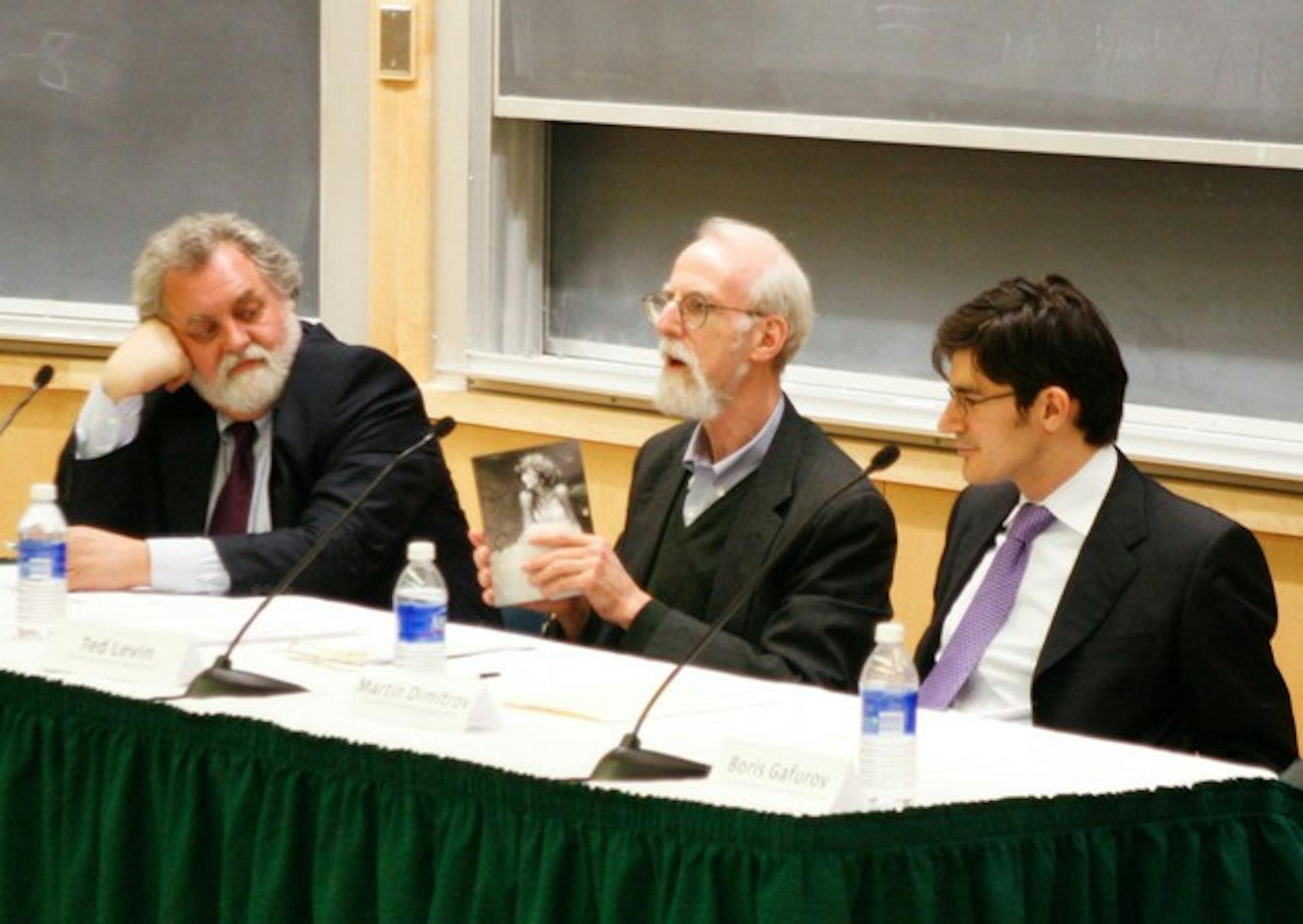
"The Theatre was born based on the pure enthusiasm of those people that were starving for new creativity, new art," Boris Gafurov, the deputy artistic director of Ilkhom, said.
The John Sloan Dickey Center for International Understanding cosponsored the discussion in preparation for Ilkhom's performance. The talk, which included both Gafurov and Maxim Tumenev, an actor in the company who translated for Gafurov, also elaborated on the Theatre's origins.
The Ilkhom Theatre, founded in 1976 under the threat of Soviet censorship, mounted its first performances in a converted basement vegetable warehouse, according to Gafurov. At the time, many Soviet intellectuals who were forced into exile in Uzbekistan found their way to the Ilkhom Theatre during its early years.
"Independence during the Soviet time was impossible," Gafurov said. "[Ilkhom] was founded as the first independent theater in the whole USSR region."
As the Theatre became increasingly prominent, the themes of its performances, often shocking and considered verboten by the authorities, came under scrutiny, he said. After Ilkhom's first performance in Moscow in 1981, Soviet officials sought to dissolve the company.
"It raised a wave from the Soviet government, which contacted the Uzbek government and tried to shut down the Theatre," Gafurov said. "For some reason, the Theatre survived, and continues to survive."
Although the Theatre remains a cultural focal point in Uzbekistan, its future course is unclear, Gafurov said. Mark Weil, who founded Ilkhom, was murdered in Tashkent, the capital of Uzbekistan, last September, leaving the long-term direction of the company uncertain.
"The Theatre is going through a very hard time," Gafurov said. "This is now a transitional point for the company."
Gafurov said he hoped Ilkhom's members, despite their concerns, would carry on with Weil's initial vision for the Theatre as a group that would rise above the traditional linguistic and cultural divisions of Soviet Theatre. For example, Ilkhom's play "White White Black Stork," which Ilkhom will perform at the Hopkins Center this weekend, contains a mix of Russian and Uzbek, he added.
"He didn't care what ethnicity you are, what nationality you are, and what language you speak," Gafurov said, referring to Weil. "And even now, if you look at our ensemble, it's absolutely international."
The discussion was moderated by Theodore Levin, a music professor. Two other professors, Sergei Kan, of the anthropology department, and Martin Dimitrov, of the government department, provided background on Uzbekistani history after the fall of the Soviet Union. They described an independent Uzbekistan that, despite economic prosperity relative to other ex-Soviet states, remains corrupt and oppressive.
"Uzbekistan has no opposition; the [opposition parties] have been banned," Dimitrov said. "When it comes to political life, there has been extensive and violent repression."
Kan, who was born in the Soviet Union, also expressed his personal interest in the Ilkhom Theatre's place in the culture of Tashkent, where the Theatre performs. He sought to discuss the impact of Ilkhom on the often restricted Tashkent art scene.
"Those of us who lived in the Soviet Union before '91 know that theater often provided one of the very few avenues or opportunities for very limited, but some, expression of dissent," he said. "Now, the fact that your Theatre still exists gives us some hope."


