
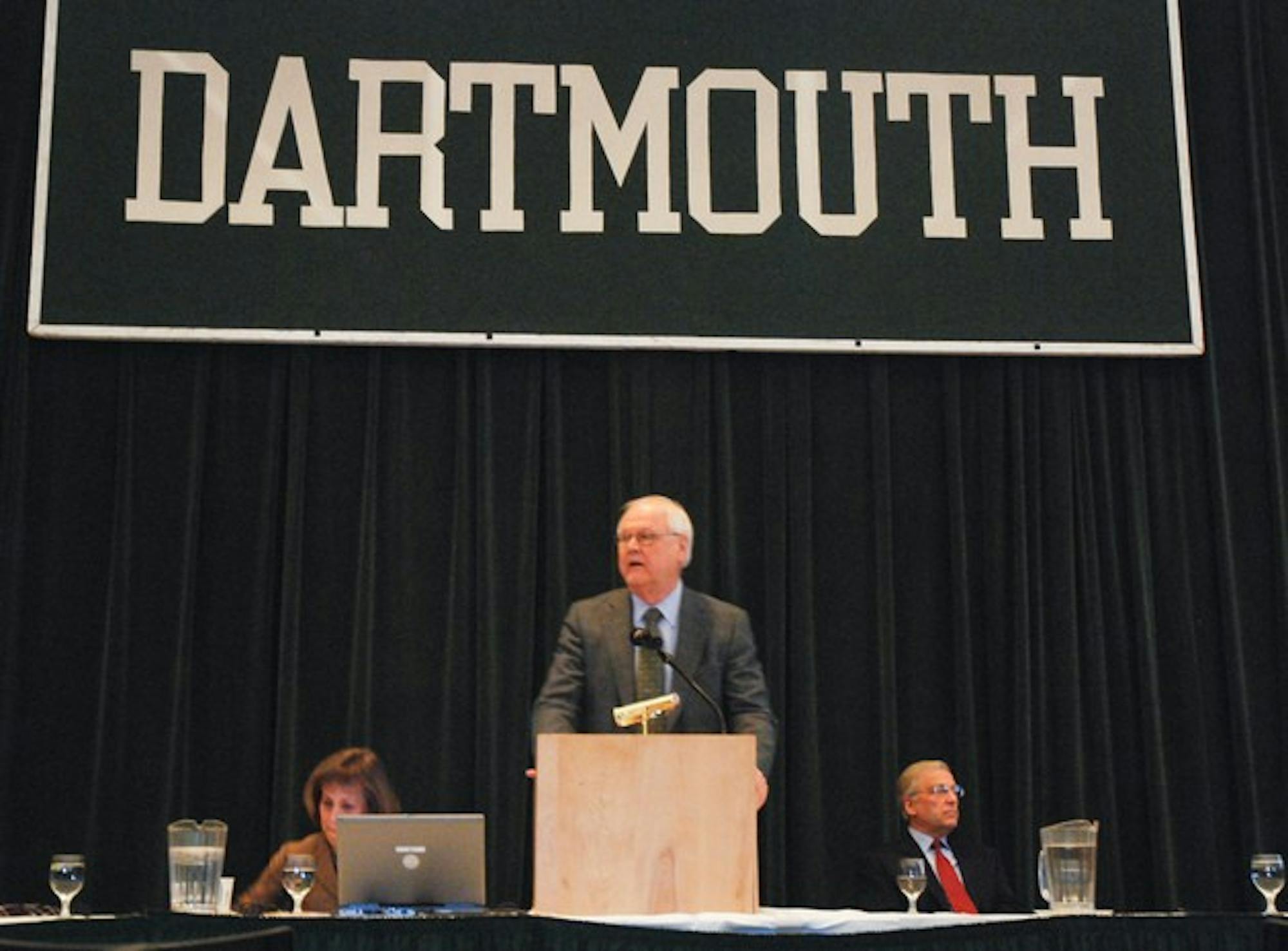
At Monday's meeting, College President James Wright also announced that current Senior Associate Dean and former Acting Dean of the College Dan Nelson '75 will step in for Sheila Culbert, senior assistant to the President of the College, beginning in July 2008.
Culbert, who has spearheaded communications and emergency management during her tenure at Dartmouth, announced in January that she will leave Dartmouth at the end of the 2007-2008 school year to assume the post of headmaster at the Connecticut boarding school Loomis Chaffee.
"Dan, I think, is a wonderful person who has a good sense of the workings for the College," Wright said in his remarks to the faculty, complimenting Nelson for his problem-solving skills, integrity and judgment.
Wright did not specify how long he expected Nelson to serve in the position, though there is speculation that he will remain in the role until Wright's successor takes over in June 2009.
The Dartmouth was unable to reach Nelson for comment by press time.
The revised plan for retiree healthcare benefits, which was approved by the College's Board of Trustees this weekend, was presented to the faculty by Peter Winkler, chair of the Committee on Faculty and a professor in the mathematics department.
The new plan, a collaborative effort between the COF and Adam Keller, executive vice president for finance and administration, was created after the original proposal was directed to the Committee on Faculty last November following widespread dissent at the Fall term meeting of the Faculty of Arts and Sciences. The revised plan lessens the impact of the changes on current faculty and staff but still eliminates the benefit for any employees hired by the College after July 1, 2009.
Under the original plan, the College's contributions to "Medigap" costs -- healthcare costs for retirees not covered by Medicare -- were reduced from 100 percent to between 40 to 85 percent for employees hired before Jan. 1, 2009. The percentage contributed by the College under the first proposed plan was to be determined by a formula that placed equal weight on age and years of service at Dartmouth.
The November plan reduced this benefit for employees hired after Jan. 1, 2009 from full coverage to a zero-percent contribution from the College -- a change that was sustained in the final plan presented on Monday. A matching savings plan will be implemented for these new employees and will contribute up to $3,000 towards these costs.
The final plan changes the College's coverage for employees hired before July 1, 2009 to between 50 and 100 percent, using a new formula which places more value on years of service than on age. Employees whose age and years of service add up to 75 will receive 100 percent coverage from the College.
The revised plan also includes the implementation of a sliding scale for lower-paid employees, which can increase contribution from the College by up to 20 percent. Employees who are paid less than $60,000 per year will receive an additional percentage point of coverage for every $2,000 increment between their salary and this base level.
In April, faculty members will receive letters confirming their individual subsidy percentage.
Changes to the plan proposed in November were the result of hundreds of faculty suggestions received by Keller and the COF. At Monday's meeting, Winkler outlined several of the most common complaints, all of which are addressed under the new proposal, he said.
These complaints included allowing for service interruptions without benefits reductions, Winkler said, and a desire to avoid "sharp cutoffs" in benefits which would make employees "subject to the vagaries of being born at 11:00 p.m. one night or 1:00 a.m. the following morning."
"Absolutely everyone does better in the amended plan," Winkler said.
In contrast to the harsh criticism of the November plan, Monday's meeting saw little dissent from faculty, who largely limited their comments to factual questions about the plan's content.
Several faculty members were invited to provide their age and years of service in order to compute the amount of coverage they will receive from the College on a subsidy calculator now available on the Dartmouth web page.
One faculty member did argue that the plan should have been presented to the faculty again before its approval. In response, Wright reminded the gathered faculty that the plan's implementation was never contingent on their approval.
"It's not one to be approved by any singular group," Wright said.
Wright predicted that the changes would have the greatest impact on "lateral hires," faculty that the College hopes to draw away from other institutions.
"We'll need to find ways to improvise and be supportive there," he said.
Keller also presented the plan to the Dartmouth Division of the Services Employees' International Union on Monday. The union, which strongly contested the original proposed changes, has said that the benefit reductions could affect contract negotiations with the College, set to occur in the coming months.
Earl Sweet, president of the College's division of the SEIU, told The Dartmouth on Monday that he had not yet determined the union's position on the revised plan.
"We're going to see what the rank and file has to say about it," Sweet said. "We still may be at the contract table negotiating."
Changes in healthcare benefits arose from a 2003 mandate from the Board of Trustees to reduce the College's liability, particularly in the area of retiree healthcare benefits. The original plan was compiled by a working group convened by the College Benefits Council.
Although the new plan does not result in as large a reduction of the College's liability as the plan proposed in November, Wright affirmed that the revised plan was largely accepted by the Board.
"The Trustees are prepared to implement this," Wright said.
The Board's 2003 request came as part of a larger trend of declines in this coverage which began in the mid 1990s. At the meeting, Keller noted that Brown University, Emory University and Northwestern University have completely eliminated healthcare benefits for retiring faculty and staff.
Monday's meeting also included Dean of the Faculty Carol Folt's annual report, in which Folt enumerated several key initiatives for the College, including the formation of an ad hoc committee to address previously proposed changes to the Sophomore Summer program.
In her remarks, Folt also reviewed the College's progress on interdisciplinary learning, international studies and off-campus programs, independent and small-class setting study and the creation of a diverse learning community.
"Doing each of these really well is, to my mind, one of the biggest challenges facing higher education," Folt said.
Folt used side-by-side comparisons of current statistics from the College with those from the past to reflect the College's growth in each of these areas. She also highlighted new programs, including a possible new minor in international studies, the expansion of Dartmouth's offerings for foreign study and the construction of a new Visual Arts center and the Class of 1978 Life Sciences Center.
Folt also outlined challenges to meeting these objectives, noting that the College needs to continue to increase the diversity of its faculty and maintain efforts to foster personal interaction in larger classes.


