
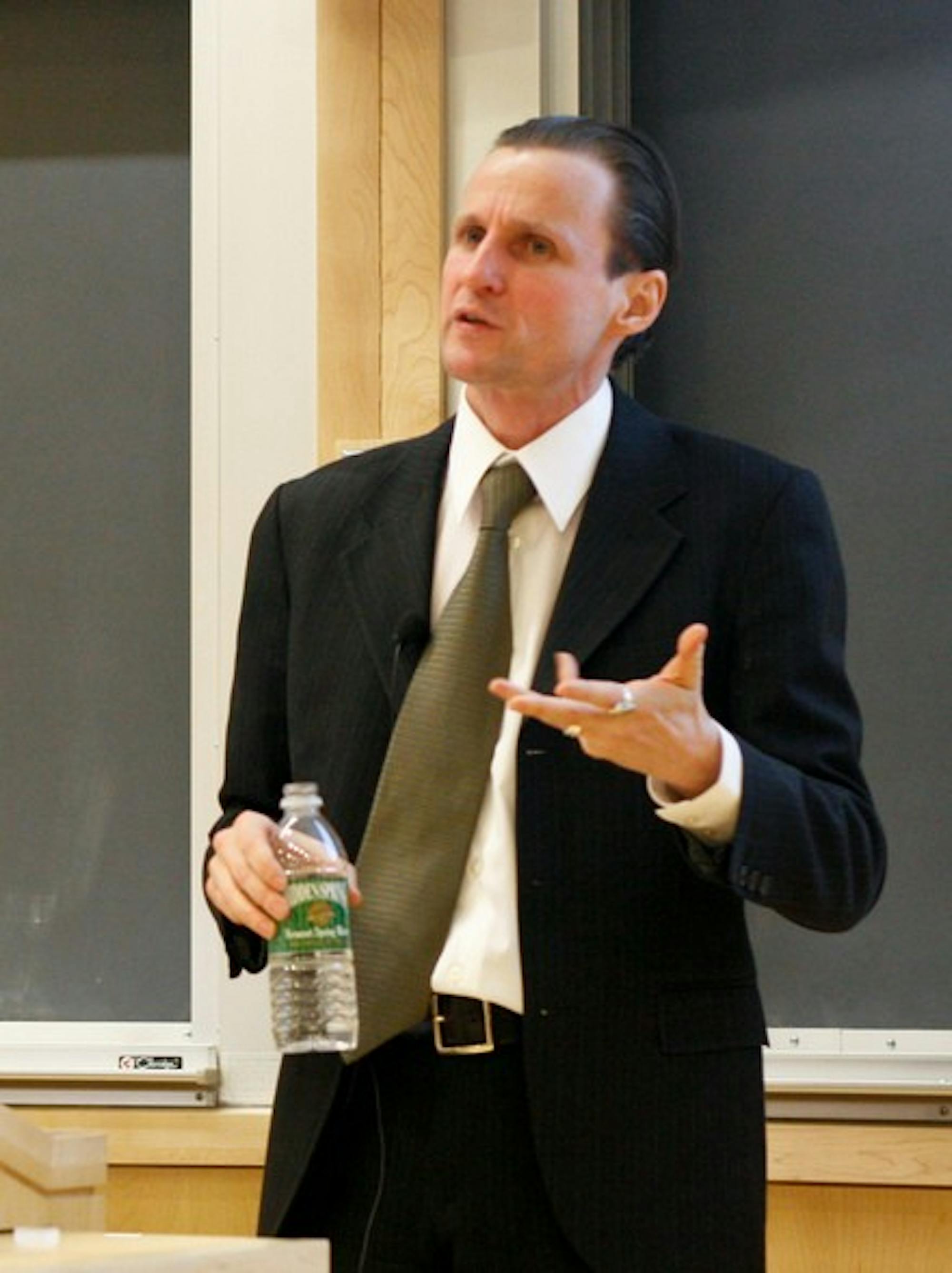
"What if our experience of everyday life was becoming more game-like?" Wark asked members of the Dartmouth community assembled in Haldeman Hall to hear his Monday-night lecture, titled "Gamer Theory." "How would we then think about the game?"
Wark, a professor of media studies at the New School's Eugene Lang College in New York, spoke primarily about his newest book, "GAM3R 7H30RY." The work addresses the interaction and overlap between the virtual and real worlds. Video games are the most prevalent example of this interaction, Wark said.
Wark cited the current presidential campaign as an example of the growing presence of a "gamer" mentality. He noted that people increasingly focus on "the race" rather than on the issues when thinking about elections.
Games are also a type of social allegory, Wark said, because they allow individuals to construct worlds that are closer to their social ideal.
"Is [reality] a level playing field? Maybe not," he said, adding that games, in which the same rules apply to all players, are egalitarian.
Technology's limitations are of equal importance and interest as its capabilities, Wark said, citing the game "SimEarth" as an example of these limitations. In the game, players create a planet, meant to represent Earth, and raise a civilization on it. While the game simulates the society's time on the planet, it reaches its limit after the civilization develops the technology to travel into space. These restrictions demonstrate that even the most complicated models cannot fully address all aspects of reality, Wark said.
Although Wark mainly focused on his book, he also raised several questions facing scholars of modern media.
"What comes next? What are the new shared forms?" he asked, describing the progression of written media, such as literature, to visual media, and finally to interactive media -- such as modern virtual gaming.
"For the humanities, we like to think about ourselves as custodians of the past, but we're also custodians of the future."
While Wark has published multiple books over the past decade, he viewed "GAM3R 7H30RY," written as a project for the Institute for the Future of the Book, as a unique opportunity. The process of writing the book, Wark said, is equally important as the book's content. Wark solicited comments from readers by posting each section of the book online. He subsequently incorporated these comments into successive versions of the book.
"It was sort of like making a promise to readers: 'I will change the book. This text will change,'" Wark said.
The final version of the book was posted on the institute's website and published conventionally.
Each chapter of the book used a particular popular game, such as "The Sims" and "Civilization," in order to explore the place of such games in society.


