
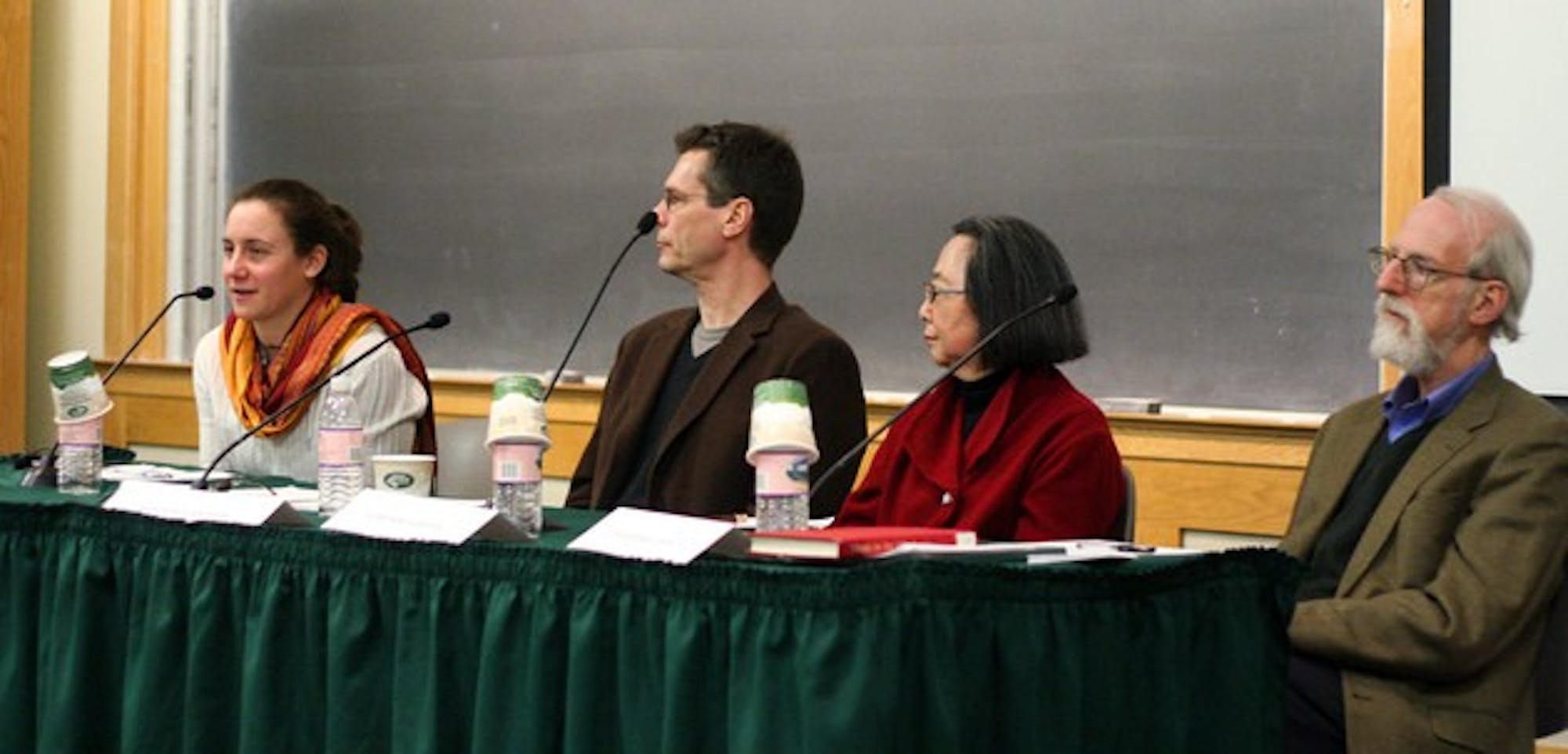
Blumenthal, the recipient of the 2007 Chase Peace Prize for Senior Thesis, shared her knowledge of the serious ethnic tension between Muslims and the Buddhists in the region at a panel in Filene Auditorium on Tuesday. This tension has led the region's Buddhist majority to discriminate against the Islamic Beda musicians.
"The Beda musicians, originally looked upon with some respect, are now degraded as musicians who only served a function within the society," Blumenthal said. "They are looked down upon as a caste and can not intermarry with other communities in Ladakh."
The caste to which the musicians now belong is seen as "untouchable" by Leh residents of higher castes. At social gatherings, the musicians are forced to use separate utensils and are often insulted, abused and even beaten up after festivals if they played too little music, according to Blumenthal.
"There are examples of people who were forced to play until they vomited blood," she said. "A man I met named Abdul Ali was never able to play again. This took away his livelihood, and now he depends on donations from neighbors because he has no other way of getting income."
Blumenthal believes that modernization could provide a shred of hope for members of the lower castes. Many ex-musicians are able to escape discrimination by joining the army or moving to an urban environment. Some, however, are attempting to embrace their past and see the good in their culture, she said.
"They see that tourism and making recordings is an economically viable way to keep their culture alive," Blumenthal said. "They have also tried to organize unions to advance the status of their fellow musicians."
Blumenthal, now an intern at the Smithsonian Institute, plans to set up a cultural center in Ladakh that would serve as a community center for those who suffer from discrimination in Leh.
On the panel, Blumenthal was accompanied by Hiromi Lorraine Sakata, a professor of ethnomusicology at the University of California, Los Angeles, and Martijn Van Beek, an associate professor and Ladakh scholar at the University of Aarhus in Denmark. Theodore Levin, the Parents' Distinguished Research Professor in the Humanities at the College, who advised Blumenthal in her major, hosted the event.
"This is a really important topic and hasn't been researched much at all," Van Beek said. "Katey shows sensitivity in her field of research and clears up some of the complexities in the field."
Blumenthal, who focused her studies on ethnomusicology, spent more than two years doing field research and working on her thesis, according to Levin.
The Chase Senior Thesis Prize is awarded annually to a member of the graduating class whose thesis demonstrates a broad knowledge and understanding of any topic relating to war and peace. The award grants the recipient $1,500 and the opportunity to return to Dartmouth the following year to host a panel relating to the subject of his or her thesis.
"This is not an obvious discipline in which to award a prize for peace," Levin said. "It is a wonderful mark of distinction for Katey's work and for the Chase Peace Prize committee."
The Chase Peace Prize was founded by Edward M. Chase, a native Lithuanian who settled in Manchester, New Hampshire until his death in 1939. In addition to his gifts to Dartmouth, Chase endowed Harvard University and a number of other private institutions with similar bequests in order to "encourage people to think about specific peace issues," according to William Wohlforth, chair of Dartmouth's government department.
"This award encourages people to think broadly about the issue of war and peace, especially the peace side," Wohlforth said. "This is a legacy started by an individual who saw the potential of higher education."


