
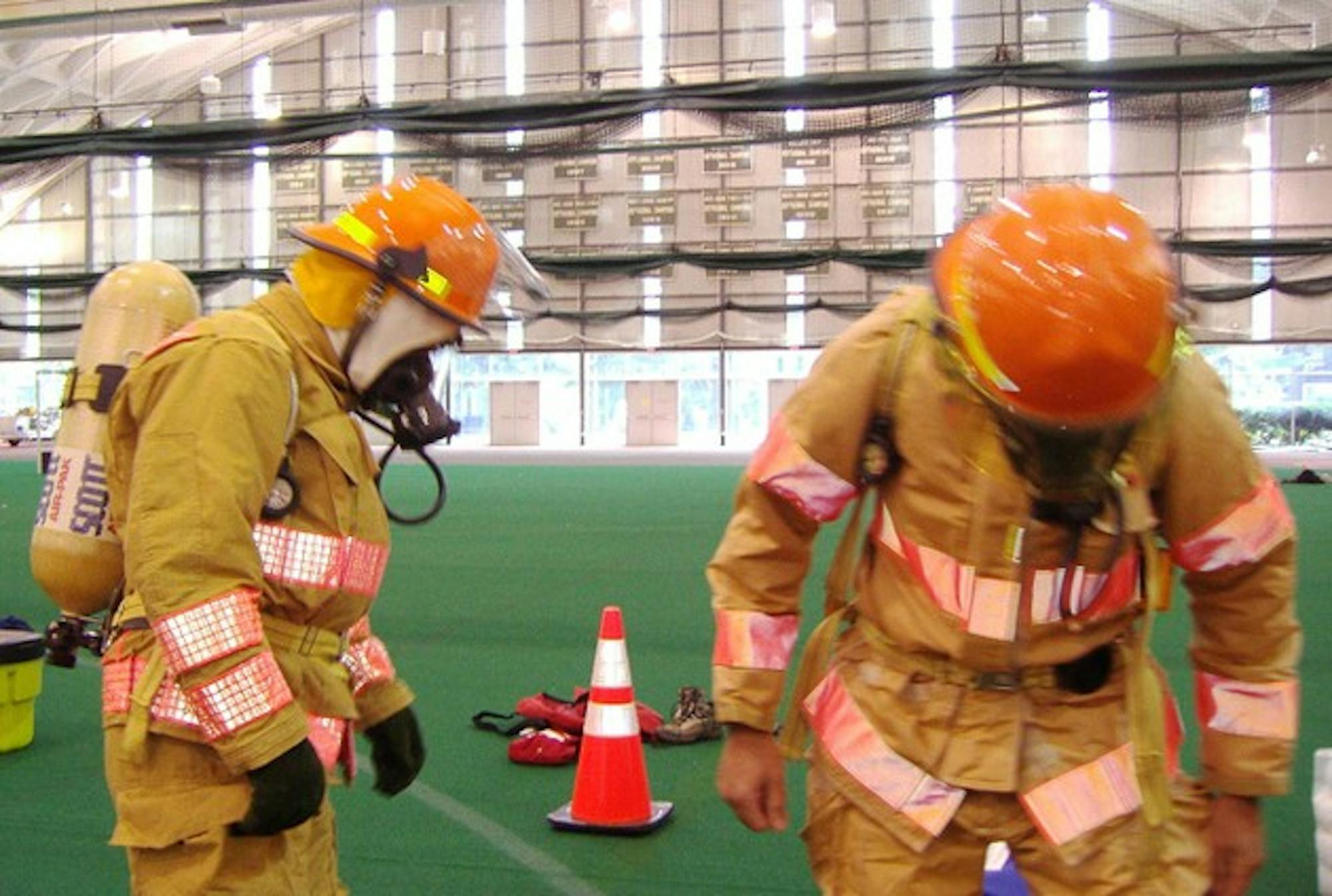
Harry Kinne, head of Dartmouth Safety and Security, said his department is currently working with the New England Center of Emergency Preparedness, a non-profit organization, to develop scenarios testing the College's handling of a crisis. He could not discuss details on the current project but said a previous scenario had tested the College's ability to deal with a SARS outbreak.
"The most extensive work we've done has been on pandemic planning," Kinne said. He added that a plan to fight pandemics "is still in effect, though hopefully we won't have to use it."
Dr. Robert Gougelet, assistant professor of emergency medicine at Dartmouth Medical School and head of New England Center of Emergency Preparedness, said these drills represent an important part of disaster training.
"We think exercises and drills are very valuable for assessing if people are prepared for actual events," he said.
Gougelet said one of the biggest challenges emergency planners face is making people aware of how a disaster can completely overwhelm states or communities, though he said the problem can be mitigated by designating "buildings of opportunity" -- such as schools and hospitals -- to function as medical centers for both emergency and routine situations. For instance, patients were housed in the Leverone Field House last year when the Dartmouth-Hitchcock Medical Center was filled to capacity, he said.
The EHS also used the Leverone Field House to run simulations of a hazardous materials incident, Michael Blayney, Environmental Health and Safety director, said. EHS has not yet had to implement these skills for anything more dangerous than minor chemical spills in laboratories.
Blayney said that in his 12 years working at the College, he has seen a change in the way the school responds to emergencies, especially since Sept. 11, 2001.
"The real change is we don't just talk about a discreet emergency; now what we do is talk about 'all-hazards,'" he said.
In order to coordinate work between different departments, Dartmouth will implement a new digital radio station to sync communication across the College. The station will also make it easier to talk to officers in Hanover, Lebanon, Hartford, and the Dartmouth Skiway.
The College also works with the greater community -- which has received direct aid from the federal government -- as partners in security.
The most recent federal grant to the area enabled the $55,000 purchase of a Mass Casualty Emergency Response Trailer for Lebanon, N.H. in 2005. The response trailer, controlled by the Lebanon Fire Department, services the entire surrounding region and includes prophylactics, vaccinations and other medical supplies.
The trailers will help to quickly mobilize resources against any disaster, Gougelet said. He added that the federal funding of these trailers allows local groups to focus on other issues because they already have the resources necessary for an emergency.
Lebanon Fire Chief Chris Christopolis said most recent federal grants to the region have improved communications infrastructure, facilitating coordination between fire, police and other departments. He also said the fire department is better equipped to respond to a range of emergencies, from terrorist attacks to natural disasters.
New Hampshire received $6,955,299 from the Department of Homeland Security in 2007 from funds established after the Sep. 11 terrorist attacks. The state received fewer funds than in previous years and less money for its size than most other states because Homeland Security does not consider it a high-risk target. The Department of Homeland Security recently changed its formulae to emphasize risk and automatically allocate less funding to each state.
New Hampshire's approach to emergency management is similar to that of the College.
"You have one plan, an all-hazards plan, under the assumption that the consequences of any disaster -- whether natural or man-made -- are the same," James Van Dongen, public information officer for the New Hampshire Department of Safety, said.
This approach allows emergency responders to quickly adapt to new threats, Van Dongen said.
Van Dongen said that Homeland Security grants have allowed the state to train emergency responders, develop better emergency procedures and coordinate its communications networks. He cited the 1997 murder of five people in Colebrook, N.H. as an example of the need for improved communication.
"It was a little difficult to coordinate the response to all that because people couldn't talk to each other," he said, noting that this led to insufficient police reinforcement.
Despite integration with the state's emergency plans, EHS Head Michael Blayney stressed the need for the College to be self-sufficient.
"There's never been something that requires a mass mobilization, but we can certainly imagine a powerful ice storm knocking things out," he said.
He also said that EHS's work against hazardous materials corresponds with Dartmouth's larger commitment to sustainability.
"It's really applied environmentalism," he said, "I'd like to think we're part of the 'green collar' economy."


