
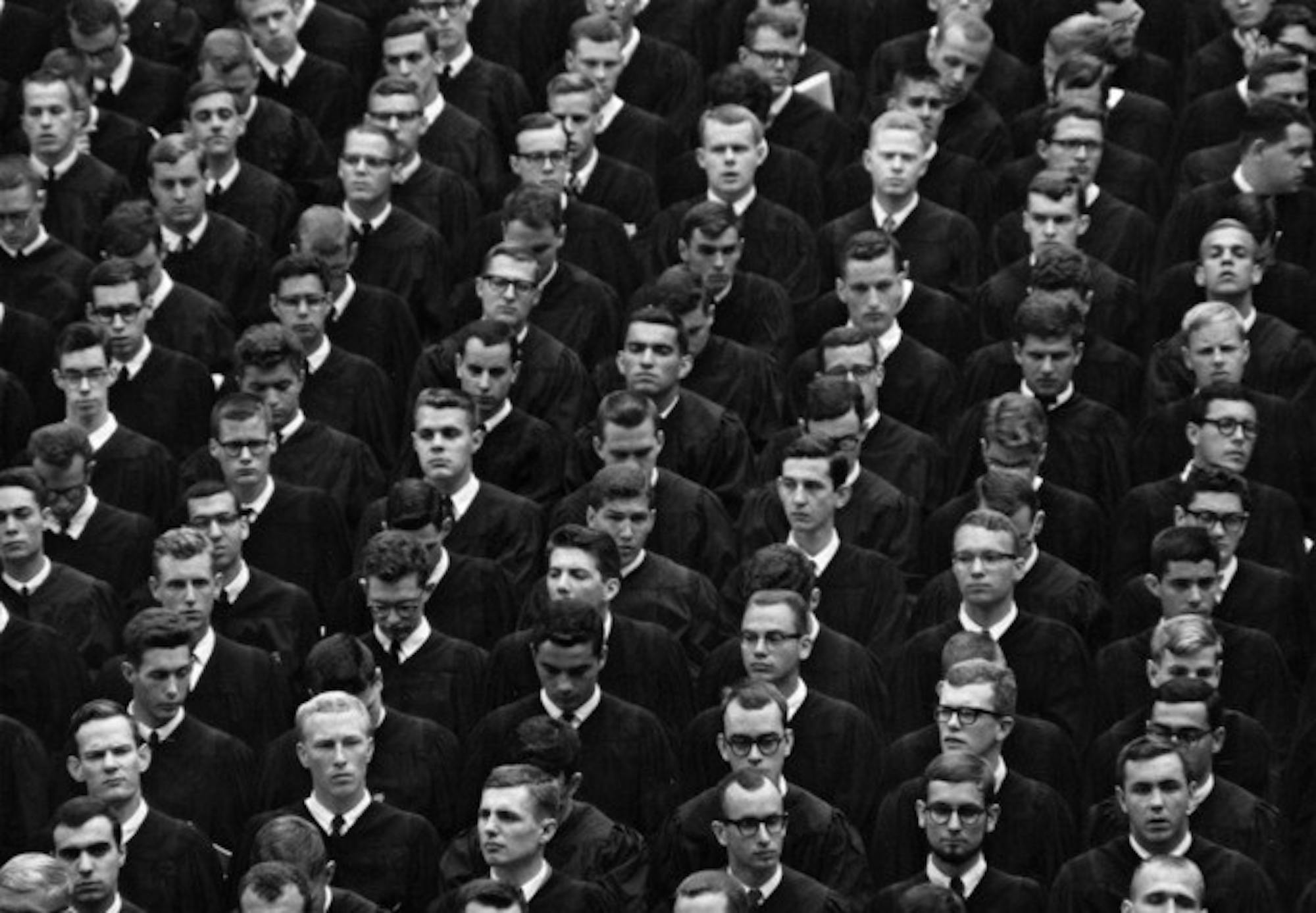
Dartmouth's first graduation in 1771 adorned only four graduates, all transfer students from Yale University who received unsigned diplomas because the Board of Trustees had not yet been established. The guest of honor was New Hampshire Governor John Wentworth, who brought with him barrels of rum and a sturdy ox to be roasted for the ensuing celebration feast. The graduates never enjoyed the meat, however, as the cooks supposedly became inebriated and never finished roasting the ox.
Early Commencements were typically day-long affairs that featured multiple speeches in Latin, Greek, Hebrew, Chaldaic and English.
The ceremony lengthened in 1835 when College President Nathan Lord demanded that all 48 students present a 10-minute speech for graduation, in accordance with his belief that elevating one student over the others was immoral. Lord also did away with class rankings and awards.
While the numerous speeches in foreign tongues droned on indoors, visitors found a very different atmosphere on the Green where a wide array of peddlers, drunkards and carnies set up booths and tents to hawk their goods and entertain those trying to escape the monotony of the Commencement speeches.
As the size of the student body increased, administrators gradually reduced the number of student speeches gradually to just one address traditionally given by the valedictorian. Commencement has also usually featured a keynote speaker whose ranks have included poets Walt Whitman and Robert Frost, President Franklin Delano Roosevelt and news anchor Walter Cronkite.
Eisenhower drew a crowd of 10,000 for his keynote address in 1953 when he delivered an impromptu speech attacking McCarthysim and censorship.
"Don't join the book burners," Eisenhower said. "Don't think that you're concealing faults by concealing evidence that they ever existed. Don't be afraid to go in your library and read every book."
Despite the heavy security presence at the event, a bomb placed under the graduation stage went unnoticed by Secret Service until after Eisenhower's speech. Luckily the bomb was deemed to be a fake -- most likely the work of a prankster.
In 1969, amid rising anger against the war in Vietnam, John D.W. Beck '69 and others urged their fellow students to protest the Commencement address of Nelson Rockefeller '30, who later became vice president of the United States.
"At our graduation Governor Rockefeller will be here to speak. I think he's a prime example of the kind of world that wants to make us go out and kill people." Beck said. "The kind of world that's afraid ... that's continuing to fight the war in Vietnam. What I'm particularly distressed about is this: I'm distressed that Governor Rockefeller is the highest example of an alumnus at Dartmouth."
Approximately one third of the student body wore white armbands to Commencement as a protest against the war, a few of whom stood up and turned their backs to Rockefeller when he began his speech.
The protestors may have had an effect on Rockefeller. According to former Dartmouth history professor Jere Daniell '55, his speech was atrocious.
"It was either the wrong speech ... or some dumb thing about finance in the state of New York." Daniell said in an interview with The Dartmouth.
President Bill Clinton enjoyed a very different reception in 1996, when Commencement had to be moved to the football field in order to accommodate the massive turnout for his speech.
As Secretary of the Treasury Henry Paulson '68 delivers the keynote address for this year's Commencement -- the 237th in the College's history -- he adds his name to the ranks of those who have taken part in Dartmouth's oldest tradition.


