
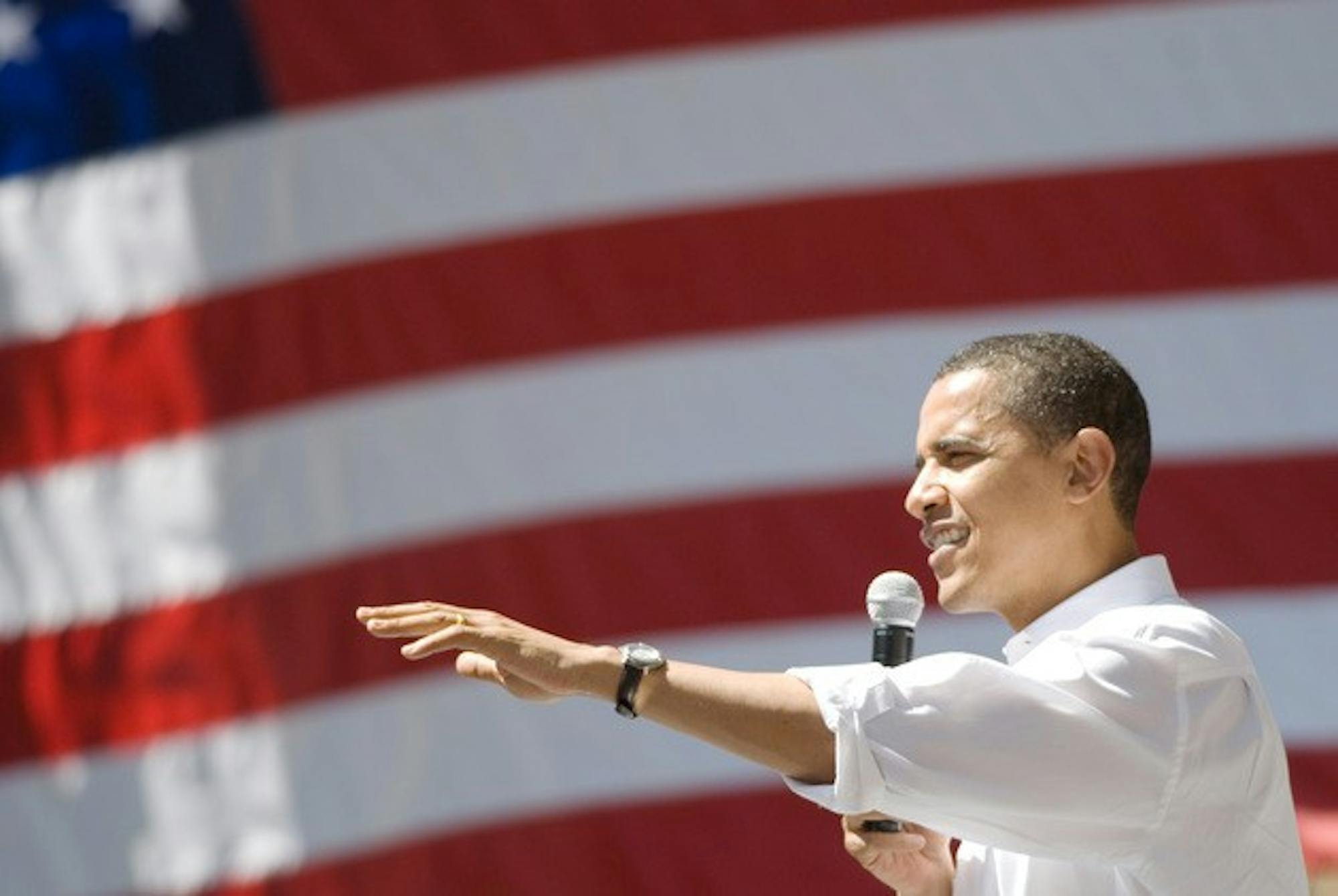
Sprinkled with personal anecdotes, Obama's speech moved from issue to issue, touching upon the war in Iraq, universal healthcare, the environment and education. Invoking the civil rights struggle multiple times, Obama demonstrated a populist leaning, arguing that the government should provide for each person's comfort and well-being.
"This country was built with a very simple idea, that every individual has dignity, every individual has worth, and we have obligations not only to ourselves but to each other in order to make sure that that worth and dignity is recognized," Obama said.
Just after 1 p.m., the gates opened and attendees quickly streamed in for the rally, some even running in order to snag a desirable position near the front of the elevated podium. With a large American flag billowing in the background, the Dartmouth Aires belted out several a cappella songs as the crowd grew restless waiting for the senator to arrive.
Rep. Paul Hodes, D-N.H., introduced Obama as he briefly reminded the crowd of his Dartmouth affiliation as part of the Class of 1972 and called for new leadership.
"The crew is on board, and now it is time for a new captain," Hodes said before Obama walked on stage.
When speaking about the war in Iraq, Obama placed responsibility squarely on President Bush's shoulders.
"People recognize that the day this president steps down from office, the entire world will breathe a sigh of relief," Obama said.
He contrasted his criticism of those who initially supported the war with glowing praise for American troops, honoring and thanking them. He said veterans should be honored with "deeds and actions and resources," rather than "rhetoric."
A major portion of Obama's speech focused on healthcare.
"Let's turn the page on a healthcare system that seems to do very well for insurance companies and drug companies but doesn't provide 45 million people with health insurance," he said.
If he becomes president, he said, he will institute universal health insurance by the end of his first term, and outlined other examples of how he would improve the efficiency of health care.
He moved from health care to education, criticizing the current administration's No Child Left Behind policy and suggesting that standardized testing is not a good indicator for success.
"The slogan 'No Child Left Behind' is nice, but we need more than slogans," Obama said. "We know that the most important person in education is that teacher standing at the front of the classroom, so why don't we pay our teachers more?"
Obama's position on education reform appealed to Lebanon resident Robert Harris, who attended the event.
"I'm a high school science teacher, so I was very impressed by Obama's stance on education," Harris said. "I thought his speech was very moving and he touched on a number of issues that need to be changed."
Obama held a brief press conference after the event, when he was asked questions concerning Iraq and healthcare. However, the question to which he seemed to have the most trouble responding was how he would differentiate himself from fellow Democratic contender Sen. Hillary Clinton, D-N.Y.
"I think she's running a terrific race. We're all on the same team, we're all just running for quarterback," Obama said without detailing differences in his and Clinton's platform.
Some speech attendees preferred Obama's status as a relative newcomer.
"He's genuine, he comes from humble beginnings, and he's what America needs," Hanover resident Amy Carney said. "I actually think it's a plus that he has little experience on the national level."


