
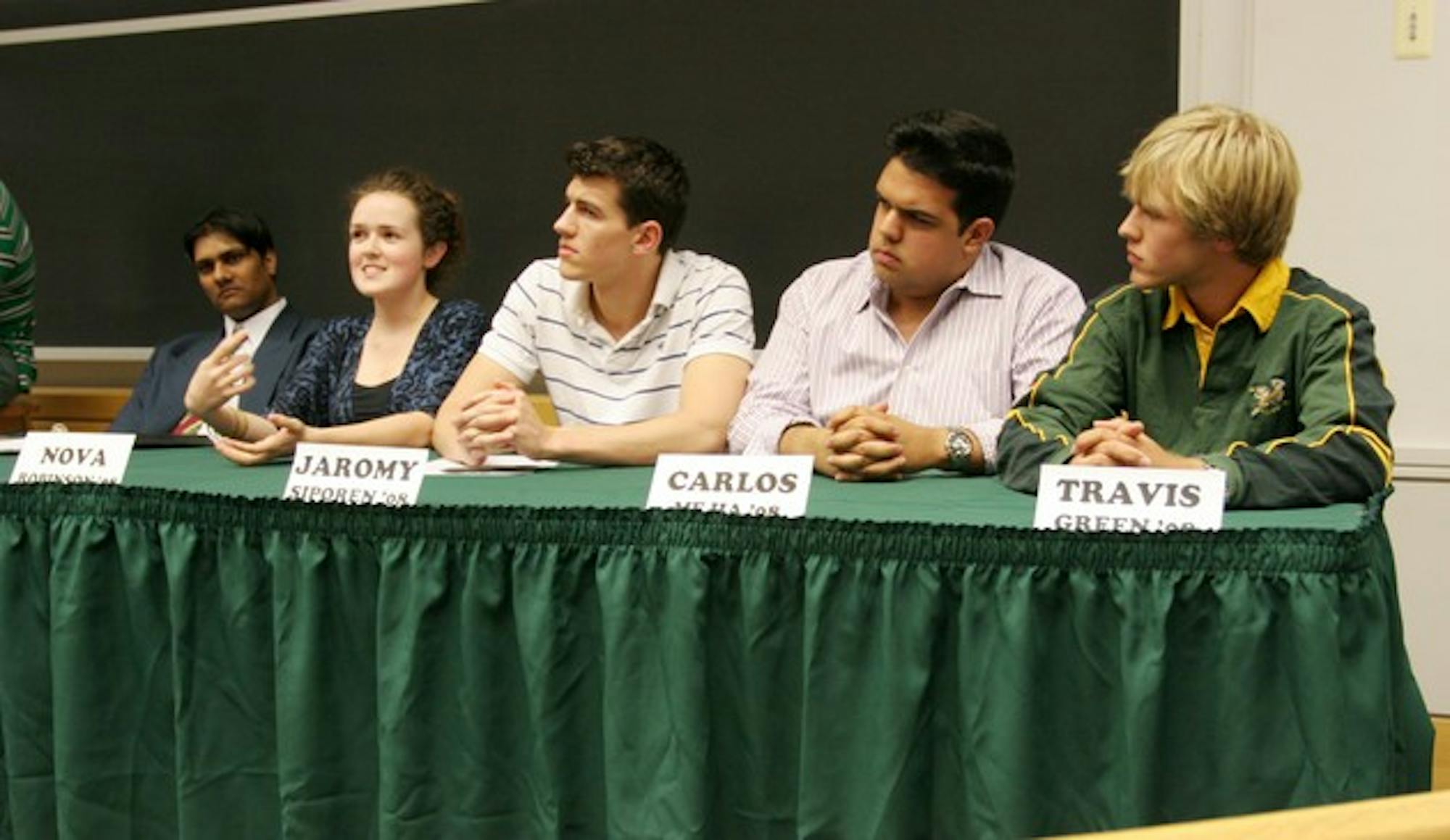
Presidential candidates Travis Green '08, Raj Koganti '08, Carlos Mejia '08, Nova Robinson '08 and Jaromy Siporen '08 were first invited to offer one-minute opening statements, which were followed by questions gathered from members of Elections Planning and Advisory Committee and the Assembly. The floor was then opened to questions from the audience.
Candidates stressed their plans for structural and social changes within the Assembly -- an issue that has received particular attention among the student body this year since a group of reformers attempted to impeach current leader Tim Andreadis '07.
Koganti called for efforts to make the Assembly less "politicized," pointing to student input as the body's greatest strength.
Robinson focused on her plan to bring the group that allocates all student activities funds -- well over $800,000 each year -- under the Student Assembly umbrella. Right now, the Undergraduate Finance Committee doles out the funds to Student Assembly, the Council on Student Organizations, class councils, the Greek Leadership Council and Programming Board. She says the change will make the Assembly better equipped to tackle some of the large platform issues raised by her opponents.
"You can't increase library hours right now," Robinson said of Mejia's plan to provide 24-hour library access. "That's not within the power of [Student Assembly] in its current structure."
Perhaps the strongest criticism of the Assembly's current function was offered by Siporen, who has served as Assembly parliamentarian for the past two years.
"[Student Assembly's] strength is that we're here," Siporen said. "[Student Assembly] is the organization on campus that is supposed to be about student interests and supposed to be about advocating. That's what our strength is. Our weakness is that we're not doing either of those."
Siporen later alleged that several pieces of legislation authored by him have been ignored by the Assembly's Executive Board, and that the Assembly has been purchasing food for meetings in an effort to deplete its current budget.
"It's amazing how much [Student Assembly] claims it does in comparison to what [Student Assembly] actually does," Siporen said. "I don't know why more people on campus aren't screaming bloody murder."
Candidates also addressed the issue of student interest in the Assembly, with some candidates stressing the need for increased transparency.
Mejia argued for an Assembly "fully and fundamentally elected by students," recommending the elimination of current rules that allow students to become voting members in the Assembly after attending three meetings.
Green emphasized the need for communication between the Assembly and the student body, outlining a plan to accomplish small goals in the Assembly's first few weeks, before moving on to larger-scale issues.
"We've got to make that one-on-one connection." Green said. "We've got to rebuild that trust."
However, when asked about increasing interest in the Assembly among apathetic students, Green was not as quick as other candidates to promise that he would attempt to reach out to every student.
"You're never going to get everybody -- you just can't. There are going to be some people who just don't care," Green said. "I don't want to go out and look for those people. I want to talk to the people who have ideas."
A question posed by Jamal Brown '08 prompted the candidates to share their views on the issue of free speech, revealing divergent opinions about the limits of free speech on a college campus.
Koganti took a moderate stance on the issue, inviting self-regulation by students.
"I think we all know where the limit is," he said. "We just need to follow that limit."
Green had a different take.
"My personal stand is that if you say something that offends someone else or hurts someone else you've violated the boundaries of free speech," Green said.
Shaun Stewart '10, a columnist for The Dartmouth, asked the candidates to reflect on incidences of discrimination or disadvantage in their life.
When it came time for Green to respond to the question, many in the audience were prompted to laugh.
"So, I'm a straight white man. I don't encounter prejudice. I don't encounter a lot of the things that people on this campus encounter," Green said. "I can never fully understand it -- but I'll be out there for every single person here trying to fix the things that they need fixed."
EPAC chair Kevin Hudak '07 moderated the debate, using a system of finger snaps to indicate how much time candidates had left to speak -- a system that initially created confusion among candidates.
Before the debate began, the Assembly passed a resolution supporting the transfer of responsibility of upkeep for BlitzMail terminals to Computing Services -- a change made possible by an allocation of $18,000 from the budget of Provost Barry Scherr.
Under the new plan, the terminals will be professionally maintained, and a third of the computers will be replaced each year. The old computers will be given to the Assembly, which will have responsibility for deciding what to do with them.
Green, Hudak and Stewart are members of The Dartmouth staff. Robinson is currently taking a leave of absence from The Dartmouth to pursue the presidency.


