
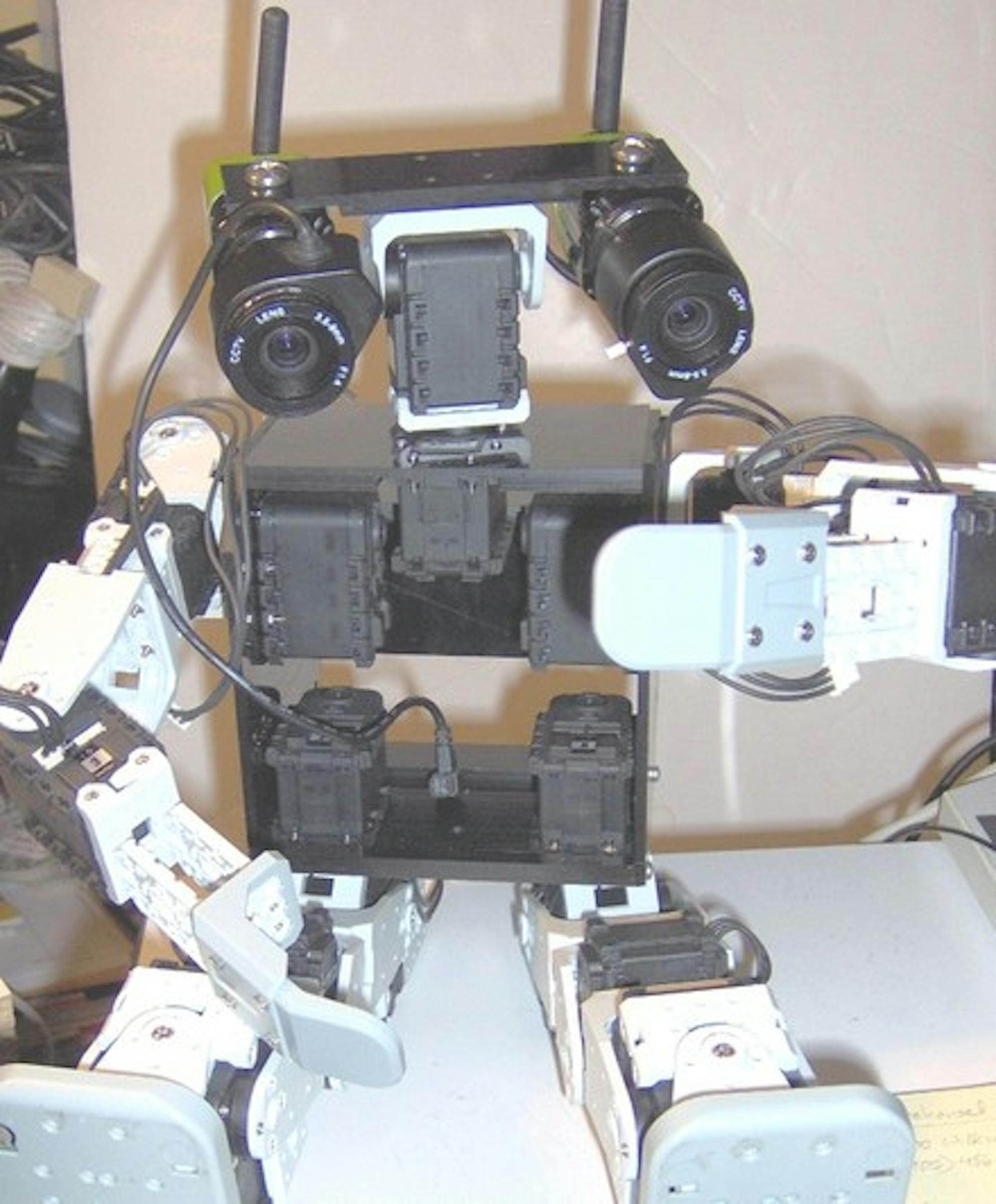
Brainbot is part of the cutting-edge research carried out by the Neukom Institute for Computational Science, founded by William Neukom '64, current chair of the Board of Trustees, who donated $22 million to the institute three years ago. The goal is to create robots that are capable of seeing, hearing and thinking, because their programming is based on the human brain. Although Brainbot may be a primitive version of the robots of science-fiction fame, according to Richard Granger, director of the Neukom Institute, we are only 10 to 15 years away from creating robots that are capable of thinking like humans.
The Neukom Institute's central purpose is to apply computational science to a wide array of subject areas, ranging from music to public policy. Computational science is the process through which scientists apply mathematical models to real-world events, and computational models often are important to test hypotheses when standard scientific experiments would not be possible.
For instance, for ethical and physical reasons, it is difficult (or impossible) to conduct an experiment on distant star systems or on the human brain. Computational scientists construct algorithms of these real-world systems which can then be used in scientific tests.
Granger was appointed director of the institute six months ago, and this past winter term, the institute offered a new course: Introduction to Computational Neuroscience. The institute also began offering undergraduates internship opportunities through the Women in Science Program, and sponsors an interdisciplinary special major in computation and neuroscience.
Travis Green '08, the first Dartmouth student to pursue the new major, said that he was grateful that the Neukom Institute allowed him the opportunity to pursue his passion for artificial intelligence.
"You have to know so much about so many different fields," Green said. "You won't find classes on this stuff. You have to be willing to read about philosophy, and have to understand engineering, neuroscience and computer science."
(Green is a member of The Dartmouth staff.)
One of the Neukom Institute's chief subject areas is computation and neuroscience, which studies how the brain works and applies the same process to computer systems.
According to Granger, the human brain has solved many problems that have eluded computer scientists. For instance, currently a computer recognizes an upright soda can as a separate object from a soda can tilted on an axis. According to Granger, this is because a computers operate by rules while the brain operates by matching the sensory image of the soda can with the brain's general image concept of a "soda can."
The Neukom Institute is trying to implement the human system of pattern recognition into robots. Current robots under development are capable of learning to visually recognize different objects, hear and repeat different sounds, and match objects with their corresponding names. Granger admitted that the current capabilities of the robots are far below those of the human brain, but added that they are learning more every day.
Granger predicted that robotics is bound to be a controversial topic. He said that robots could take jobs away from blue-collar workers, and could also be used to fight wars.
"These things can be used for nasty purposes," he said. "The awful uses of robots will be very much like the awful uses of humans. We can be sent out to kill, and robots will also be capable of these things."
Granger remained optimistic, however. He noted that the government regulates humans by giving them driver licenses and criminalizing murder and robbery. These same restrictions, he said, will be placed on robots.
Granger also outlined the positive aspects of robotics. He said that robots could perform simple tasks, such as carrying groceries for the elderly and infirm. Robot armies could also make warfare so overwhelming that states are dissuaded from entering into war.
"Simple robots already exist," Granger said. "Factories are automated. It has helped and created new jobs. One can hope for these kinds of consequences."
Humans, Granger argued, cannot be sure what the consequences of artificial intelligence and robots are. What we can be sure of is that robots will play an increasingly prominent role in our daily lives, and that debates about robot ethics are likely to be imminent.


