
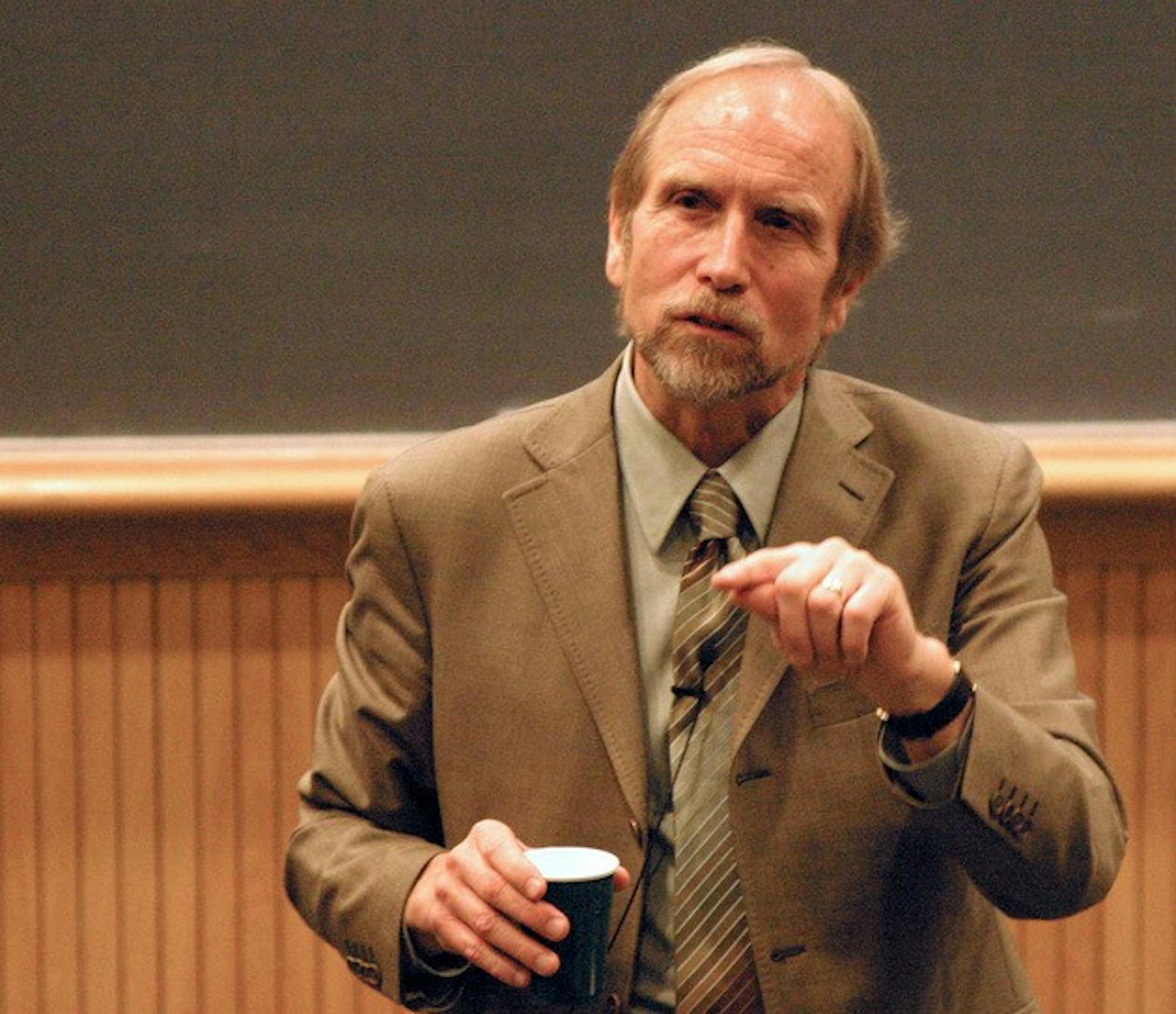
Using evidence from ancient Greece, ancient Rome and medieval and early modern Europe, Pennington argued that recent United States practices in Afghanistan and Iraq fall under the category of torture, despite the government's hedging the exact definition of the term.
Pennington stated that the lack of clarity in the Geneva Convention can be partially blamed for the United States' current situation. He focused on Section C of the Convention, which outlaws "outrages against personal dignity, in particular humiliating and degrading treatment," to illustrate his point.
"What does this mean? Is not even the mildest form of torture degrading or humiliating to the personal dignity of a human being?" Pennington asked. "If you know what torture is, you don't have to add that it's denigrating with outrages against personal dignity or that it's degrading."
Pennington stated that the first doubts of torture's ethicality emerged from Roman thinkers in the middle of the third century. By the early fifth century, Christian leaders such as St. Augustine began to argue that torture was wrong not only because it opposed "divine law" but also because of the risk of torturing an innocent person.
The relevance of St. Augustine's perspective became apparent later in the lecture when Pennington referenced the story of Dilawar, an Afghan taxi driver who was tortured to death by United States Army officials in 2002 after taking a wrong turn onto the Bagram Airbase. Dilawar had no connections to terrorism and had never committed a crime.
"I think Dilawar could probably define torture very well indeed," Pennington said. "We have not just been inflicting pain and suffering on people, but also, we have been killing people by torturing them."
Pennington also outlined the extensive writings of Prospero Farinacci, an Italian he designated "the most important criminal proceduralist at the end of the 15th and the beginning of the 16th century." Farinacci wrote that substantial evidence must precede a sentence to torture and that judges must give the accused a certain amount of time to produce evidence of their innocence before torture occurs.
Farinacci also outlined the five grades of torture and common torture practices. The highest degree of torture, shaking a defendant after weighting his feet, was reserved for the most serious crimes and could only last for an hour. Farinacci defined the lowest grade as simply bringing the defendant to the place where torture would occur.
Pennington argued that current use of torture has become so prevalent due to a lack of knowledge and concrete definitions of the procedure, a problem that was nonexistent in Farinacci's era.
"The people who are employing torture have never experienced torture, and they don't know the jurisprudence of torture," Pennington said. "Farinacci knew torture very well. They studied torture in law school. Nobody studies torture in law school today."
Phrases in the Convention against Torture and Other Cruel, Inhuman or Degrading Treatment or Punishment, adopted by the United Nations in 1984, further demonstrate Pennington's point. The Convention defines torture as "any act by which severe pain or suffering, whether physical or mental, is inflicted on a person." Pennington imagined Farinacci's response to this clause.
"Farinacci would just throw up his hands. Torture is not just severe pain," Pennington said. "Of course our government has latched onto this particular phrase and has tried to define what severe pain is. If you define torture as severe pain, then something less than severe pain is just."
Pennington documented two specific cases of torture in the late 13th and early 15th centuries, and analyzed the illustration of torture in paintings by Artemisia Gentileschi and Caravaggio to trace the practice through medieval and Renaissance history, the period that he specializes in.
Pennington received his Ph.D. in Medieval History from Cornell. Prior to teaching at the Catholic University of America, he taught medieval and Renaissance history at Syracuse University for 30 years.


