
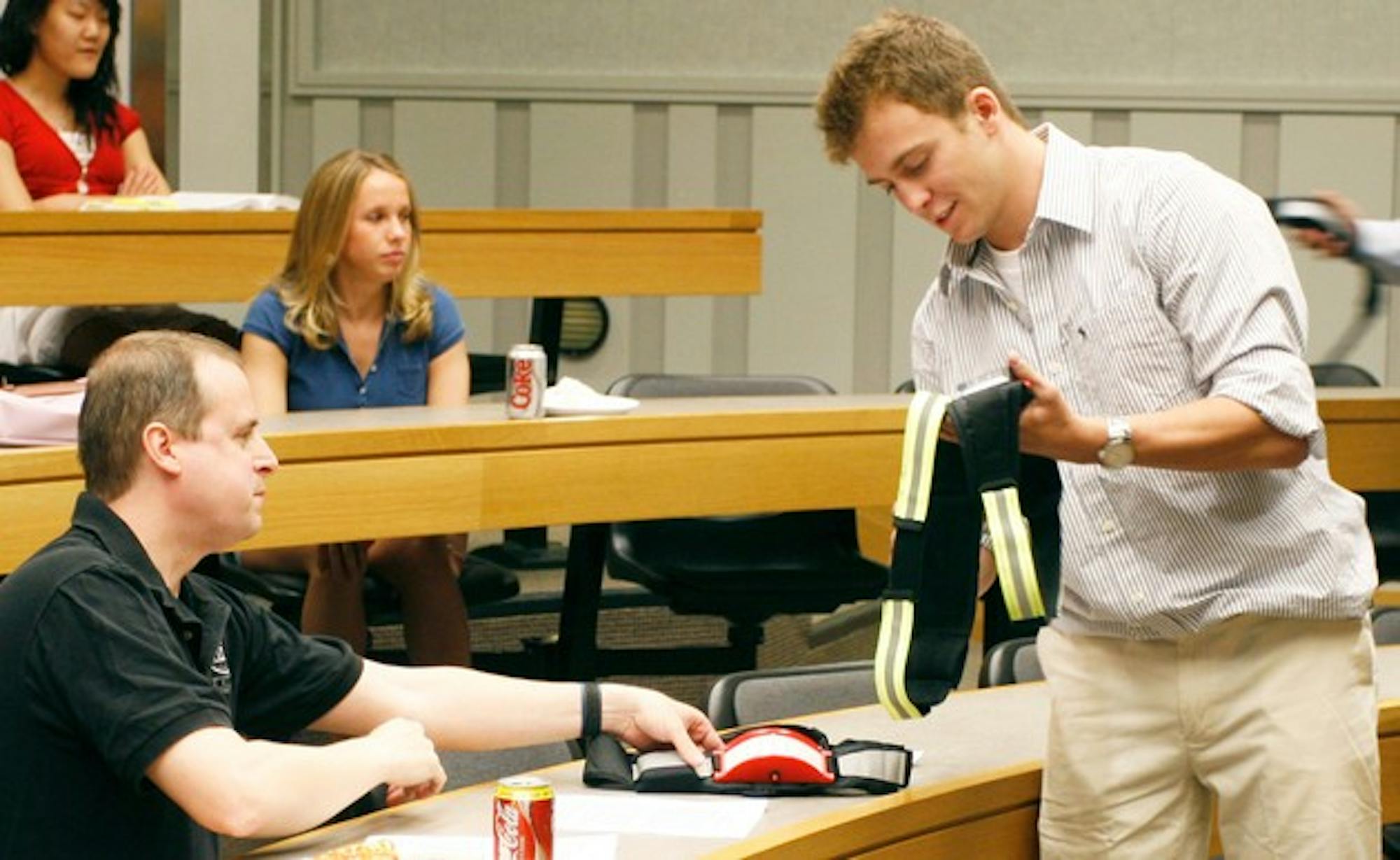
The Nightrunner is a high-powered light-emitting diode worn around a lightweight belt that creates a broad swath of light in front of the runner. The group believes that its product is superior to the headlamps that apparel companies currently market, both because it uses a more powerful light source and because it can be worn comfortably around the waist. The invention originated as a group project for a fall engineering sciences class. The team won the Jackson Award for best project at the end of the term. Since then, the four students continued to work on the project as an independent study and are now trying to sell their creation.
The Nightrunner also won a first prize of $2,000 last week in Dartmouth's second annual Big Green Business Competition, which encourages and aids Dartmouth students who start up their own companies. Last year's BGBC winner was the Gyrobike -- another product created by engineering students -- which replaces training wheels on bicycles with a self-balancing gyroscope. Today, Gyrobike is a multimillion-dollar company. The BGBC is sponsored by the Dartmouth Club of Entrepreneurs and the Dartmouth Entrepreneurial Network.
President of the Dartmouth Club of Entrepreneurs Sander Duncan '09 said that while the Nightrunner and the Gyrobike may seem to be obvious innovations, they still rely on entrepreneurs to turn them into viable products.
"My high school teacher demonstrated the effects of a gyro by attaching it to a bike," Duncan said. "When I told my teacher about the Gyrobike he said high school teachers around the country combine gyros with bike, but none of them thought about developing it into a product. A lot of products can be very obvious."
Hull said that he believed there to be a definite market for the Nightrunner, because many runners would prefer to run in the dark, but are afraid of getting hurt. He said that some runners have even attempted taping flashlights around their waists in order to get the necessary light. According to Hull, many who have tried the Nightrunner--including the Dean of Thayer School of Engineering Joseph Heble--said that they would definitely buy the product.
"In Hanover there aren't a lot of daylight hours." Hull said. "If you have class or you're working, you might not have the time to go out in the night. Also in the summer it can get uncomfortably hot, and it's better to run in the cooler nighttime."
Clayman said that the group is working on improving their product while pursuing a patent, and that professors from both Thayer and Tuck School of Business have offered advice on developing the product and marketing it.
He admitted, however, that the Nightrunner's success still faces several obstacles.
"Our biggest obstacle is competition." Clayman said. "There are large established companies with similar solutions. They've been doing this for a long time and have large resources. We're trying to enter a market and essentially beat them at their own game, by selling lighting devices to runners."
He said that he believes the patent will prevent others from copying their product, and hopes to eventually sell the rights to the Nightrunner to a larger corporation within two to three years.


