
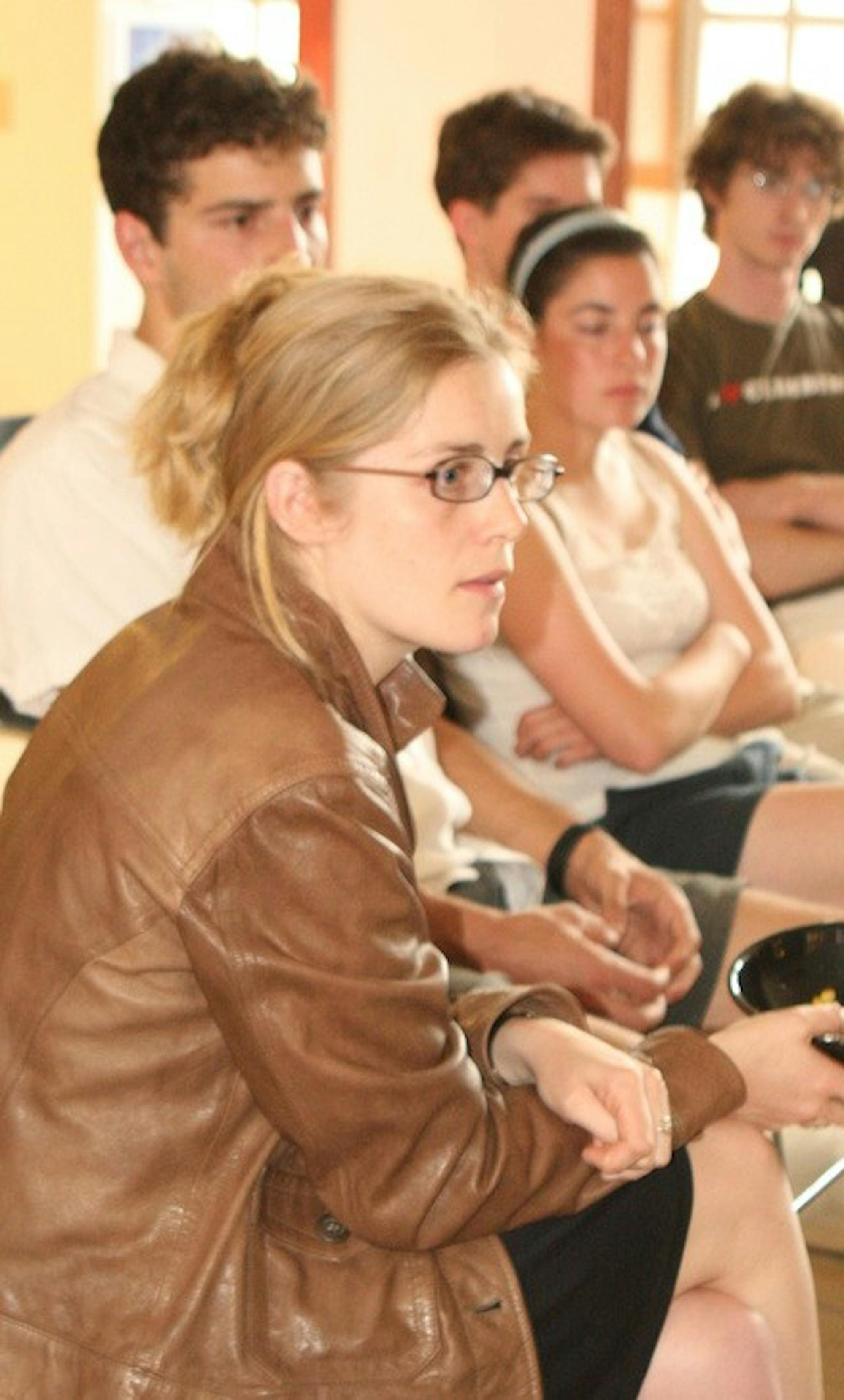
Dupas criticized the World Bank and other international aid organizations for spending billions of dollars on foreign aid without having any idea of whether or not it works. To highlight her point she compared the World Bank to pharmaceutical companies.
"Pharmaceutical companies don't just mix whatever molecules together and say I'll market it tomorrow," Dupas said. "The FDA insists that you try your stuff out before you market it. There's a long process to see what works and what doesn't. The World Bank doesn't do that. They get an idea and say lets do it."
According to Dupas, many forms of foreign aid -- such as distribution of school textbooks -- do not have any empirical evidence showing that they are effective. While giving all students new textbooks may sound like a good idea on paper, she said that when put to the test, textbooks failed to improve the students' quality of education and only benefited the rich whose English was good enough to understand them.
Dupas used Mexico's Oportunidades program as a good example of efficient foreign aid programs that the World Bank should try to support. In the Oportunidades program, the government gives cash benefits to poor families provided that they make their children to go to school and get health check-ups. Dupas said that instead of introducing the program to the entire country at once, the government randomly instituted the program in some villages and not others. They found that those villages that received aid had a much higher school attendance and better health. Dupas said that with firm evidence supporting the program, the government was able to institute it with fairly little opposition.
Many of the students had mixed feelings towards the effectiveness of foreign aid. Some supported trying to use the aid to fight corruption while others suggested giving the aid to non-governmental organizations instead of corrupt governments.
"I'm confused about foreign aid," Nick Lomanto '10 said. "Before I read about it, I thought it was a good thing. Now I'm on the fence. Maybe sometimes it works, sometimes it doesn't. The World Bank is especially confusing. I have a better image of NGOs."
Dupas said that governmental corruption is a very hard problem to tackle, and that it was unclear whether poverty caused corruption or corruption caused poverty. She also said that NGOs often use money less efficiently than governments. She used Doctors Without Borders as an example of the inefficiency of NGOs.
"When I was working in Kenya, [the Doctors Without Borders'] house would have a fence with six bodyguards and cellphones," Dupas said. "They don't make much money, so to compensate them, they get a very nice life on the ground. It would make more sense to take the money spent on the Doctors Without Borders and spend it on hospitals.
According to the chief organizer of Rice and Beans, Caroline Esser '10, this is the third year and fifth term that DEH has sponsored Rice and Beans. The group is also actively involved in fair trade issues on campus. Esser said that this year they were able to get DDS to add fair trade bananas in Homeplate and are now working on fair trade rice.
"We're trying to get at the root cause of things," Esser said. "We're not just sending cans to foreign countries. Instead we're trying to promote fair trade."


