
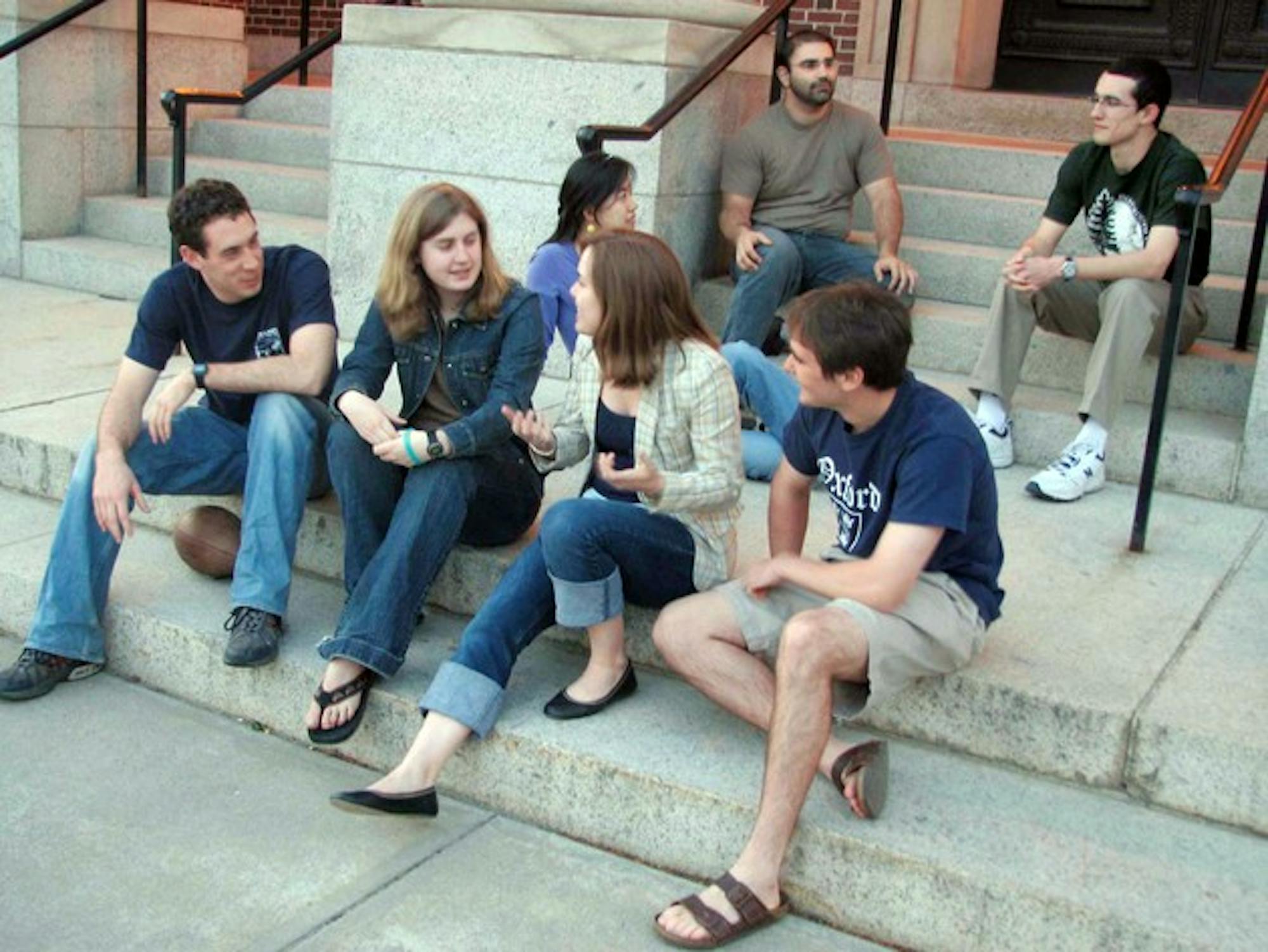
Nondenominational Christian journal Apologia published its first issue last Monday, making it the first publication of its kind at Dartmouth. The student journal's staff seeks to bridge the divide between intellectualism and Christianity as well as foster a more open dialogue about faith on campus.
Executive Editor Andrew Schuman '10, who plans to put out a new issue every term, said that for hundreds of years intellectualism and Christianity were viewed not as opposing forces, but instead as complementary ones.
According to Schuman, much of the Western intellectual tradition is founded upon a bedrock of Christian thought, and many of the greatest Western scientists such as Copernicus, Newton and Galileo were devout Christians who sought to integrate their faith with their academic pursuits.
Apologia seeks to bring this rich Christian intellectual tradition back to the mainstream, Schuman said.
"There seems to be a distinct separation between academic life and religious life. That's a gulf we're trying to bridge," said Robert Cousins '09, arts and literature editor. "For hundreds of years the first book everyone would read is the Bible, and that would inform the decisions they made in life. The two paths of academic and intellectualism have in my opinion diverged for no reason."
Cousins said that he believes focusing on Christian intellectualism helps improve understanding of both Christianity and academics.
While Cousins said that the majority of Dartmouth professor's are not overtly hostile to Christianity, he does believe that much more could be gained intellectually if professors incorporated Christian thought into their classes.
He cited as an example a medieval literature class he took where many obvious biblical references from the readings were not discussed by the class as an example of areas where this improvement is overlooked.
The editors of Apologia said that they believe the separation between Christianity and academia is not only due to an anti-Christianity movement within academia, but is also due to an anti-intellectual movement within Christianity. Both movements feed off of each other to create an increasingly hostile situation, Cassandra Sieg '10 said.
Cousins said, however, that Christian intellectualism is alive and well. "There is an anti-God machine that is alive and well and is still churning out material. If there was no intellectualism on the Christian side that would not be necessary," he said.
Apologia is not just a written publication, but also is an organization dedicated to promoting a dialogue about Christianity on campus.
"There is very little discussion about religion on this campus." Production Manager Tessa Winter '09 said. "We thought that if we [published a magazine] it would create a touch-point from which to start or join a discussion about religion."
Winter said that she believed no one talked about Christianity because they were afraid of offending others, but what happens is often the opposite.
"Dialogue is a great way to break down barriers," Winter said. "If no one is there talking about it the only thing that is built is hostility and false conceptions. If there is a discussion at least all the ideas are out on the table, and you can get a fair assessment."
Schuman has said that he can already point to some success in fostering dialogue. Blogs on the Apologia website, for example, have led to discussions on the nature of hell. Apologia is also sponsoring a discussion on philosophy and religion with a professor this Tuesday.
"We haven't experienced any negative feedback." Schumaker said. "People do say 'I disagree with that article,' which is exactly what we're encouraging."
Sieg said that while it was difficult creating a journal completely from scratch that the process has been her most rewarding experience here at Dartmouth. She said that it has helped bring together different Christian organizations from across campus to talk about their differences and similarities.
"We'd sit there 'til like 2 or 3 A.M., talking about the big questions that you'd like to discuss at some point." Winter said. "Its something that's been amazing to have access to outside of class."
Apologia was also mentioned in an article about the resurgence of Christianity in the intellectual environment, in an issue of First Things, an ecumenical journal founded by prominent conservative Catholic Richard John Neuhaus.


