
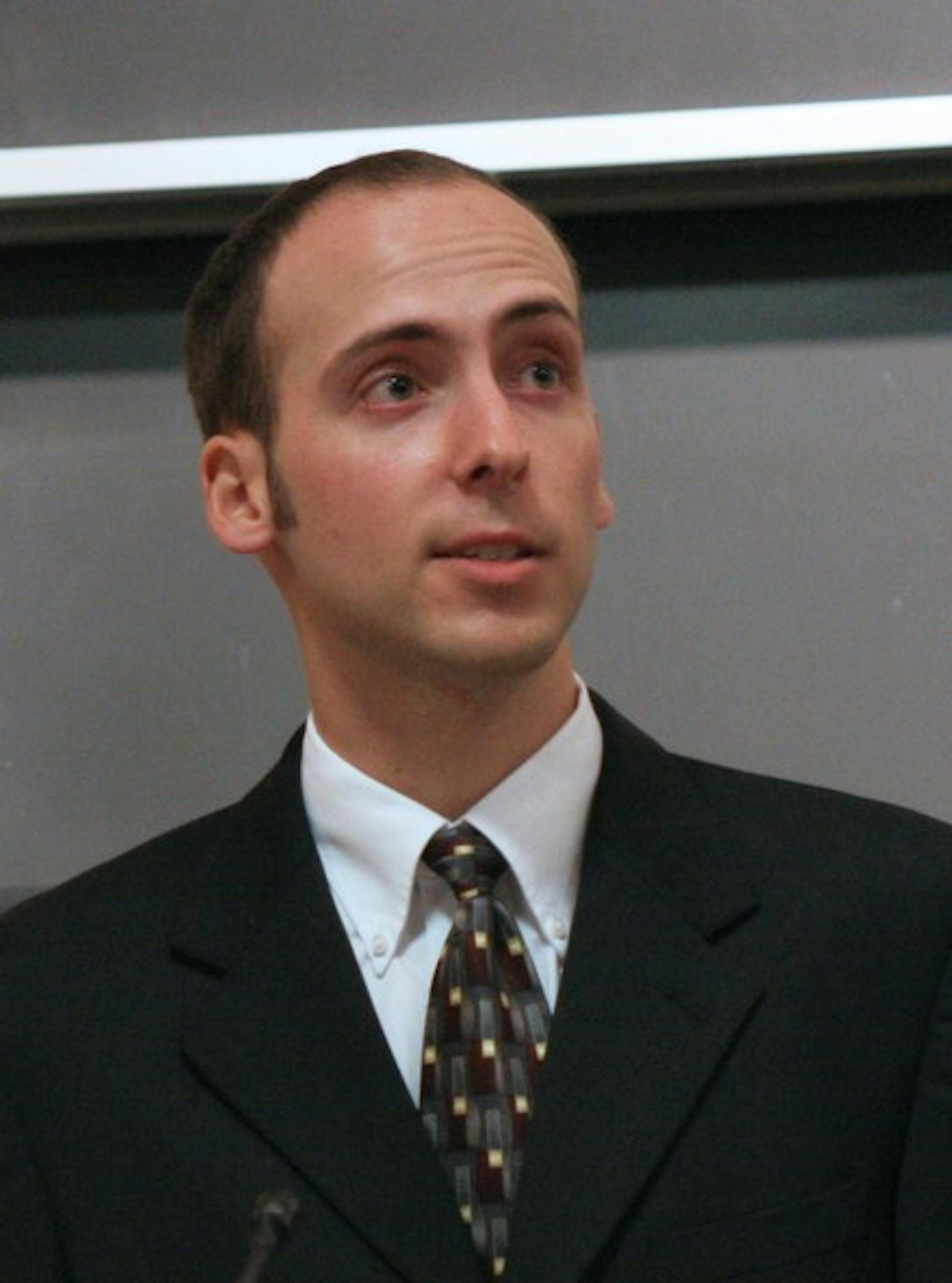
Ryan McAnnally-Linz '06, the 2006 Chase Peace Prize Senior Thesis Recipient, presented his thesis about mass murder and genocide as part of a panel in Filene Auditorium on Monday night.
Each year, the Chase Peace Prize is awarded to the senior who writes the best senior thesis involving the subjects of war, conflict resolution, the problems of maintaining peace or other related topics. Prize winners receive $1,500 and are given the opportunity to return to campus the following year to participate in a public event about their thesis topic featuring both the recipient of the prize and experts from a related academic field.
McAnnally-Linz's thesis, titled "Murder by Proxy: How Ethnic Groups Become Targets of Mass Killing," identified the paradox that while ethnicity is not the primary cause of mass violence, most mass violence is conducted along ethnic lines.
McAnnally-Linz investigated four cases studies -- the racial genocide in Guatemala and Rwanda, the Spanish Civil War, and Apartheid South Africa -- to analyze the conditions under which governments resort to mass killings.
He concluded that governments that lack the military and administrative capacity to identify specific individuals who oppose them develop "proxy indicators" to classify entire groups of people as threatening to their regimes. McAnnally-Linz argued that ethnicity served as one of these proxy indicators.
"It's very costly to go around your country and sort out only the people you know, and you can prove court, have engaged in an action that is threatening to your regime," McAnnally-Linz said. "Governments that don't have the resources to do that ... end up using a kind of a list of categories of people they think might be more dangerous to them than others."
McAnnally-Linz asserted that regimes resort to mass violence only after other measures have failed, and that such violence is often structured along ethnic lines because it allows governments to limit the scope of their actions to one particular societal group.
Asserting that governments usually use mass violence only out of a position of weakness, McAnnally-Linz posited that one way to prevent such violence in the future is to strengthen the security capabilities of weak states. As these actions may reinforce undemocratic regimes, McAnnally-Linz acknowledged that individuals and governments may be reluctant to take such steps.
"You don't want to take an unjust regime and say, 'Hey, how about we help you out with your police force?'" McAnnally-Linz said. "But there are situations in which this conclusion can be very operable."
Applying his research to the current situations in Afghanistan and Iraq, McAnnally-Linz suggested that the United States government should provide the two states with the military and administrative resources they require to combat internal terrorism without having to resort to ethnic violence.
Other panelists included Bridget Coggins, a recently hired government professor and Scott Straus '92, a professor of government at the University of Wisconsin, Madison. Benjamin Valentino, a government professor and McAnnally-Linz' thesis advisor, moderated the event.
After McAnnally-Linz finished presenting his thesis, Coggin and Straus commented on how his thesis related to similar research in the field and what areas he could focus on for future research -- encouraging him to investigate the role that ideology might play in causing racial genocide.
Approximately 30 students, professors and community members attended the event.


