
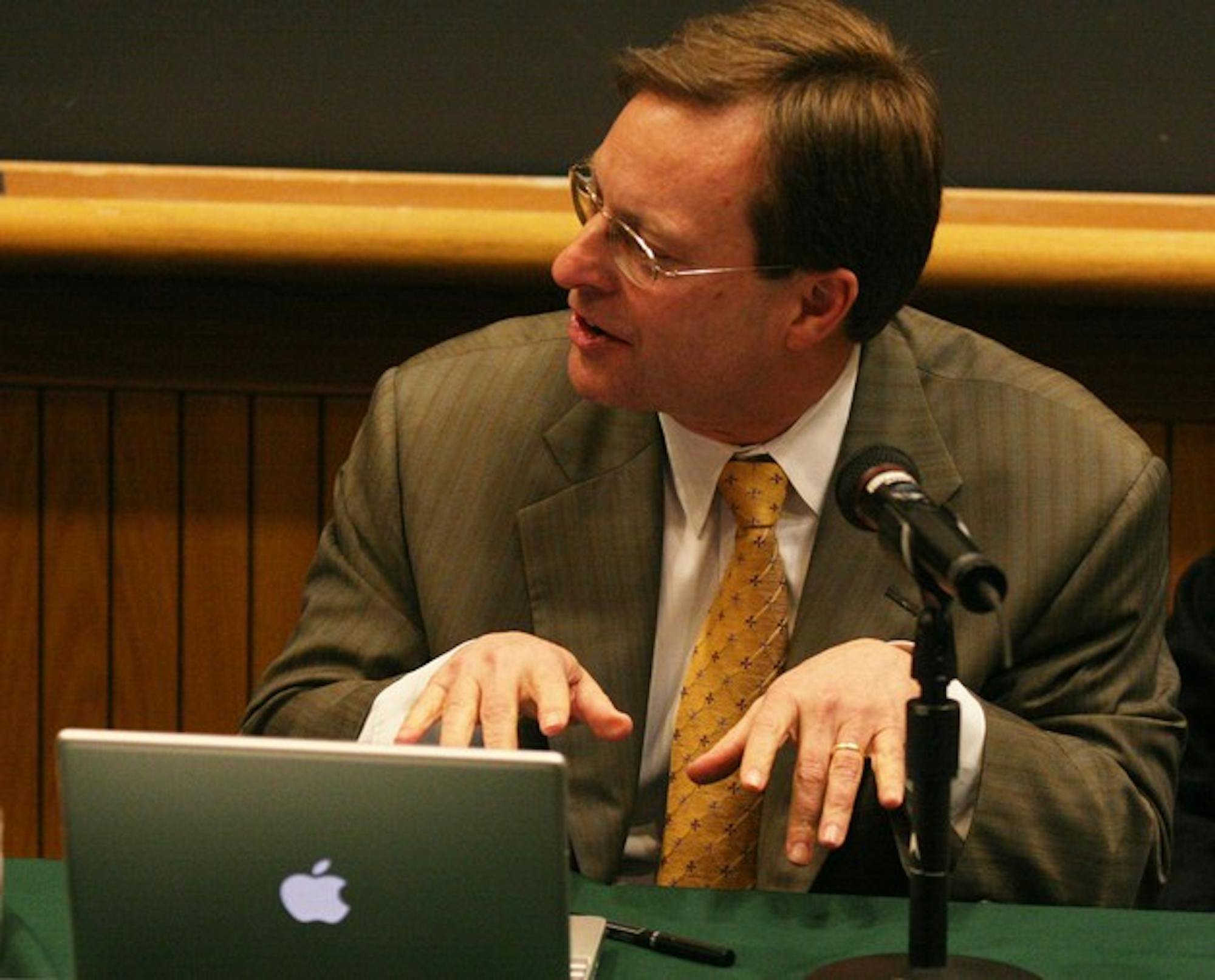
John Hinderaker '71, who writes for the politically conservative blog Powerline, said that before the Internet, only people who had the capital and infrastructure were able to project their views to the world through the newspaper and TV, and those who did not have the millions of dollars could not have their opinions heard. According to Hinderaker, the accessibility of the Internet erased this imbalance. Powerline, which gets between 50,00 and 75,000 hits a day - more than many newspapers - only costs $1 per day to maintain, he said.
"Mass communication is now essentially free." Hinderaker said. "The only limit is the number of people who are interested in what you have to say."
According to Roger Simon '64, who heads the blogging consortium Pajama Media, blogging has essentially destroyed the aristocracy of the mainstream media.
"The names that we knew as columnists were names that were forced upon us," Simon said. "The comment that the freedom of the press belongs to the man who owns one was pretty accurate. [The blog] just ruined that line. There is a dread of it upon a lot of mainstream media people. The audience, however, doesn't care they just wanted to see who was interesting. They're voting with their mouse."
Brendan Nyhan, who started the non-partisan blog Spinsanity, disagreed that much had changed.
"There is really a paradox to blogging," Nyhan said. "On one hand its opened up, but on the other hand the group of people who are being read the most look a lot like the old [journalists]. The group is dominated by ex-journalists and people in information age industries."
Hinderaker said that maintaining a blog required no technical expertise and that the software is so easy to use that his 10-year-old knows how to blog. Hinderaker said his colleague had such limited technological skills that he needed to learn to type before he began blogging.
Nyhan said that, despite predictions that blogging would lessen partisanship and hold politicians and mainstream media accountable for what they say, the new blogs have increased partisanship and most fact-checking that goes on in blogs is ideologically slanted.
"Who's going to spend the time to update every day? The people who have a strong desire to do so because they really care," Nyhan said, saying earlier that he "could have made more money working for Starbucks."
"The people who blog are pretty extreme. The political blog looks like a food fight on TV," he added.
Simon said that he believed fact-checking on blogs to be more extensive than newspapers. He used the example of an article he wrote for The Los Angeles Times about a Siberian Film Festival, where the fact-checker simply asked him if the story was accurate and accepted Simon's response. According to Simon, every blog reader is a fact-checker because readers who see errors can easily post responses so Simon could make corrections.
Most of the panelist did not see the blogs and the mainstream media as two forces locked in combat with each other. Many believed that reporting was still necessary and that blogging was meant to complement, rather than compete with, other sources of news.
"No one is going to say, 'I don't want to read The New York Times,'" Nyhan said. "A lot of media that came along hasn't killed other media. Newspapers and radios are still around."
A few of the panelists predicted video posts to be the next big development in blogging. Simon said that Pajamas Media was trying to create a way for blog reporters from "trouble spots" across the globe to post their personal footage of events that are transpiring.
"The whole blogging thing is inevitable," Simon said. "And its only the beginning of something. No one knows what's going to happen."
"Dartblog" founder Joe Malchow '08, "Little Green Blog" contributor Andrew Seal '07, "Althouse" founder Laura Althouse and "Daily Kos" contributor sociology professor Laura Clawson also spoke on the panel.


