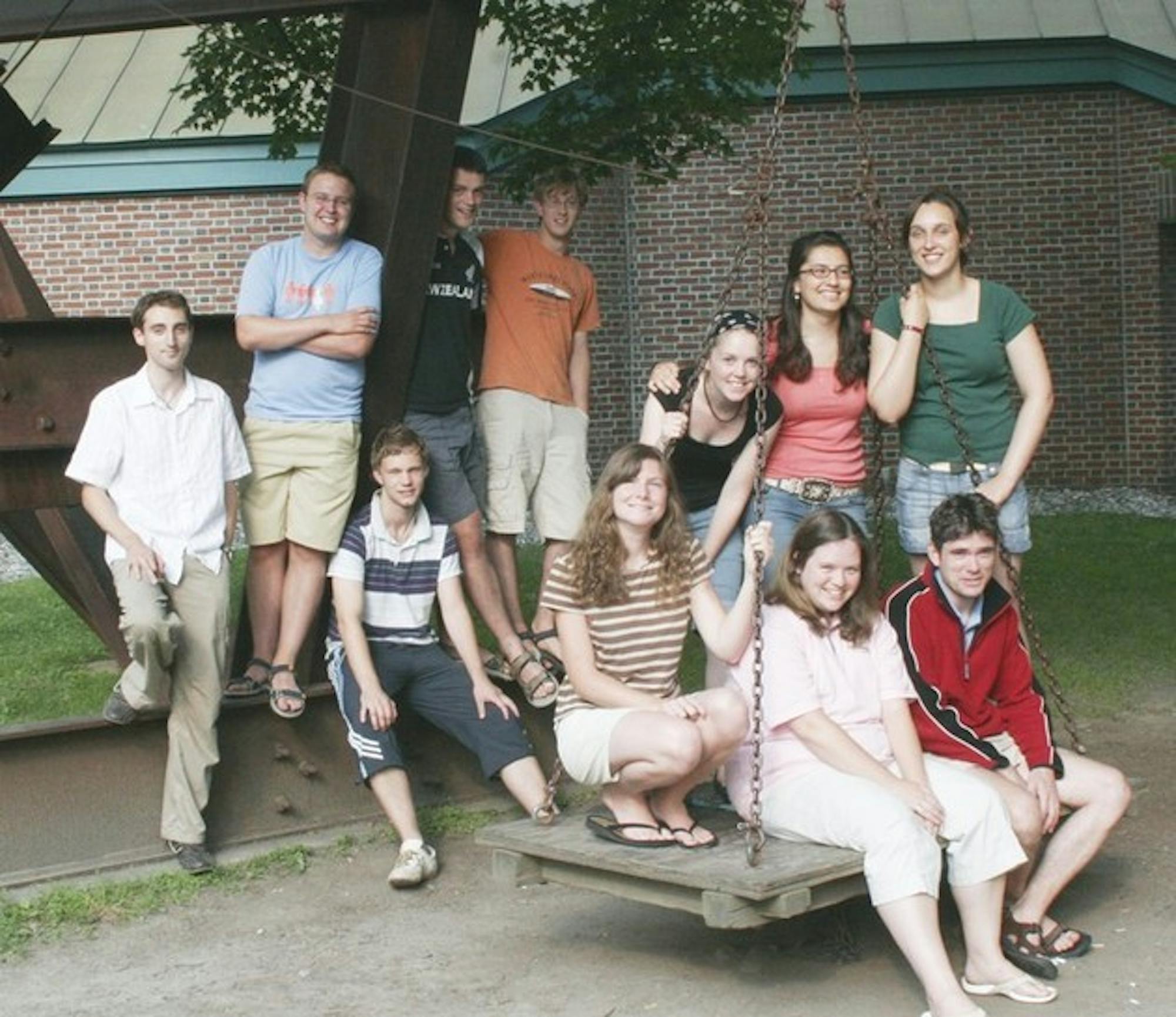
The visitors, comprised mostly of 19- to 22-year-old students from the Birmingham, England-based Christian group Agap, are working with Dartmouth's Christian Impact for the third year in a row and have been living in the Lodge dormitory since June 24.
Both the Dartmouth group and the British group are part of the international ministry organization Campus Crusade for Christ, whose mission is to "take the gospel of Jesus Christ to all nations," according to the group's website.
"The goal is to assist us in all of our ministry efforts here," Christian Impact Director Chris West said of the collaboration. "They want to as much as possible spread faith in Christ but they want to do that in the context of relationships with people."
The Dartmouth group was also known as Campus Crusade for Christ until about three years ago, when it changed its name to Christian Impact because "the word 'crusade' doesn't resonate too well," West said.
Phil Keates, who is leading the British students along with his wife Ceri, said that his group wants to make friends, focus on "people who aren't really believers" and "encourage people to know Jesus, [but] that's tempered by the times and how we interact with people."
Phil said universities are particularly appealing for missionaries because people graduating from prestigious universities tend to go on to be influential, and college is a time for learning and finding one's identity.
Ceri said that there's "no soapbox on the Green," though.
"Our main aim is to meet Dartmouth students and to learn about what life is like here at Dartmouth, what culture and background people come from and to be able to engage in spiritual conversations with people," she said.
The Keates said they have been invited into several Greek houses and have played pong with students -- but only with water.
"We have a no-alcohol policy on the program," Phil said.
British student Emma Hale, 20, said that very few Dartmouth students have been uncomfortable being approached over meals or on the Green, and that the majority have been happy to share their opinions on faith with people from her group.
"It's not just about sharing Jesus and exploring Jesus." Hale said. "It's really nice to just get onto levels of understanding about what's important to them."
The British group's trip to Hanover is one of six summer projects the organization is undertaking; others include trips to Russia, Lithuania, Siberia and the Middle and Far East.
Another British student, 20-year-old Guy Little, also said that he is here both to learn about American culture and start honest friendships in which he can share the role Jesus has played in his life.
"I want desperately for other people to have the transformation that I've had," Little said, "[but] if they're not interested, I'm not going to force it."
"It's not our job to convert people, we're just here to present what he's done in our lives," he added.
Charlie Stoebe '08 said he was approached last week by two of the British students while he was having lunch in Food Court. The students said they were on a religious retreat and wanted to get an idea of what religion is like at Dartmouth.
"It was the first time at Dartmouth that a complete stranger has come up to me and said 'can I join you for lunch,'" Stoebe said, "so I was like, whoa they're probably not from around here."
Stoebe said the students asked him and his friends about their beliefs in God in the course of a 45-minute-long conversation.
"I haven't had too many religious philosophical discussions at Food Court," he said.
West said that students here have generally been friendly to the visitors and open to discussing religious issues, and that the group persuades and encourages students without manipulating or coercing them.
"If a person is committed to whatever faith background they have, then we wouldn't want to force the issue with them," West said.
West, the director of Christian Impact, said he is not concerned about the approach of the visitors but about the sensitivities of the people they are approaching.
"Due to the nature of the things that they're talking about, they're probably going to trip a wire or two as they talk to people, but keeping in mind that their goal is not to force the issue -- with that guiding principle, I'm not too concerned," West said.
College Chaplain Richard Crocker of the Tucker Foundation, the umbrella group for campus ministries, said that the Tucker Foundation has virtually no oversight over visiting groups like the one from England. He said there is a "fine line" between the visitors' freely expressing themselves and proselytizing, and that they "should err on the side of making sure they don't infringe upon peoples' freedom."
"It's a little eerie, especially for younger people who don't have experience gauging social experiences," Crocker said.
Ben Paull '08 was also approached by three of the British students during lunch in Food Court, where they asked if they could sit with him and said they were researching religious beliefs.
Paull said he was not sure of what the visitors were doing, nor was he interested in discussing religion with them, but that "I thought they were friendly enough, they didn't try to convert us or anything."
"Overall it was positive," Paull said, adding "[but] I wouldn't want random Christian group people coming up to me every day and sitting by me."