Since I was five years old, the months of my life between April and September have been consumed by my unyielding obsession with baseball's perennial "little guy," the Mets. Ever since their inception in 1962, the Mets have embraced everything that it is to be an underdog (sorry Cubs fans). They originated as the replacement for New York's previously beloved Giants and Dodgers who had moved to San Francisco and Los Angeles, respectively, five years earlier and the Mets immediately found themselves overshadowed by the passion of the City, the most successful team in professional sports history, the New York Yankees.
The Metropolitans, their commonly forgotten official name, began their tenure in the major leagues the only way these "lovable losers" knew how -- by dropping 120 games, the second most in Major League Baseball history. Yet in 1969, going from worst to first, they beat the heralded Baltimore Orioles in the World Series.
The Mets, solidifying their underdog image, became a social icon for the times and acquired a nickname that would, mostly sarcastically, remain with them throughout the years -- "the Amazin's." (Tom Seaver even sponsored a commercial saying, "If the Mets can win the World Series, America can get out of Vietnam!") Nevertheless, this championship run, although remembered, remains a distinct anomaly throughout a tradition of losing.
In a city unhealthily obsessed with success, the question outsiders always ask is, "How can anyone be a Mets fan?" Well, my answer is quite simple. My cousin has season-tickets (known by smug Yankee fans and loving Mets fans alike as "the big purple sh*thole") and the first baseball game I ever attended was a Mets game -- it was love at first site.
I also like to think there was some divine intervention creating this undying love affair, as the only Mets championship in my lifetime occurred in Oct. 86, six months after my birth.
I attended the same school for nine years before moving on to high school. In a grade of 100 kids, there were two -- that's right, two -- Mets fans, including myself. Needless to say, there was an immediate bond built between this other "traitor" and me. When I read in my eighth grade yearbook that "Middle School would not have been the same if Evan Meyerson had not been a Mets fan," I was quite proud. Even at my high school, where I was in a grade of 800 students, I knew of no more than five other Mets fans. As a distinct and reviled minority, Mets fans learn to stick together, fighting off a constant barrage of unreasonably harsh taunts and jeers from Yankee supporters. I like to compare the Mets-Yankees rivalry to the historical Battle of Thermopylae -- where 7,000 impassioned Greeks (obviously Mets fans) held off 500,000 treacherous Persians (Yankee fans) for three days.
The fun part of being a Mets fan is that we are a genuine novelty. We are unique in our misery, as no other long-time loser has also been relentlessly outshined by an in-city rival -- talk about adding insult to injury! Nonetheless, suffering proves dedication. No one can ever question the devotion or commitment of Mets fans. It is a marriage in the purest sense of the notion - "for richer or for poorer, in sickness and in health, as long as we both shall live, until death do us part."
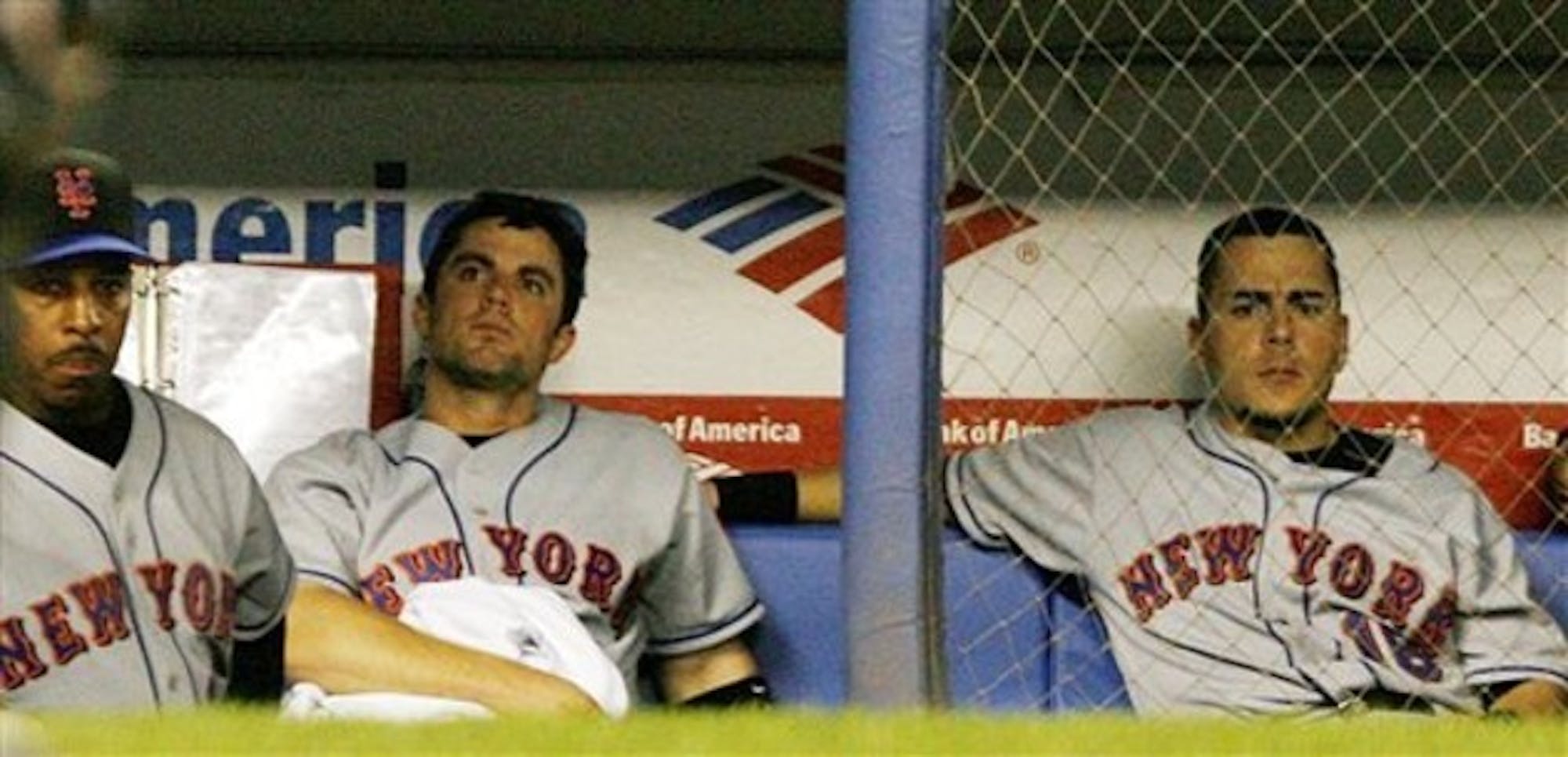
As much as Yankee fans will fight this point, they, along with the other 29 teams in the MLB, are not comparable to Mets fans in their loyalty. (Of course, this point is contentiously biased, but I will continue anyway.) We have endured the most raw of defeats (namely that in 2000), the most lopsided rivalry in history, close-calls and disastrous seasons alike -- and yet each season we return to our heroes in blue and orange with an unwavering hope that this could be our year.
If asked to prove their faith, Yankee fans like to discuss their "futility" during the 1980's. But if you have to use one decade in the span of a century as proof, how much credibility does that give your point? Not much, friends. Not much.
Being a diehard Mets fan has truly shaped who I am. I learned of unconditional love at an unusually young age. The Mets have taught me all I know about perseverance and allegiance. They have instilled in me values only equal to those taught by my parents. I find myself, under all circumstances, rooting for underdogs in sporting events. More importantly, this passion for the underdog does not stop at sports. Is it a coincidence that I am minoring in Public Policy with a focus on race and identity issues or might it have a little something to do with my life-long obsession with the New York Mets? I sincerely believe that rooting for an underdog, albeit in sports, throughout my adolescence has, in fact, made me infinitely more aware and sensitive to society's most oppressed underdogs.
The beauty of sport is that it has real life implications and lessons worth understanding. We root, we love, we suffer -- and we learn. The Mets currently find themselves with the best record, for the first time in years, in the National League.
It seems that this could actually be our season, our year to win the battle for the back page of the New York Post. But even if it isn't, the Mets know all their fans will be back in force next year, and the year after, and the year after that -- and so forth. It is, in the end, what we do.