
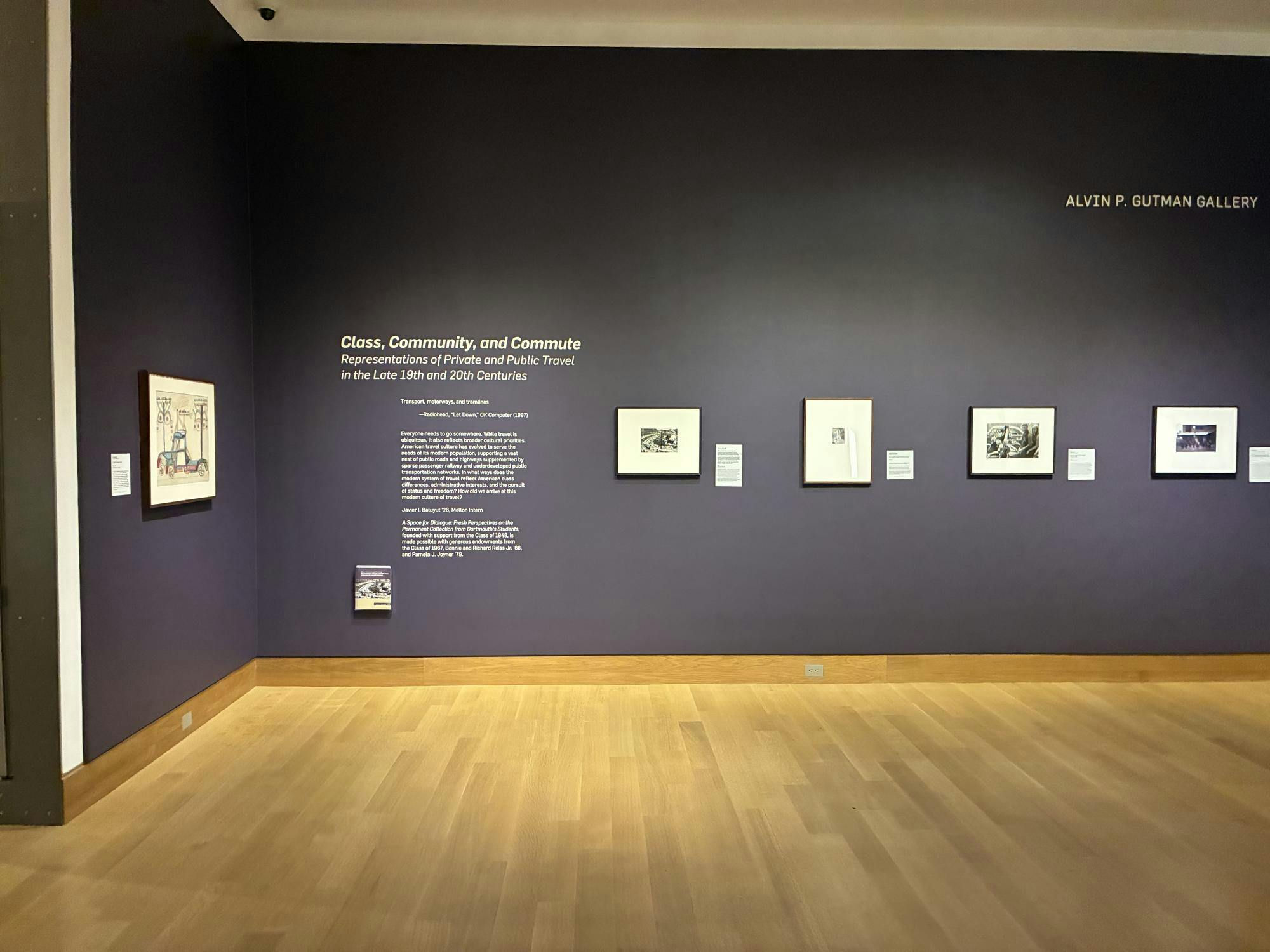
On Oct. 1, the Hood Museum of Art’s Mellon special project intern Javier Baluyut ’26 delivered a public talk at the Hood about his exhibit “Class, Community and Commute: Representations of Private and Public Travel in the Late 19th and 20th Centuries.” Part of the Hood’s “A Space for Dialogue” program, the exhibit opened at the Hood on Sept. 5 and will be on view until Oct. 24.
Baluyut, an art history major at Dartmouth who graduated last year, researched and curated this exhibit while serving as the Mellon special project intern, one of the Hood’s student curatorial internships, his senior year. As an intern, Baluyut also conducted research for other objects in the Hood’s permanent collection and exhibitions.
“Class, Community and Commute” tracks the evolutions of American travel systems during the 19th and 20th centuries, exploring the different values, interests and class backgrounds reflected by modern travel culture. The Dartmouth sat down with Baluyut to discuss the origins and ideas of his exhibit.
How did your idea for this exhibit come about?
JB: In high school in San Francisco, I felt really free traveling around the city. Then as soon as I went to Dartmouth, I felt a longing for San Francisco that I couldn’t pin down for a while. With a friend who’s a civil engineer, we started talking about the differences in infrastructure we noticed between the buildings we passed and the places we’d been. I felt a strong sense of place and connection to the people around me and to the architecture at Dartmouth and in San Francisco in a way that I didn’t in places like Lebanon, N.H., or these big areas in America dominated by car-centered infrastructure.
When I had this opportunity, I was originally going to speak on something related to my Filipino culture and heritage, but I didn’t feel that strongly attached to it. While I was surfing through the catalogue I saw these little pictures of people in cars or people going places, and I started to think about what I’m really passionate about: the social implications of infrastructure and travel, and how America has pretty much thoroughly dismantled its once super impressive railway system to make way for highways and roads. That ties into the social commentary I’m excited about, which is how the automobile industry has accumulated so much capital that it’s an oppressive force in the States. It also ties into the amount of public funding that goes to sustain this industry and the presence of these vehicles in our lives.
Did you encounter different perspectives about travel by car versus public transport during your research?
JB: A lot of people I’ve talked to associate driving with freedom and autonomy. I think a lot of people have an intrinsic enjoyment of driving, and I understand that — it’s very enticing to have your own space that travels with you and grants you access to the entire world. I approached this exhibition with the idea that private travel is a luxury, and because of that, it should feel great. So I’m really happy when people tell me they love their cars and love going places in them.
That said, I wanted to explore when the luxury of the private vehicle stops being a luxury and becomes a necessity to live. That’s when I believe the system of highways and roads fails. You see it choked by congestion, and the entire landscape becomes destroyed by parking lots and roads. I wanted to explore how these systems need to work together. Cars should be able to get you to a place, but you should also be able to walk — and you should be able to take some sort of public transportation that gets a lot of people to one place.
How do you think the modern transit system and infrastructure should be updated today?
JB: One great place to reduce reliance on freeways and highways would be travel between different nodes. If you could get railway systems like the famous American railways of the 1800s back up and running, accessible and affordable, you’d help a lot with the ways people travel longer distances. There’s no way to get from Los Angeles to San Francisco in a timely manner by train right now, and that’s a shame.
For most of this century, a lot of cities have had parking minimums that have sometimes required vast amounts of parking to accompany any sort of building. Lots of land is taken up just as a place to put your car. If we can provide an alternative transit system and not require as much parking, everything will feel better. Then, there’s the idea that infrastructure should be designed at the human rather than vehicle scale. You can change the distances between things to make sure they’re walkable.
What are your ideas about class with respect to our modern transit system?
JB: Over time, class attachments have developed to each of these modes of transit. There’s always going to be a strong attachment of class to a private vehicle because like I said, it’s a luxury — being able to pay for one and maintain it at a high level is a signal of wealth, and being able to control that much capital in the U.S. is an accomplishment that people understand as such. The inverse is that public travel becomes associated with the lower class because nobody wants to subject themselves to the public sphere or not be in control of where they go to the same extent.
A big argument of my exhibition was that private travel has become the standard even though it’s very luxurious, while public travel has become a kind of low-class reality in a lot of places, associated with people who just couldn’t afford a car. In general, there’s a big difference between places where you can take other means of transit and places where you can only drive. In the drive-only places, that’s where you really see the erosion of any sort of community around a non-home or non-work space.
Had you studied this subject before at Dartmouth?
JB: A lot of my art history classes surrounding class, race and status in art gave me the tools to look at the ways class is represented. In the winter, I also took a 20th century American fiction class that was useful for seeing American culture through different pieces of media and relating that back to the works in my exhibit.
Working with 20th century artwork was new to me. I spend a lot of my time in art history analyzing European oil paintings, so being able to pivot to American culture and a more modern idea was really valuable.
How do you think this exhibit will impact you?
JB: This exhibition will always be special to me. If people ask me about my time in college, this will be a big part of my accomplishments. A big life goal of mine is to never ever own a car, just because I don’t want to pay for it. That means I’ll be spending my time in spaces where I can survive without one and where there are other ways to get around. So, that’s one way this project is going to manifest in my physical life.
This interview has been edited for length and clarity.


