
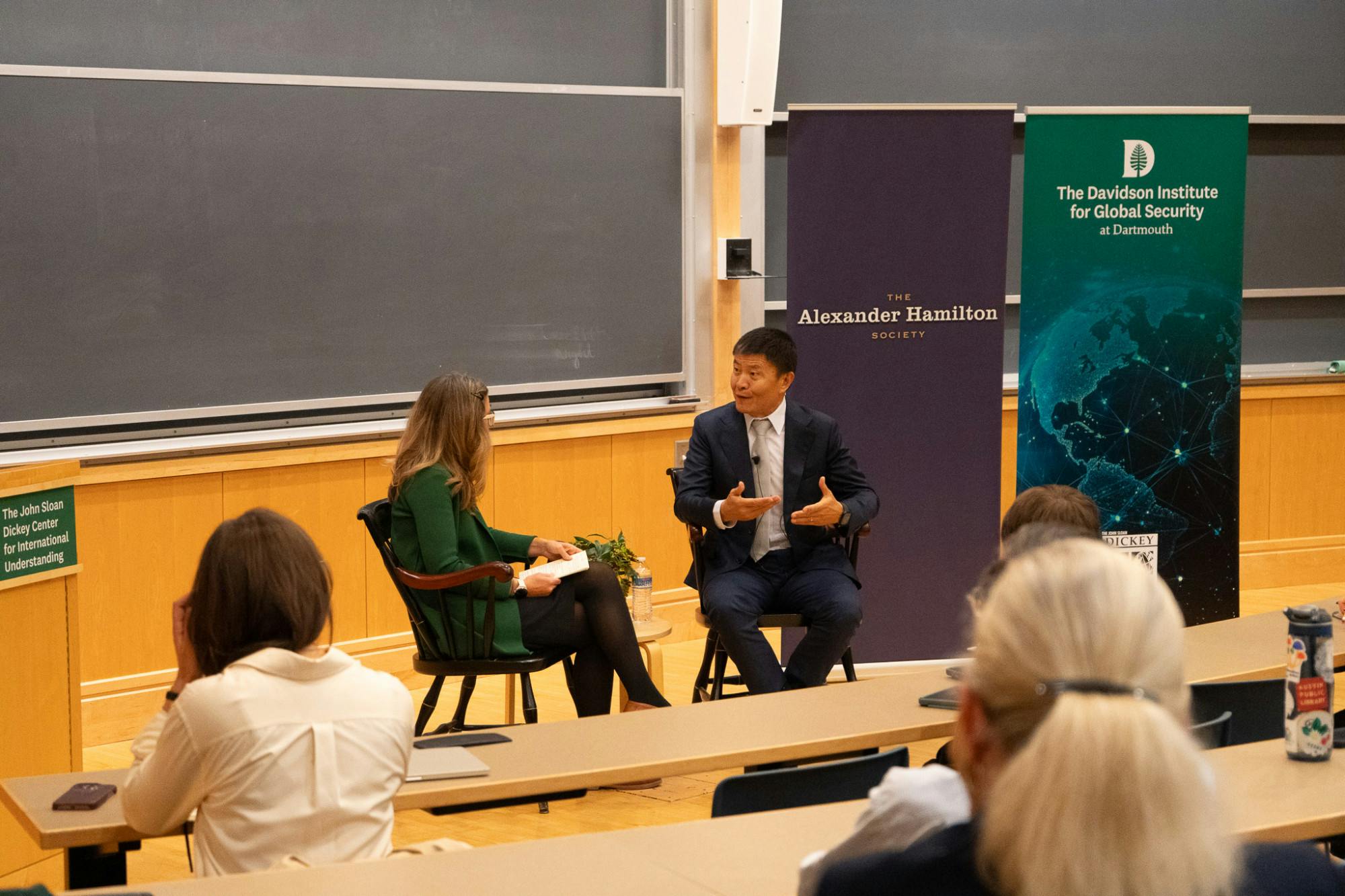
On Oct. 12, activist Zhou Fengsuo spoke about his role co-organizing the 1989 Tiananmen Square protests, modern digital surveillance and his continued advocacy for human rights in China.
The event, titled “A Student Stands: From Tiananmen to Today,” was co-sponsored by the Davidson Institute for Global Security and the Alexander Hamilton Society. It was moderated by Dickey Center for International Understanding lecturer Elizabeth Shackleford, a former United States diplomat to Poland and South Sudan. Approximately 68 people attended the event in person in Haldeman Hall and 116 people viewed a livestream recording, according to Dickey Center program and events coordinator Naomi Wade.
The Tiananmen Square protests were a series of student- and worker-led demonstrations in April 1989 that ultimately gathered widespread support across China. Zhou founded the protest’s radio station and coordinated medical aid for hunger-striking protesters before the movement was forcefully suppressed by the Chinese government on June 4, 1989, when Chinese troops killed hundreds of protesters, according to Amnesty International.
After the crackdown, Zhou was fifth on the Chinese government’s most-wanted list of protest organizers. He spent a year in prison before he was exiled to the United States, he said.
“For me, this was also a call of duty,” he said at the event. “I have become a face of this protest — one of the most notable voices about this because of this government-designated role.”
Since then, Zhou has pursued a career in human rights advocacy, co-founding Humanitarian China, which provides financial aid and legal assistance to Chinese political prisoners, dissidents and their families. He also serves as the executive director of Human Rights in China, an international non-governmental organization that monitors, documents and reports on civil and political liberties in China. Zhou said he felt “proud” of his advocacy work, which he called his “solemn duty as a survivor” of the Tiananmen Square crackdown.
In response to Shackleford’s question if dissent is more dangerous in China today than it was in 1989 due to the rise of “certain technologies and the surveillance state,” Zhou said that while such tools are useful for the Chinese Communist Party, they also have limitations.
“The success of the CCP is that people over-exaggerate their power,” he said. “We amplify this if we believe they are everywhere, at any time, any moment. That’s not true.”
The advance of technology has also helped activists, he said. Digital meeting places, such as Zoom, provide a more accessible, modern-day alternative to Tiananmen Square that allows people to protest in “very creative ways.” In 2020, Humanitarian China organized a virtual commemoration of the Tiananmen Square crackdown on Zoom that reached 200 people, “many” of whom accessed the event from China through a distributed QR code before Zoom shut down the event at the direction of the Chinese Ministry of State Security.
”Our account was shut down by Zoom,” he said. “And later, an FBI investigation revealed that Zoom actually had an MSS agent as an employee who gave them direction.”
Zhou also discussed why exposure to democratic countries through trade did not lead to democratization in China as the U.S. expected. Zhou said the World Trade Organization’s decision to allow China to join the body in 2001 despite its “severe human rights violations” was a “huge mistake.”
Former President Bill Clinton “removed the linking of human rights from trade,” Zhou said. “With this, democratic countries lost leverage against China.”
Since then, China has been able to “exert its influence globally, not only commercially, but politically” through its trade ties with other countries.
“We want China to change,” he said. “I say that should be top priority, instead of trade as priority. If we prioritize human rights, real change can happen in China.”
Zhou attributed Chinese President Xi Jinping’s removal of presidential term limits in 2018 to his unwillingness for “our generation within the system to succeed him,” pointing to his generation’s memory and experience of the Tiananmen pro-democracy movement. However, “the generational shift will happen no matter what,” Zhou said
“There’s a lot of possibility,” Zhou said. “In 10 years, probably, the majority of CCP leadership will be our generation.”
Zhou said people remember the Tiananmen Square protests because they were peaceful.
“It was probably the most peaceful protest ever,” he said. “I think this is very important to be peaceful.”
Attendee Caleb Smith ’30 said he attended the event because he was intrigued to hear from “one of the greatest champions for human rights alive today.”
“If all your friends are getting shot around you and you’re just saying ‘Okay, I’m gonna fight even more,’ that’s just so insanely impressive and admirable,” he added.
Attendee Oliver Berle ’29 said Zhou’s emphasis on “nonviolence” and activists’ “adaptability” is “something we can all take forward.”
“For him to believe in what he was doing that much to such an incredible degree, I think is very inspiring,” Berle added.


