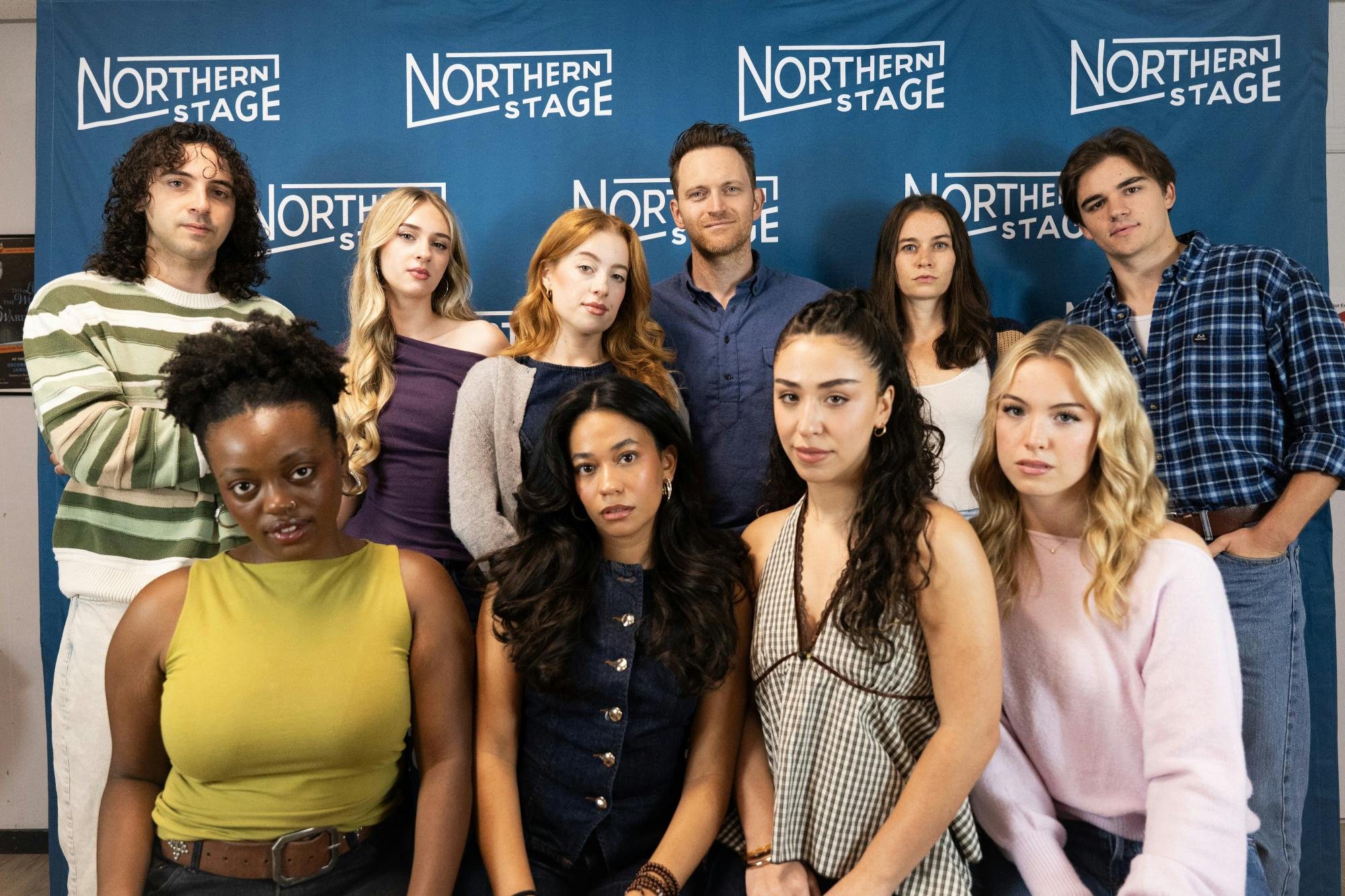
“John Proctor is the Villain,” the Tony-nominated play about a high school English class reinterpreting “The Crucible” amid a sexual assault allegation at their school, will open at the Northern Stage theater in White River Junction next Wednesday, Sept. 23.
The play was performed on Broadway during the 2024-2025 season and will run at Northern Stage until Oct. 11.
Set at the height of the #MeToo movement in 2018, the play looks beyond the critical recent moment to ask where we go as a society afterward, according to production director and Northern Stage associate artistic director Sarah Wansley.
The play asks, “‘Where has that conversation gone?’” Wansley said. “‘How do we move forward, even though there are aspects of our society that sometimes feel like they are moving backwards?’”
Wansley said this aspect of the play strongly appealed to her and Northern Stage producing artistic director Carol Dunne, who wanted to produce it immediately after watching it on Broadway.
While the play does not necessarily offer a complete resolution to this question, it presents the genuine possibility of “healing” and “empowerment” even when the outcome isn’t perfect, Wansley said.
“It’s actually a play about the students — especially the young women — and their friendship, and the way that friendship creates healing for survivors,” Wansley said.
Tristyn Girouard ’27, who will act in the ensemble and is understudying the roles of Raelynn and Ivy as part of her experiential term at Northern Stage, echoed this point.
“The concepts of sexuality and opinions and friendship aren’t just sort of treated as trivial, like adolescent drama,” Girouard said. “It actually gives young women the emotional authority to interpret their own experiences as genuinely important and meaningful.”
At the same time, Girouard said, “John Proctor is the Villain” does not promote any one perspective on the contentious issues around “accountability and power and gender” raised in the story.
“This play doesn’t tell you what to think about those questions,” Girouard said. “It just gives you a really accessible way to open a dialogue about these things.”
Theater department lecturer Robert Grant, who will play the teacher Mr. Smith, said the play urges audiences to “re-examine a piece of received wisdom.”
Wansley described how the play encourages recognition of the way in which classical texts like “The Crucible” help “reinforce” biases.
“I actually think the [John Proctor is the Villain] playwright loves the play [The Crucible],” Wansley said. “But she’s questioning the way that the school as an institution sometimes reinforces patriarchal ideas in the way that we look at classic texts.”
Girouard and Grant emphasized how the play also prompts audiences to critically reassess these texts to draw new conclusions, as the student characters do.
“The characters in 2018 use this old text in order to sort of understand what’s going on in their lives, but then their present changes how they understand the text at the same time,” Girouard said.
As part of this reevaluation, the play “asks you to think about authority figures” and to “rethink how that person’s gender or their charisma or their reputation affects your relationship with them,” Girouard said.
Grant said he hopes the play’s reinterpretation of “The Crucible” can encourage audiences to develop a more critical view of other aspects of society that we may take for granted.
Wansley called the show’s casting process “lengthy,” adding that she watched over 180 audition tapes from actors around the country.
She explained that it was a challenge to seek out actors who were “believably young enough to really play high school students,” but who also had the “professional experience to be able to lead a show.”
Contrarily, Wansley said she and Dunne knew they wanted Grant as the teacher right away.
“We often read plays and think about [how] we don’t have a ton of professional actors living up here in the Upper Valley, but those we do have ... we really do look for plays for them,” Wansley said.
She added that two Dartmouth students on their experiential terms — Girouard and Patrick Balbo ’28, who is understudying the roles of Lee and Mason and will also be in the ensemble — are involved in the production.
As a director, she described paying special attention to the transitions in the play. Because there are just “16 short scenes” in one location “with a bit of a lights-out moment” between them, she explained that she tried to use those moments to enhance the “storytelling” — including by spotlighting specific characters.
At the same time, Wansley called the play “the most fun” to rehearse. Indeed, despite the serious themes, she and Girouard emphasized that the play is very “funny” as well as, in Girouard’s words, “relatable and contemporary.”
Wansley said the cast had fun with the play’s school aspect. She recalled that instead of assigning school supplies to each character, she and the props director “bought like a whole table’s worth” and then “had the cast go school supply shopping” for their own characters.
“It is a pretty young cast, and we’re really leaning into the playfulness, but also the depth of feeling that characterizes first discoveries that are so concentrated in your high school and college years,” Grant added.
Girouard, for whom this play has marked her first “truly” professional experience, likened the rehearsal experience to being in her own high school English class with a teacher “who really just brought the super inquisitive and curious sides out of all of us.”
As a theater teacher, Grant said he believes that the intrinsic “subjectivity” of plays, as opposed to having any objective interpretation, creates “a natural and unavoidable tension” in the academic study of theater.”
“I like to really emphasize ... there is no right answer about what “The Crucible” is about, just like there is no archetypical version of any particular play,” Grant said.
He added that he believes that works of theater “only exist in their purest form” when performed live, inevitably interacting with the “perspectives” and “personalities” of the play’s collaborators.
“John Proctor is the Villain” will run from Sept. 23 to Oct. 11 at Northern Stage. Tickets, including discount preview and student tickets, are available through the Northern Stage website.
Avery Lin ’27 is an arts editor and writer from New York City. She studies Comparative Literature, including French and Classical Greek, at Dartmouth and also writes for Spare Rib Magazine.