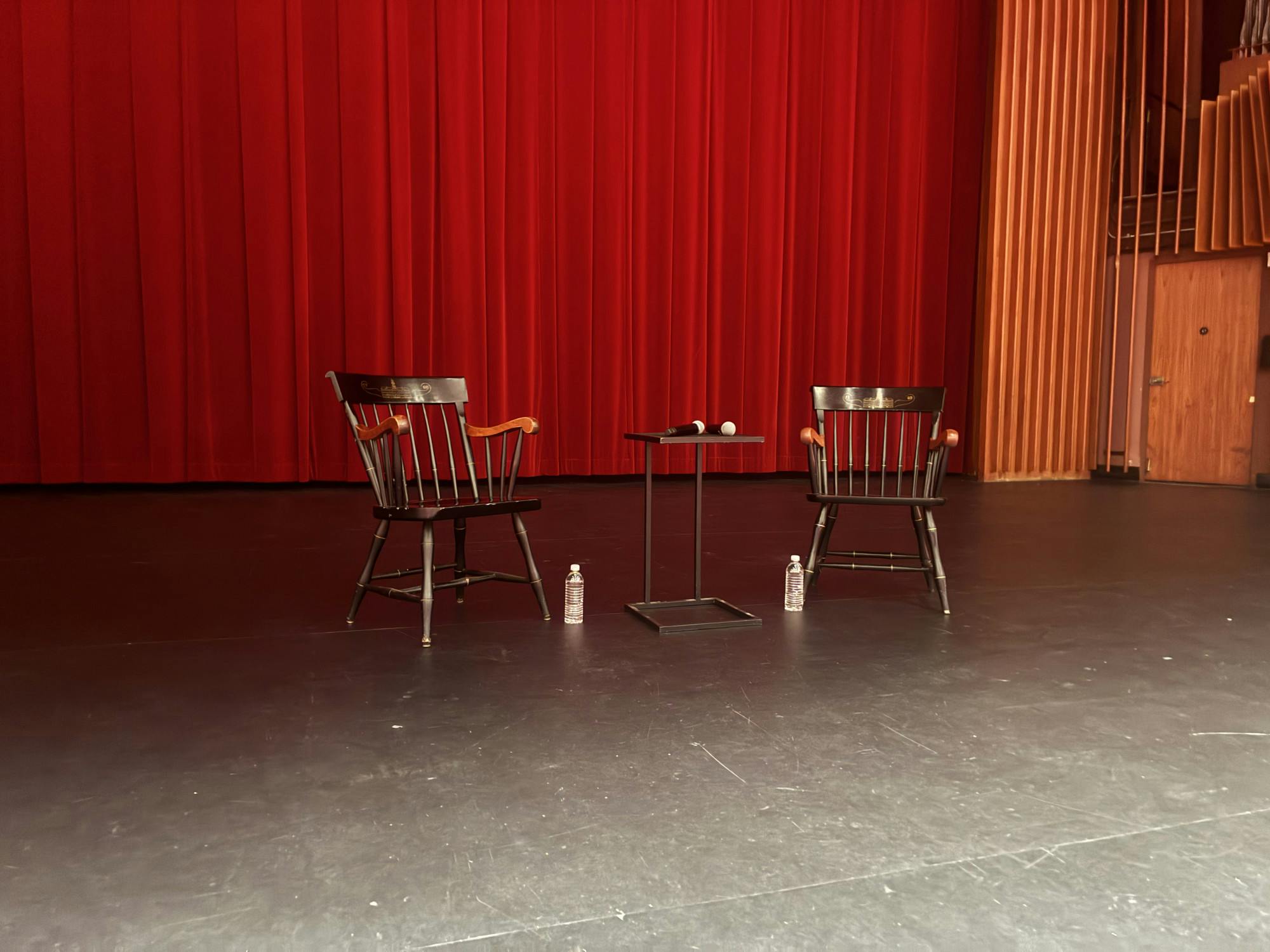
On July 23, filmmaker Ken Burns visited the Hopkins Center for the Arts’s Spaulding Auditorium for a screening of the second episode of his new documentary series, “The American Revolution,” followed by a discussion moderated by Hop programming initiatives director Johanna Evans.
The six-part documentary series premiered on PBS on Nov. 16, 2025, and amassed more than 4 billion minutes streamed across all platforms within two months, according to Burns.
The second episode, roughly two hours long, opens on the Charlestown Peninsula and builds toward the Battle of Bunker Hill on June 17, 1775 — a battle the Patriots technically lost, but at a cost that stunned the British. American forces suffered 115 killed, 305 wounded and 30 captured, while the British absorbed more than 1,000 casualties, including an estimated 226 dead. As the Hopkins Center described it in advertising, the episode examines “how America’s founding turned the world upside-down.”
The structure, Burns said during the discussion, is chronological, moving from the political maneuvering in Philadelphia to the war itself. To tell that story, Burns and his team combined reenactments, paintings, letters and archival material drawn from museums, galleries and libraries across the country, filming with groups of Americans from New Hampshire to Georgia. Gathering that material took five years, he said, and the full production — what he called “a ballet between documents and maps and paintings, live and portrait” — took nearly ten years. He credited his editors for their meticulous work while assembling the material into the film. Some of the more intimate texture, like footage of rain or snow, he said he simply shot himself on his phone, a detail that drew a laugh from the audience.
The series relies on roughly 400 first-person voices and 61 actors, including Meryl Streep, Morgan Freeman, Tom Hanks, Amanda Gorman and Kenneth Branagh. The actor Josh Brolin voices George Washington, a casting choice Burns said he came upon almost by accident: Flying home from a film screening in Rome, he watched “Dune: Part Two” and decided, based on Brolin’s performance in the movie, that he had found his Washington. The soundtrack draws on musicians including violinist Johnny Gandelsman, folk musician Rhiannon Giddens and cellist Yo-Yo Ma, blending period music with newly composed pieces, layered so densely that, in one battle sequence, Burns said there are 152 sounds playing simultaneously to build the atmosphere of combat.
Much of the post-screening discussion turned on how the Revolution is remembered versus how it actually happened.
“We learned a bloodless version,” Burns told Evans, describing how the war pitted brothers against brothers. He argued that treating the founders as flawless does them and us a disservice: Their “imperfections,” he said, are what make them people we can actually aspire to be. He described the series’ guiding principle as serving “the facts rather than the art,” explaining that new scholarship led Burns and his team to change many parts of the documentary throughout production.
Burns also spoke at length about how the series treats Washington’s relationship to slavery. He was an advocate of liberty, and yet he never fully broke from the system established upon slavery. Therefore, according to Burns, one’s stance on slavery cannot be reduced to a simple binary, given how deeply the economies of Britain and its colonies worldwide were tied to slavery at the time.
Still, Burns was clear that he sees the Revolution as something to celebrate as much as interrogate.
“The door is unlocked, tyranny is over” at the end of the war, he said, describing the fighting and the subsequent government as the start of a genuinely new kind of political order. He called the American Revolution the “most consequential revolution in history.” In this context, he pointed to Washington — then the wealthiest man in America — and emphasized how he walked away from power at the height of his military and political standing rather than becoming a king. Without that choice, Burns suggested, there would be no United States at all.
As the country marks the 250th anniversary of the war’s opening battles, Burns left his audience at the Hopkins Center with the perception of the founding revolution as an “uncomfortable” yet “collective” history, one worth looking back to as a whole.