On April 24, Hood Museum of Art hosted its quarterly “Art in Focus” tour, an interactive program designed for people with dementia-related illnesses and their caregivers in collaboration with Dartmouth Health’s Aging Resource Center.
The Art in Focus tour was modeled after the Museum of Modern Art’s monthly gallery program “Meet Me at MoMA,” which makes art more accessible for people with dementia and their care partners, according to Hood Museum assistant curator of education Brooke Friday.
“They kind of wrote the manual on how to do these types of programs,” Friday said.
Aging Resource Center dementia program specialist Kristina Ward, who facilitates “Art in Focus” visits, also organizes monthly excursions to places like the Castle in the Clouds, Dartmouth Greenhouse, Full Circle Farm, Memory Cafe at Howe Library and Tomapo Farm.
“Many of the people who come, come to everything,” Ward said.
The program, which predates the COVID-19 pandemic, moved online during the COVID-19 pandemic and has since returned to an in-person format. A staff member or docent leads participants through the galleries, after which participants engage in a hands-on art activity, Friday said.
Robin Ahrens ’82, a docent at the Hood, led the April 24 “Art in Focus” tour through the “Nurturing Nationhood: Artistic Constructions of America, 1790 to 1940” exhibition. The Hood has dedicated all of its galleries to American art ahead of the United States’ 250th anniversary.
“That gallery, that exhibit, is a gift to teach with and to facilitate a tour with because it has so much to think about,” Ahrens said in an interview with The Dartmouth.
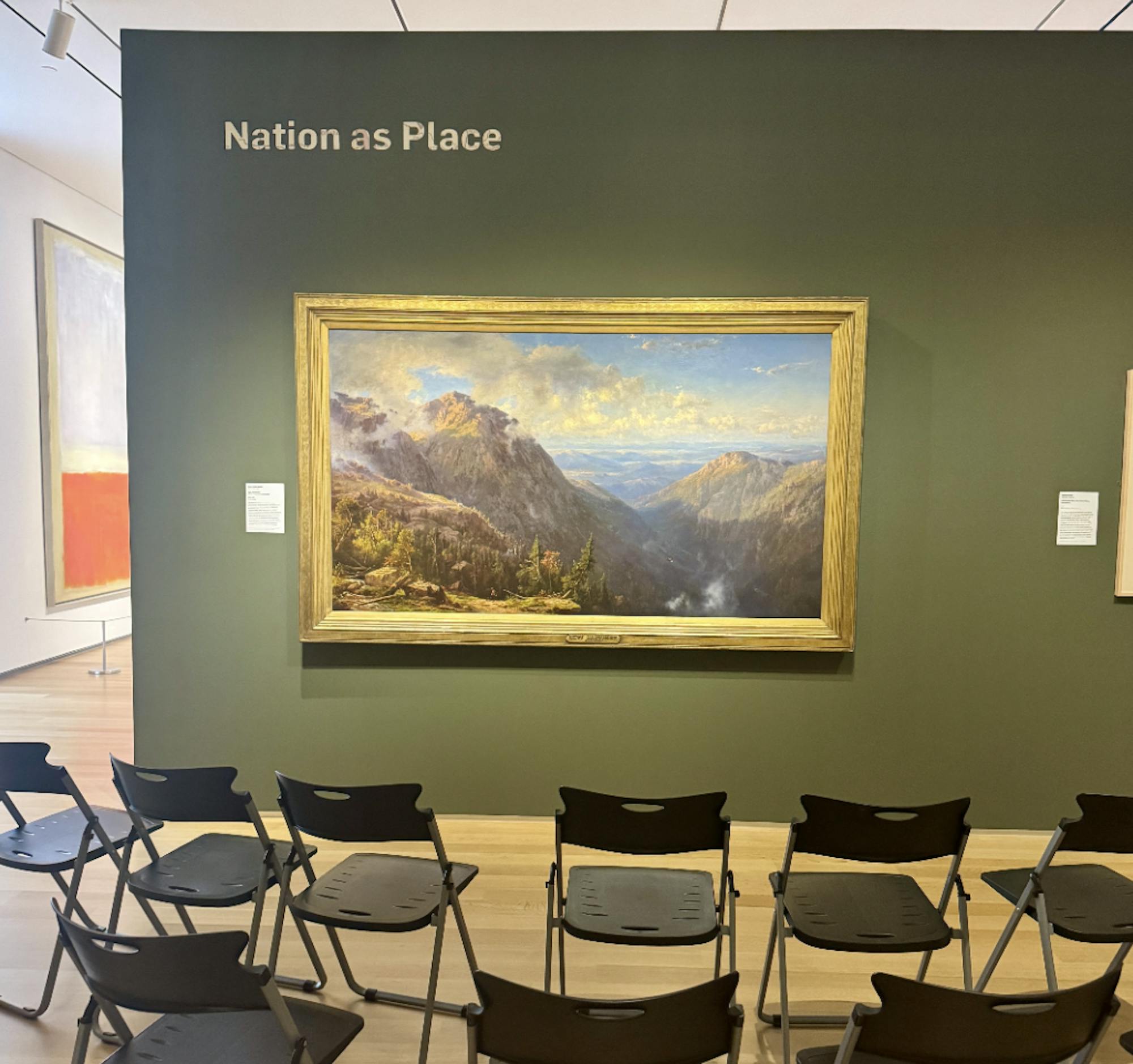
In the Rush Gallery, visitors were invited to consider “New Hampshire (White Mountain Landscape)” by French artist Régis François Gignoux. The oil painting, created around 1864, is an imagined composite of the state’s mountain ranges.
“The Gignoux [painting] is such a large canvas,” Ahrens said “I intentionally picked an artwork that gave them a full wall experience. They could travel across it with their eyes.”
Guides at the Hood use the “learning to look” method, where they ask a focused question about the artwork and invite discussion from visitors before sharing the accompanying wall text, according to Ahrens.
“All we want to do is spark curiosity, spark these conversations,” Ahrens said. “The goal is to create space — to take our time, to look at it, to process it, to talk about it.”
Ward said the shared experience between individuals with dementia-related illness and their caregivers is central to the program’s design.
“So many caregivers struggle in so many ways, not only with burnout, but with isolation,” Ward said. “Our main goal was to try to alleviate some of that isolation by getting people out and about, and in small periods of time. All of our events are only two hours in length.”
During the April 24 tour, Ahrens asked participants to vote on which topic — history, personal experience, dreams, nature and color — interested them most. The group collectively chose nature and dreams, and Ahrens selected works in the gallery that matched the themes accordingly.
“It’s wonderful because it allows people agency in seeing what they want to see next and what their interests are,” Friday said.
In the Sack Gallery, the group examined three depictions of horses. The first was F. Mortimer Lamb’s “Blacksmith Shop,” an early 20th-century oil painting depicting a horse at a blacksmith’s forge, evoking labor and transport. Next was Edmund Charles Tarbell’s “Study for Edmund and Eaglet.” The oil painting, created in about 1914, depicts the back half of the horse rather than identifying it by its face. Ahrens then showed a print out of what the eventual study became, a complete portrait of the race horse. Then the group turned to a large pictorial elk hide painting made in 1905, possibly by Eastern Shoshone artist Cadzi Cody. This piece drew on associations of both hope and conflict for visitors.

Three depictions of horses hang in the Hood Museum of Art's Sack Gallery.
The tour then continued to Ilse Bischoff’s “Madonna,” an oil painting made in 1940. The group focused on the figure’s skin, expressions and the use of color. Bischoff painted this work in Harlem, N.Y., and later moved to Hartland, Vt., where she began an artist colony.
Ward emphasized that the tour is valuable for creating a space for movement, conversation and engagement.
“Art and music are two things that stay the longest with a person, even as their memories are starting to go,” Ward said. “Not everybody in the group is verbal, so oftentimes it’s not that easy to communicate, but you can just tell by how someone’s looking at a piece of art or listening to the docent talk whether or not they’re actually connecting.”
The second hour of the tour was dedicated to an art-making activity in the Georgina T. and Thomas A. Russo Atrium, where participants were invited to make collages using scraps of paper, brochures, old magazines and colorful tape.
“When you see great art, you want to create yourself, and it gives them that opportunity right before they leave,” Ahrens said. “It makes for a complete experience.”
The goal of the “Art in Focus” tour and all excursions is to make them accessible and fun, according to Ward.
“Some people are pretty easygoing and depending on where they are in their dementia journey, [so] it can be easy to get them to go to places,” Ward said. “Then there are other people who really struggle with even leaving their house… The goal is really just to get them out of their houses and to try to do different things.”
The partnership between the Aging Resource Center and the Hood has created a sense of community for participants and organizers, Ward said.
“I just feel really grateful for them and trusting us with their communities,” Friday said.
Ward encouraged caretakers who might be tentative about participating in the program to start small, and show up.
“If you can get them in the car and they’re willing to go for a ride, just try it, because usually if somebody comes, they always come back,” she said.