
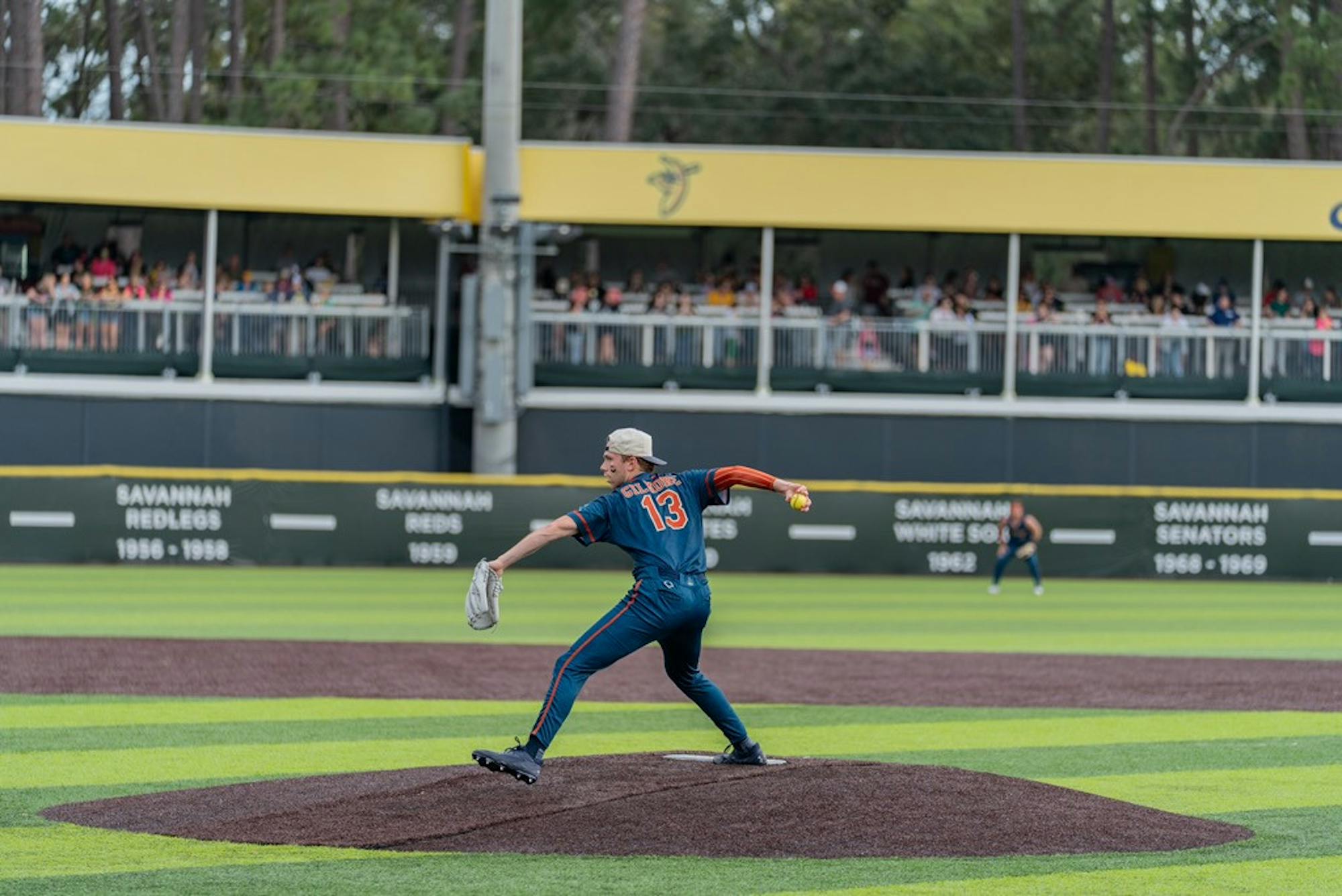
Clark Gilmore ’24 never planned to play baseball for life. At five years old, he swore he would never even play the game. Yet, nearly two decades later, he’s turned his passion into a career that’s taken him from Dartmouth to the University of Notre Dame, and now onto the national stage of Banana Ball.
Banana Ball traces its origins to 2016, when the Savannah Bananas — originally a college summer baseball team — began experimenting with alternate rules designed to make the game faster and more entertaining. In 2018, they played the rules for the first time against Lander University, and by June 2020, Banana Ball officially debuted when the Bananas split into two squads and played against each other. The format continued to evolve, and by 2022 the organization had fully transitioned into a Banana Ball league, expanding rapidly to include six total teams.
Founded by Bananas owner Jesse Cole, the league was built around the idea that traditional baseball had become too slow for modern audiences. To change that, he introduced rules such as a two-hour game limit, batters being ejected for bunting and even allowing fans to record outs if they catch foul balls in the stands. The result is a high-energy, entertainment-focused version of baseball that now draws more than 3 million fans across games played in NFL stadiums, college venues and professional ballparks in over 45 states and 75 cities.
Gilmore is a pitcher for the Indianapolis Clowns, known for his behind-the-back pitching and flair on the mound. He sat down with The Dartmouth to discuss his journey from Ivy League baseball to the professional stage of Banana Ball and how his love for the game has shaped his unconventional path.
How long have you been playing baseball, and what first got you into the game?
CG: I’ve been playing baseball since I was five years old, so about 19 years now. I started playing because my dad told me I should start T-ball, and when I was a stubborn five-year-old, I said, “I will never play baseball, Dad!” Yet, here I am 19 years later doing it for a living.
What led you to choose Dartmouth?
CG: I grew up about 30 minutes from Yale University. My freshman year of high school, we saw the Dartmouth and Yale baseball teams face off in the Red Rolfe Division Championship and I just fell in love with Ivy League sports. What really sold me on Dartmouth, though, was the beautiful campus. I went to a camp there with Coach Bob Whalen, crossed the Ledyard Bridge and just immediately knew it was the place for me.
How would you describe your overall experience as a student-athlete here?
CG: It was fantastic. I got to experience so many different parts of Dartmouth culture all at once. I was the president of Chi Heorot, so I got to experience Greek life and everything that came with that. Athletically, it was cool competing in the Ivy League, getting to go see all the historic campuses and playing against some of the oldest teams in the world. One of my favorite places was the Rauner Special Collections Library. I remember going there for a class and looking at the copy of Shakespeare’s First Folio. I also got to hold the letter written by George Washington to the trustees of Dartmouth. I had so much fun at the College on the Hill. I loved every moment of it.
How did you end up playing at the University of Notre Dame?
CG: I graduated from Dartmouth in 2024, but because my freshman season was the second time the Ivy League decided to cancel spring sports due to COVID-19, I had an extra year of eligibility. I decided I wanted to get my master’s. I ended up speaking with the Notre Dame baseball coaches and committing to play at the University of Notre Dame. I then applied to the Mendoza College of Business, where I got my master’s of business management in a year and a half-ish and I got to play Atlantic Coast Conference baseball for my fifth year.
When did you realize you might want to pursue playing baseball professionally?
CG: For everyone growing up, the goal was to become a major league baseball player. But, I like to have a lot of fun on the field and truthfully, it’s been something that has gotten me in some trouble over the years because coaches are like, ‘Why aren’t you taking this more seriously?’ And I’m like, ‘Because I’m having the most fun ever! I’m on a baseball field, this is great!’
When I found that there was a place that not only was okay with the dancing, the tricks and having fun on the field, but actually promoted it, I thought that it would be a really good place for me.
How did you first get involved with Banana Ball?
CG: I graduated in May 2025 from Notre Dame, but still had two months left on the lease for my housing so I stayed. I discovered Banana Ball, and decided to become one of their players. A lot of the players had good social media followings, so I started putting videos out on the internet every day and they caught traction. I applied to Banana Ball by making a one-minute video that basically said, “I’m not going to tell you that I should be a Banana. I’m just gonna show you.” I submitted it as part of my application and it ended up going viral. From there, I got invited to a tryout in Savannah, Ga., and was drafted to the league in November 2025.
How challenging was it to adapt from traditional baseball to the unique rules and style of Banana Ball?
CG: For most people, I’d say that’s a challenge, but for me, it’s something I’ve been doing my whole life. When I was younger, and we had a little bit extra time at the field, I was always catching a ball behind my back and throwing it in a funky way. That’s now one of the things that puts fans in the seats when we play Banana Ball, and I’ve been doing it my whole life.
Looking back, what advice would you give to younger players who want to follow a similar path?
CG: This is the Banana Ball answer, and I couldn’t agree more: Have fun and love the game. I loved baseball and I loved it more than almost anyone I know. What that did for me was allow me to persevere through the ups and downs of a sport where you fail almost 70% of the time. If you love it, there is nothing that will stop you from continuing to grind, and ultimately, from keeping you playing that game as long as you’d like to.
This interview has been edited for clarity and length.
Gabriella Messina ’27 is a sports writer. She is from Rye, N.Y. and is majoring in Engineering and minoring in French. On campus, Gabriella is on the club lacrosse and taekwondo teams. She is also a member of the 2027 class council.


