
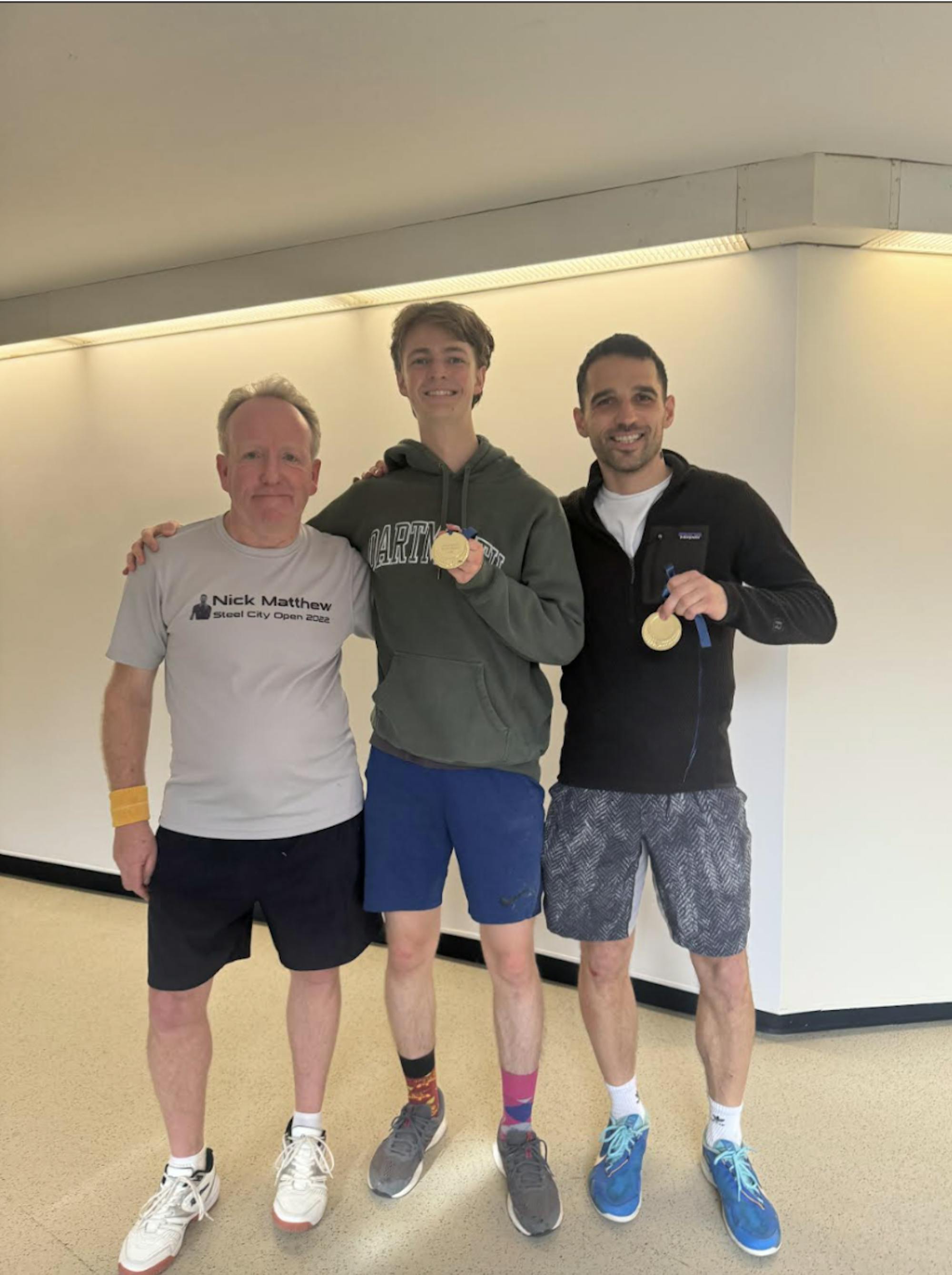
Most people train for years to master one racket sport. At a recent national tournament, two Dartmouth players competed in four — back-to-back.
The sport, known as racketlon, combines table tennis, badminton, squash and tennis into a single match. Players face the same opponent in all four disciplines, playing each to 21 points, with the highest total score determining the winner.
On April 11-12, Stoyan Dimitrov, a visiting mathematics professor and postdoctoral researcher, and Nathaniel Thornell ’28 teamed up to compete in the CHA Massachusetts Racket Masters 2026 tournament at Smith College in Northampton, Mass. Despite both having limited experience in playing the four sports competitively — and entering with few expectations — the pair won their doubles division by a single point.
The pair also qualified to play for Team USA in the Federation of International Racketlon World Championships in Rotterdam, Netherlands in August. Thornell and Dimitrov are currently unsure whether they will attend.
In an interview with The Dartmouth, Dimitrov and Thornell reflected on how they got into racketlon, what makes it uniquely challenging and how they pulled off an unlikely win.
How long have you been playing racket sports, and how did you first get started?
SD: I played recreationally in high school, but I’ve never taken a lesson in any of these four sports. I played a lot of table tennis, then I transitioned to badminton in college and then tennis and squash when I came to the U.S. for my Ph.D.
NT: I’ve been playing tennis since I was eight. I just started playing table tennis about three years ago, and the other two, squash and badminton, I’d played a couple times when I was younger, but I had never really played them competitively until the weekend of the tournament.
How did you start playing racketlon?
SD: It’s very funny. I initially wanted to invent a sport of a similar kind before knowing about racketlon. I just started thinking about it and then Googled various things related to it, and I just came across this thing called racketlon. I thought it was pretty reasonable in its current format, so I decided to try it.
NT: Stoyan told me about it because we play tennis and table tennis together. He’d thought I’d be decent at it and it would be fun.
What is the most challenging thing about racketlon?
SD: You have to adjust pretty quickly because the strokes in each game are different. When you play table tennis, for example, the strokes are more sharp and quick, whereas in tennis, you have to prepare much earlier and the whole swing is much longer. Additionally, racket sports are a mental game. For people who watch tennis, they know that Novak Djokovic is so successful because of his strong mentality, and it’s very similar in racketlon. You have to keep yourself focused and in the match, regardless of the results.
NT: Your legs want to give out because you’re playing for so long. We played around seven matches, which means we played all four sports seven times, so 28 games to 21. It was a lot.
What was your strategy going into the tournament?
SD: We came up with a strategy in particular for the two sports that Nathaniel has less experience with, badminton and squash. For badminton, I just told him, ‘Okay, just clear it high so that we get more time,’ and then he was also responsible for the short pause because he’s young and quick. Even though he has barely played badminton, in doubles, we were not bad.
NT: Honestly, to not get injured before the weekend ends because we were playing so many matches and working so hard. I had no strategy other than that.
You won your division by just one point. What happened in that final match?
SD: We won the first three games easily, and we only needed 12 points in tennis to win our division. But our opponents turned out to be quite good at tennis, so it was a battle. By the time we got to 12 points, we hadn’t even realized that we won because the game was so close.
NT: Our final match was crazy because we were up by a lot in the first three games, and so we thought we’d win by a lot because we’re both really good at tennis, but then they shocked us because they were able to keep up with us. Then we started losing, which wasn’t good. There’s a lot of pressure when this happens, but I still had fun because I didn’t have any expectations and we were already playing in the championship.
Do you see potential for racketlon to grow at Dartmouth or in college sports more broadly?
SD: It’s kind of challenging to attract new people to the sport because you need to have some sort of experience with at least one of the sports, all four if you want to become more serious. You need equipment, rackets and facilities for all of this too. That being said, being at Dartmouth helps a lot because you have these facilities for free.
NT: Yes, because I recently met two other people that play all four sports, which really surprised me and was super exciting. I told them all about the tournament and told them to put it on their calendars for next year. The only problem is that there’s only one tournament each year in the U.S., so you kind of have to be free for that one weekend.
This interview has been edited for clarity and length.
Gabriella Messina ’27 is a sports writer. She is from Rye, N.Y. and is majoring in Engineering and minoring in French. On campus, Gabriella is on the club lacrosse and taekwondo teams. She is also a member of the 2027 class council.


