
Krista Oehlke '13 won the Grimes English Prize, given to a member of the graduating class. Oehlke read poems from her collection "Winter Drafts."
Mitchell Jacobs '14 won the Academy of American Poets Prize and the Jacobson-Laing Award in Poetry. Kathleen Chung '14 accepted the prize for Jacobs, who is currently in China.
Kate Sullivan '13 won the Erskine Caldwell Prize for work in short story writing, and she read an excerpt from her story "Mustard and Grease in East Houston."
"I had a lot of fun writing it," Sullivan said. "I felt like the voice of it and the voice of the character would make it very fun to read aloud."
She said that she decided to submit her piece "on a whim."
Aaditya Talwai '13 won the William C. Spengemann Award in Writing in recognition for a section of his thesis. The award is given to students whose prose is distinguished by technical precision and original subject matter.
William Callan '15 won the Lockwood Prize, awarded to a member of the junior class.
"I was encouraged by a professor to submit, and I thought I might as well," he said. "I really didn't think about it between submitting it and getting the award."
Claire Park '16 was awarded the Mecklin Prize for her work in creative nonfiction.
"I took a writing class with {English] professor [Jeff] Sharlet, and it was a revision of our first prompt," she said. "I just got inspired."
Josh Koenig '16 won the Thomas Henry Ralston IV English 80 Prize for a student in introductory creative writing who shows potential.
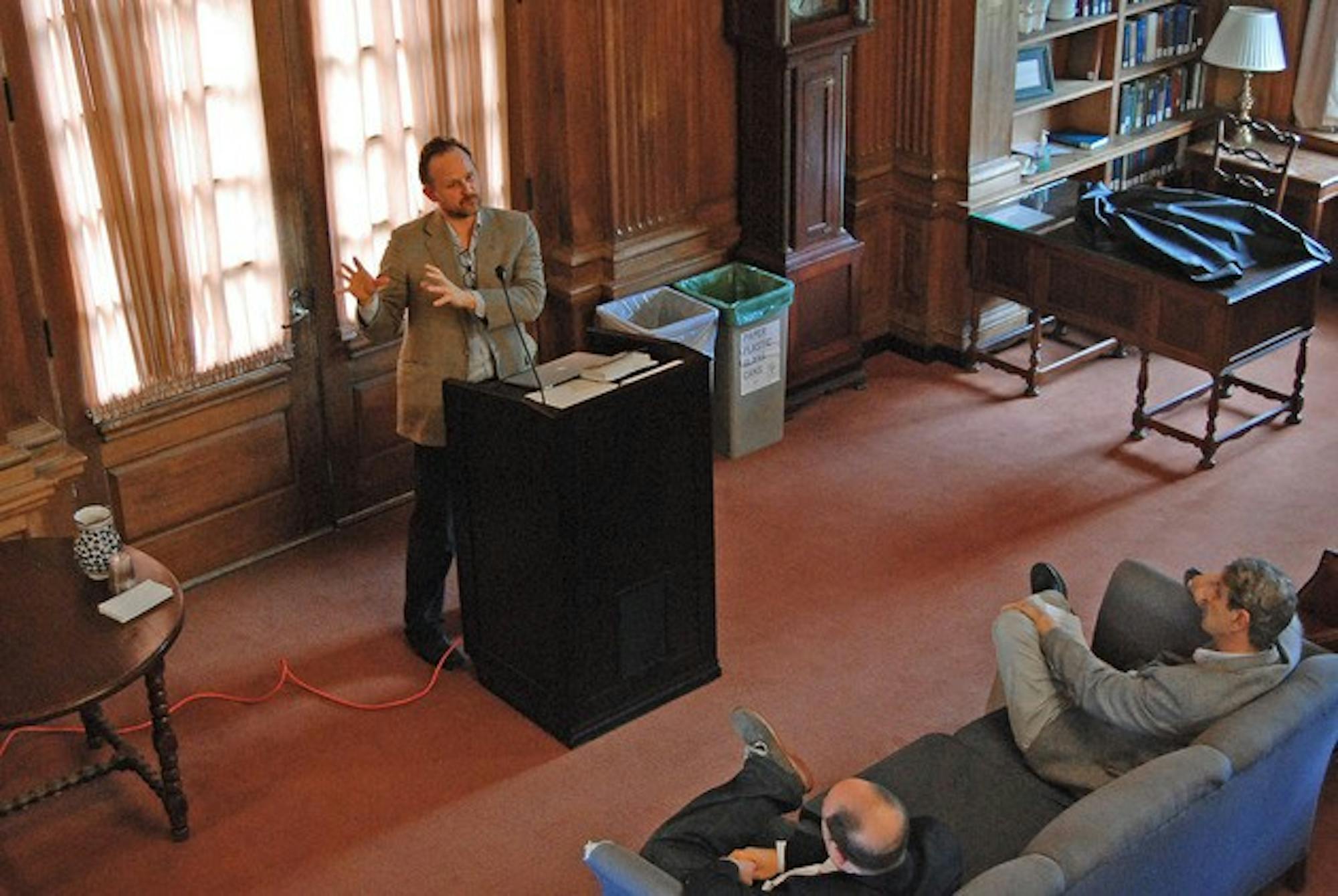
John Jeremiah Sullivan, who won a National Magazine Award in 2003 for feature writing and in 2011 for essay and criticism, read from his essay "Unknown Bards," featured in his newest collection of essays "Pulphead." The essay focuses on his work with the guitarist John Fahey, a famous guitarist who studied early blues and folk artists.
Sullivan said the work gave him a chance to explore pre-war blues, an obscure type of music that had a tremendous influence on modern music.
"It's exciting because it's not just about blues and country music," he said during the reading. "This story is about lost styles of music."
When Sullivan's father was young, he attended one of Fahey's concerts. Sullivan focused on his and Fahey's attempts to decipher the lyrics of legendary blues singer Geeshie Wiley's song "The Last Word Blues," which Sullivan played for the audience. After spending hours listening to the unclear lines, he and Fahey figured out the meaning.
"That was the end of that little mystery," he said. "It was a really fun night."
Sullivan said he knows he wants to write a story when he becomes obsessed with a topic and is inspired by other writers.
"When you're a writer, it's like you're in the machine in X-Men' that professor Xavier uses," he said. "You are very aware of your spiritual colleagues."
Carina Conti '16 said she enjoyed Sullivan's enthusiastic reading.
"It was very spur of the moment, especially when he played the song," she said. "It became obvious with his excitement with the actual material and that he got to share the actual experience."
*Koenig and Kate Sullivan are members of The Dartmouth staff. *


