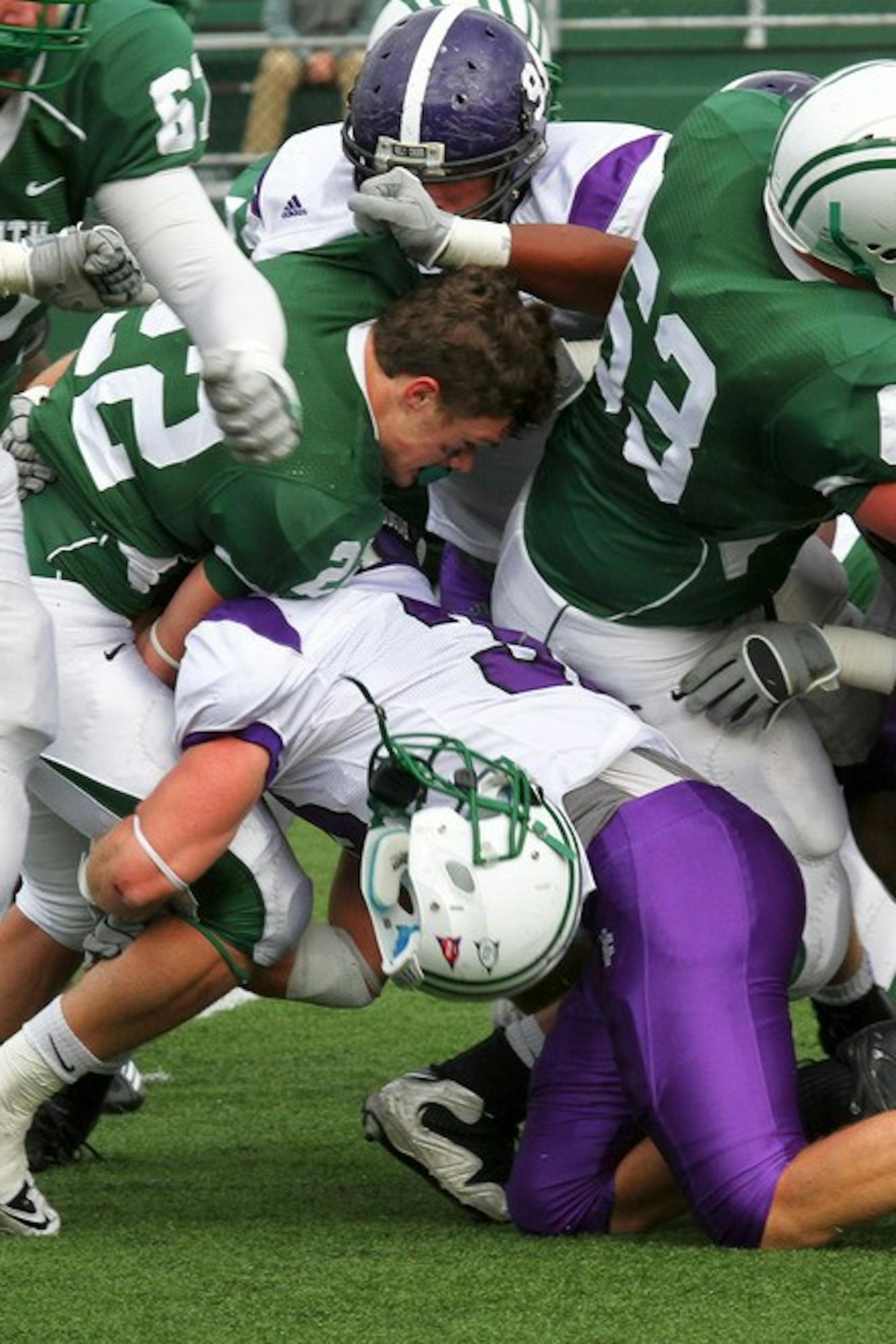
Although still in its early stages, an initiative launched this month led by College President Jim Yong Kim and Cornell University President David Skorton will set an example for athlete safety in college athletics by developing recommendations and policies for safe play at practices and games, according to Turco.
A committee composed of Kim, Skorton, football coaches, trainers, doctors and other experts was initially formed to focus on football head injuries.
The program will now take the same basic principles and apply them to other sports, Turco said.
"We obviously don't want to exclude other contact sports," he said.
A major goal of the initiative is to ensure that sideline concussion tests brief exams that are intended to determine whether or not a concussion has taken place in athletes who have sustained head injuries are as accurate as possible so that concussed players do not continue to play while injured, Turco said.
The University of Pennsylvania School of Medicine released a study advocating a new sideline concussion test that can detect a concussion in less than a minute on Feb. 2, according to a Penn School of Medicine news release.
The exam, called the King-Devick Test, requires athletes to read a series of one-digit numbers on index cards. If an athlete takes more than five seconds longer than their baseline test time to read the digits, the athlete is said to have suffered a concussion.
Turco said he is not convinced by the research, which could theoretically replace the Standardized Assessment of Concussion, the test that is currently used to assess head injuries.
"The first part of any concussion program is the sideline concussion test," Turco said. "Whatever you use, you want it to be evidence-based [and] very sensitive to people who are concussed. I think that [SAC testing] is very effective for identifying people on the sidelines."
Coaches and officials at the College and Dartmouth-Hitchcock Medical Center are now demonstrating an increased degree of concern toward Big Green athletes, Turco said.
Although the League-wide initiative is still being developed, Turco said administrators are taking the issue seriously.
"All of the presidents in the Ivy League are concerned about this," he said.
League athletes are becoming increasingly aware of the severity of concussions and other head injuries. Several Cornell football players recently expressed concern regarding the NFL's debate about the rules regarding excessively big hits and in the League and their related impact on head injuries, The Cornell Daily Sun reported on Nov. 11.
"Obviously it's an important issue because the head is something that needs to be taken very seriously," Cornell freshman Brian Gee said in an interview with The Daily Sun. "It's not like a shoulder or a knee or something, you only have one [head] and it's clearly irreplaceable."
After a serious concussion in a game against The Citadel, the Military College of South Carolina, in 2008, Princeton University football player Tom Methvin neglected his doctor's advice to end his playing career after Impact Testing a post-concussion test that compares an individual's cognitive levels to what they were before a head injury indicated he had suffered a concussion. He instead returned to the team in a coaching capacity.
"Throughout my playing career at Princeton, I have had a series of mild concussions," Methvin said in an interview with The Daily Princetonian. "At times they have been diagnosed, other times they went undiagnosed."