"Coastline to Skyline: The Philip H. Greene Gift of California Watercolors, 1930-1960" displays works painted by California natives between 1930 and 1960. The collection was donated by Philip H. Greene, a Hanover resident and Southern California native.
In an interview with The Dartmouth, Greene said he was pleased with the Hood's presentation of the watercolors and that he especially likes the essays that accompany the pieces.
"I wanted to get these paintings in a place where they could get a fresh perspective," Greene said.
In choosing to share his collection with the Hood, Greene sought to remove the paintings from their original regional context and to introduce the Californian scenes to a wider audience.
"For people here, it's a new experience," said Greene.
Millard Sheets, who created the mural "Touchdown Jesus" (1964), which spans the side of the Hesburgh Library at Notre Dame University, has two pieces in "Coastline to Skyline." Other artists whose works appear in the exhibit include Phil Dike, Rex Brandt, Barse Miller and Emil Kosa, Jr.
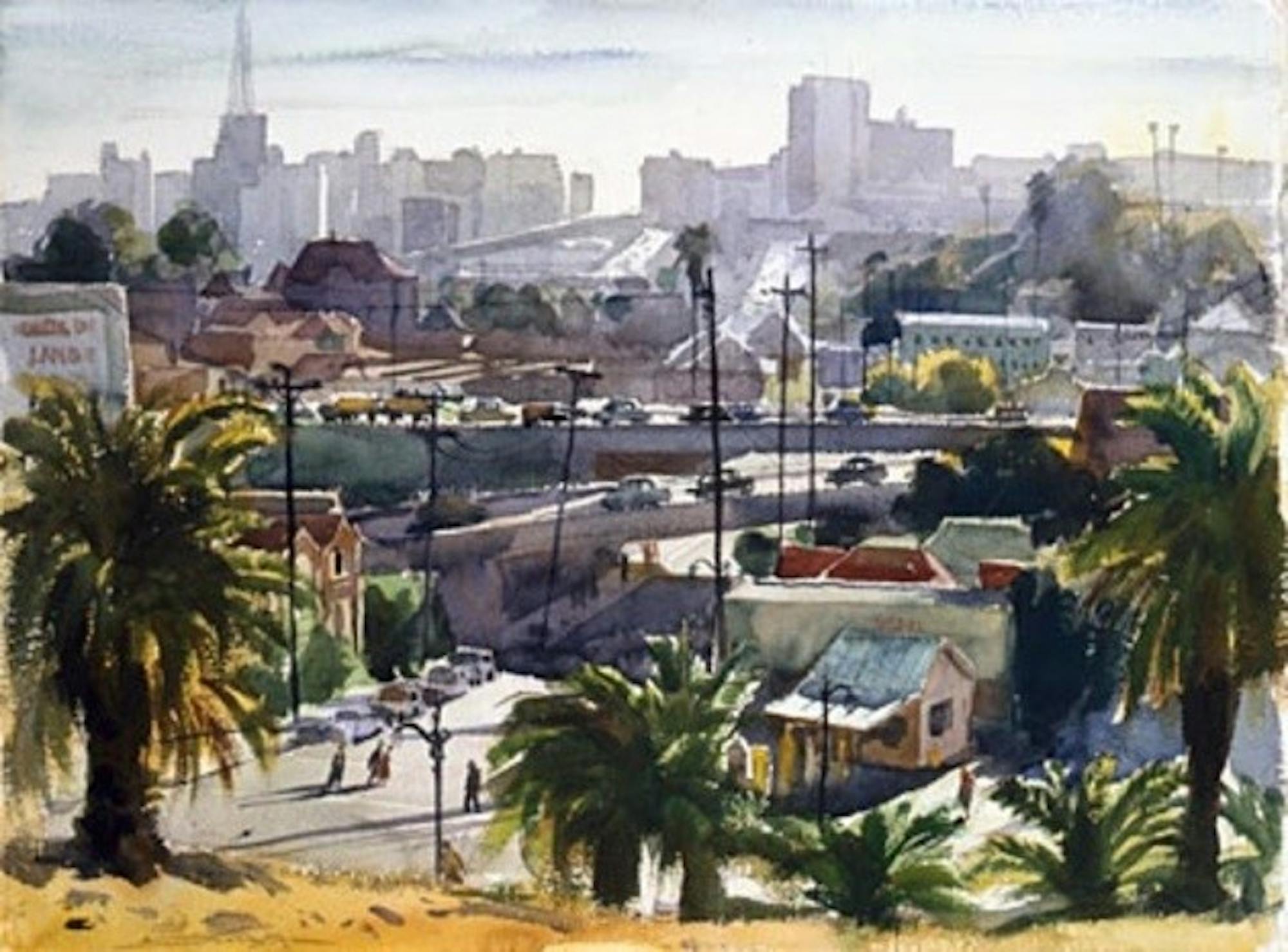
Heavy brushstrokes and dark tones characterize the California Watercolor style, and the artists make stunning use of the white paper as a part of the scenes themselves. Painted during a period of heavy domestic and international upheaval in American history, war and the depression surface as distinct themes throughout all the works.
While many of the paintings address the difficulties of the Depression and its aftermath, they often make no statement about social change. Instead, they primarily serve to bring about a sense of dignity.
Sheet's "Camp Near Brawley"(1938) depicts life in migrant labor camps in bold and varied colors. Despite the terrible conditions he portrays, the bright palette gives the scene a hopeful quality and dignifies his subjects' hard work. In a similar vein, Phil Dike places dockworkers in the foreground of "Fish Harbor (Net Mending, Newport)"(1935), casting the scene against a sharply contrasting industrial landscape.
"They're portraying things that are in decline and passing by, so [the paintings] have a nostalgic quality," Barbara MacAdam, Jonathan L. Cohen curator of American Art at the Hood Museum, explained.
MacAdam also pointed out the artists' desire to paint subjects that ordinary people would find relatable. Trains appear in the center of many of his paintings, and their smoke lends a dreamlike, romantic effect.
Sheets described his days traveling and painting with Phil Dike, writing that, "It was a very exciting thing, because the boats were coming in with these great batches of fish. They were being unloaded, they were being handled ... inside the building where the fish were either prepared for canning or prepared for market. And we saw it all."
Other painters with pieces in exhibit share Sheets' interest in animating the mundane. The busy avenue in Dong Kingman's "Mott Street" (1954) takes on a certain whimsicality with hidden eyes and faces depicted on the facades of buildings.
While the California Watercolor painters showed great sympathy for people affected by the Depression, like many in California they did not feel the Depression's effects as heavily as did most Americans. Citrus and oil industries sustained the state, and Hollywood protected the artists.
Many of the painters in the collection also worked as animators to maintain a steady income. A few cartoon sketches and Hollywood portraits, previously acquired by the Hood, join the California Watercolors exhibition in a side display.
The Hood also pairs Greene's collection with the work of Paul Sample '20, an artist in residence at Dartmouth from 1938 to 1962. Sample, whose work depicts similar scenes of everyday life, often showed his paintings with those of the California Watercolorists. He was a good friend of Barse Miller, and taught with Miller and Rex Brandt at the University of Vermont in the summer of 1941.
"Coastline to Skyline," will be at the Hood Museum until Jan. 4th. Judith C. Walsh, associate professor of paper conservation at Buffalo State College, will give a lecture on Wednesday, Oct. 29th, on the influences of California Watercolor style at 5:30 p.m. in Loew Auditorium at the Hopkins Center for the Performing Arts.
A tour of the exhibit will take place at 2 p.m. on Saturday, Nov. 22nd.