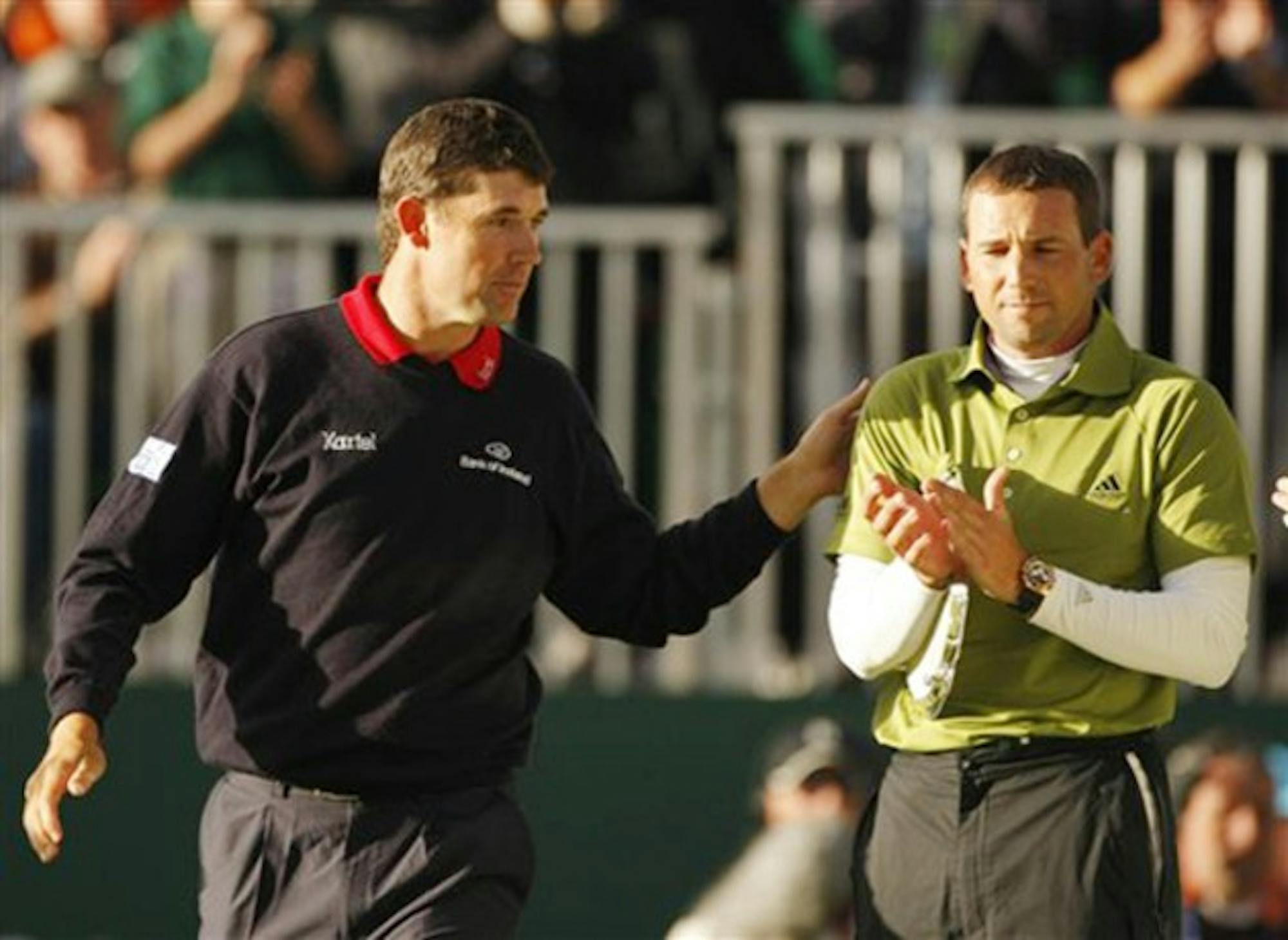
Until the next British Open, the trophy Harrington won has only one owner.
"I'm not going to put this down," Harrington said as a rainbow stretched over Carnoustie.
His victory capped a fairy-tale finish for the 35-year-old Irishman, who made up a six-shot deficit in the final round, appeared to throw it away with a double bogey on the final hole, then made good on his second chance by beating Sergio Garcia in a four-hole playoff.
The last time Harrington swirled his flag with such fervor was at The K Club last September. But unlike the Ryder Cup, which Europe won for the third straight time, a major championship is not supposed to be about country or continent, but rather personal achievement.
This one might be different.
Europe had not won a major in 32 tries over eight years, dating to the stunning victory in 1999 by Paul Lawrie on these same links, in the same theatric fashion.
It wasn't the longest drought for Europe, but perhaps the most perplexing. Along with its success in the Ryder Cup, the list of candidates grew longer each year, from Harrington and Garcia, to Paul Casey and Luke Donald, to Henrik Stenson and Justin Rose.
Miguel Angel Jimenez of Spain and Paul McGinley of Ireland followed along during the playoff Sunday evening, and the flags did not reflect the rooting interest. All that seemed to matter was that a European would be the winner.
"Miguel Angel Jimenez came to me on the first hole of the playoff and said, 'We've got a European winner,'" Harrington said. "I do believe very much in that side of things, that hopefully it will inspire the other players."
Europe needed that.
It had 18 players who had 42 finishes in the top five since Lawrie stunned everyone -- France's Jean Van de Velde, mostly -- by winning the British Open in 1999. The feeling was that if Lawrie could win a major, anyone could.
But it needed inspiration from the top of the lineup.
Colin Montgomerie might retire someday with a label in perpetuity as the best to never win a major. He showed massive cracks last year at Winged Foot when he chunked a 7-iron from the middle of the 18th fairway at the U.S. Open.
Darren Clarke and Lee Westwood have underachieved in the majors. Thomas Bjorn gave himself two good chances, blowing it in the bunker at Royal St. George's in the '03 British Open, coming up one shot short in the '05 PGA Championship at Baltusrol.
Sergio Garcia still might be the most talented of the lot, but he continues to lose respect as a whiner.
"We need the likes of a Seve or a Langer or a new Faldo or Lyle to come through, a real world-beater," Montgomerie said at the start of the week, referring to Europe's "Big Four" -- Seve Ballesteros, Bernhard Langer, Nick Faldo and Sandy Lyle -- who combined to win 11 majors. "We haven't quite got there. Who says it won't happen this week, and then go forward from there?"
Harrington might be the inspiration that takes them forward.
No one might have guessed that would be the case when he turned pro. Harrington played on a Walker Cup team in 1995 that beat a U.S. squad led by Tiger Woods, but he set modest goals after finishing a degree in accounting and turning pro.
"When I turned pro, I would have settled on being a good journeyman," he said.
Vijay Singh gets credit as the hardest working man in golf, but Harrington should share equal billing. Even when the best players gather in California for free money at the season-ending Target World Challenge, the Irishman is the first to arrive on the range and the last to leave. He is sometimes guilty of working too hard, spending too much time finding flaws only he can see.
"The idea was to turn pro, have a couple of years on the tour if I could," Harrington said. "With those couple of years, learn the ropes, see what I needed to do to improve, and then try to move on after a couple of years on tour. I just kept my head down and ran with it."