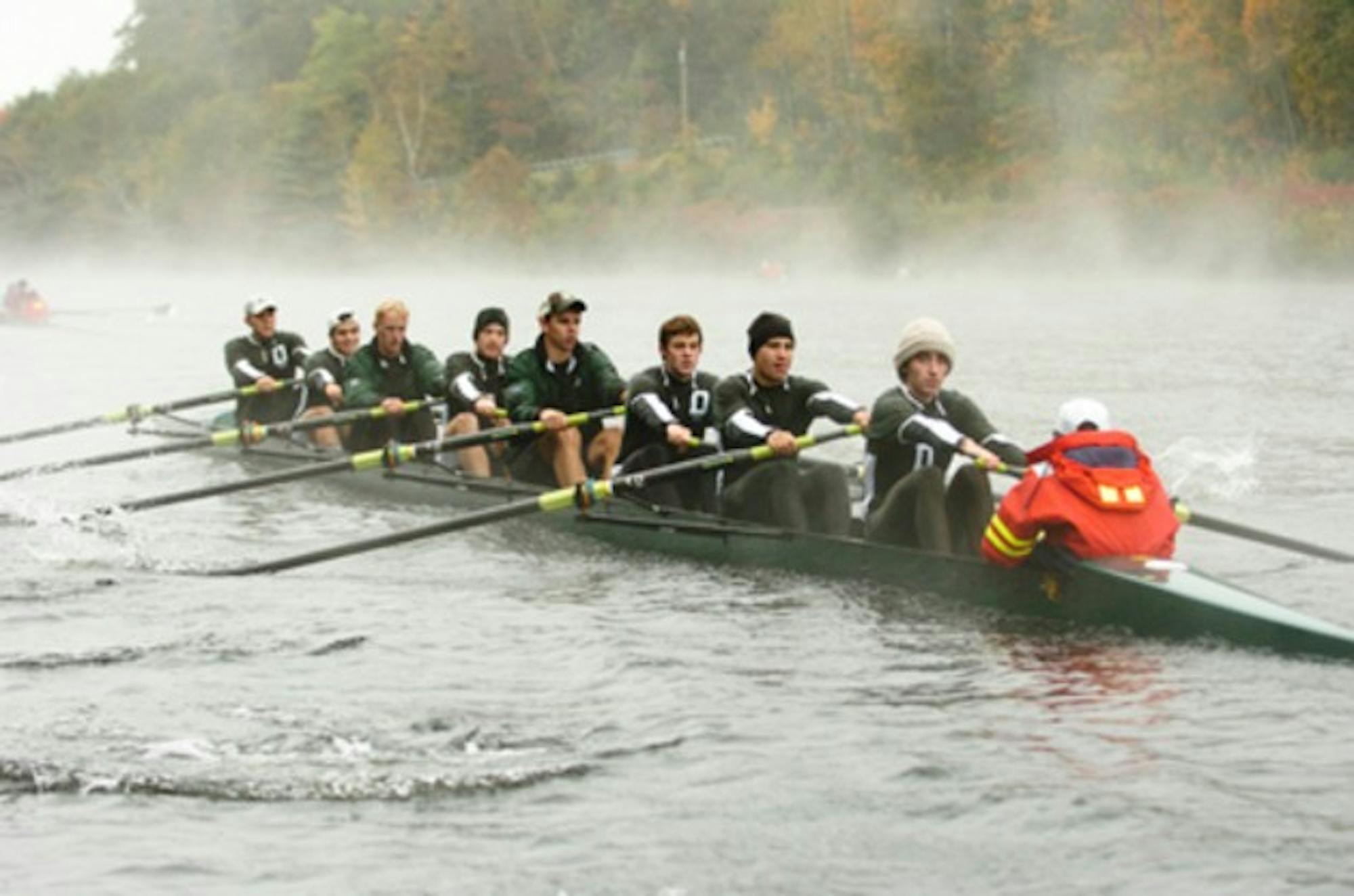
The team, however, came up short, losing in the first round of the single elimination competition to their Eastern Association of Rowing Colleges foe, Georgetown in the Temple Challenge Cup. Dartmouth had split two previous races against the Hoyas in the spring.
The lightweight squad earned its invitation to Henley by virtue of its first-place performance at the EARC Sprints Championship as well as a strong record throughout the spring season. It was the 15th time that a Dartmouth crew has been invited to Henley and the first appearance since the lightweights advanced to the quarterfinals in 2003.
Dartmouth had mixed success against Georgetown this year. In the two crews' first meeting at the EARC Sprints on May 13 in Worcester, Mass., the Big Green lightweights qualified for and won the grand final with a time of 5:38, six seconds ahead of last place Georgetown.
The two squads met again three weeks later in Camden, N.J., for the Intercollegiate Rowing Association Championship. In this race, the tables turned in Georgetown's favor, as the Hoyas finished third out of 12 in the Grand Final -- more than a second in front of Dartmouth.
The previous results suggested that the race at Henley would be quite a grudge match. This prediction proved true as the two crews rowed stroke-for-stroke for the first half mile of the 1.31-mile course. At that point however, the pace of the Georgetown crew became too quick for the Dartmouth rowers to handle, as they were slowly but steadily left behind. The Hoyas finished the race two and a half lengths ahead of the Big green in 7:42, averaging a speed of over 10 miles per hour.
Regardless of their finish, the Big Green's invitation to Henley was an unbelievable accomplishment. The opportunity to compete in an event such as Henley is not taken lightly -- it is a once-in-a-lifetime opportunity for any rower.
The Henley Royal Regatta is considered one of the preeminent events in the world of rowing. It was first held in 1839 and has been held annually since then, except during the two World Wars. It has enjoyed the patronage of the royal family of Great Britain since 1851.
The Temple Challenge Cup is one of the eight competitions held yearly at Henley. The race is open to male crews from colleges, universities and schools. It was first held in 1990 and a year later it became an annual fixture of the regatta.
This year, 32 crews from 31 schools competed in the cup. Seven of the schools were American universities, including the eventual winner, the University of California at Berkeley and two other Ivy League schools, Brown University and Cornell University.
The semi-finals and finals of the Temple Challenge turned out to be all-American affairs, with Berkeley, Brown, Cornell and Colgate all surviving the bracket. The final race took a mere 6:45 to complete.
On June 30, in preparation for Henley, the lightweights competed in the Reading Town Regatta, held just nine miles away From Henley on the River Thames.
The Reading Town Regatta was held on an 800-meter course, approximately a third of the length of the Henley races. Rowers competed in the Senior 1 Eights Division along with King's School -- Canterbury (United Kingdom), University of KwaZulu-Natal (South Africa) and Colgate University.
The Big Green defeated the South African squad by three and a half lengths in the semi-finals and went on to beat Colgate by one and a half lengths in a hard fought and competitive final.
The lightweight squad and coaching staff was unavailable for comment, as the rowers remained in Europe after their race.