Farrar, a member of the U.S. freestyle kayaking team, put her skills to the test several weeks ago when she traveled north to the Ottawa River in Canada for the World Freestyle Kayaking Championships from Sunday, April 29, to Saturday, May 5.
She finished fifth out of 28 riders in the senior women's division.
"Going into it, I thought I had a chance to maybe make the top three," Farrar said. "My main goal was to make finals, and I was really happy when I made [it]. Ending up fifth, I'm really excited and I have a lot of time to progress from there, but I think I could have done better."
The pressure of the final round, Farrar believes, may have had an impact on how she performed in the finals. While she thought her practice rides before the finals went well, she admitted that she could not duplicate her practice run when it counted.
"I wish I could have my practice ride for the competition," she said.
The 28 female riders had to compete in two separate rounds to make it to the finals. After the preliminary runs the number of riders was cut down to 10, and then an additional cut was made to place only five riders in the finals.
Farrar estimated that out of all the divisions competing -- men's junior, men's senior, women's junior and women' senior -- there were almost 200 riders from 20-30 countries at the championships.
Riders had four runs at the wave, called Mini Bus, in the opening round, with each ride lasting for 45 seconds. The best two rides were used to determine scores in the preliminary round, while in the second and final round the score was taken from the best ride out of two runs.
In freestyle kayaking, the purpose of competition is to accumulate the most points based on tricks. Judges use three criteria when scoring -- difficulty of tricks performed, variety of tricks and amplitude.
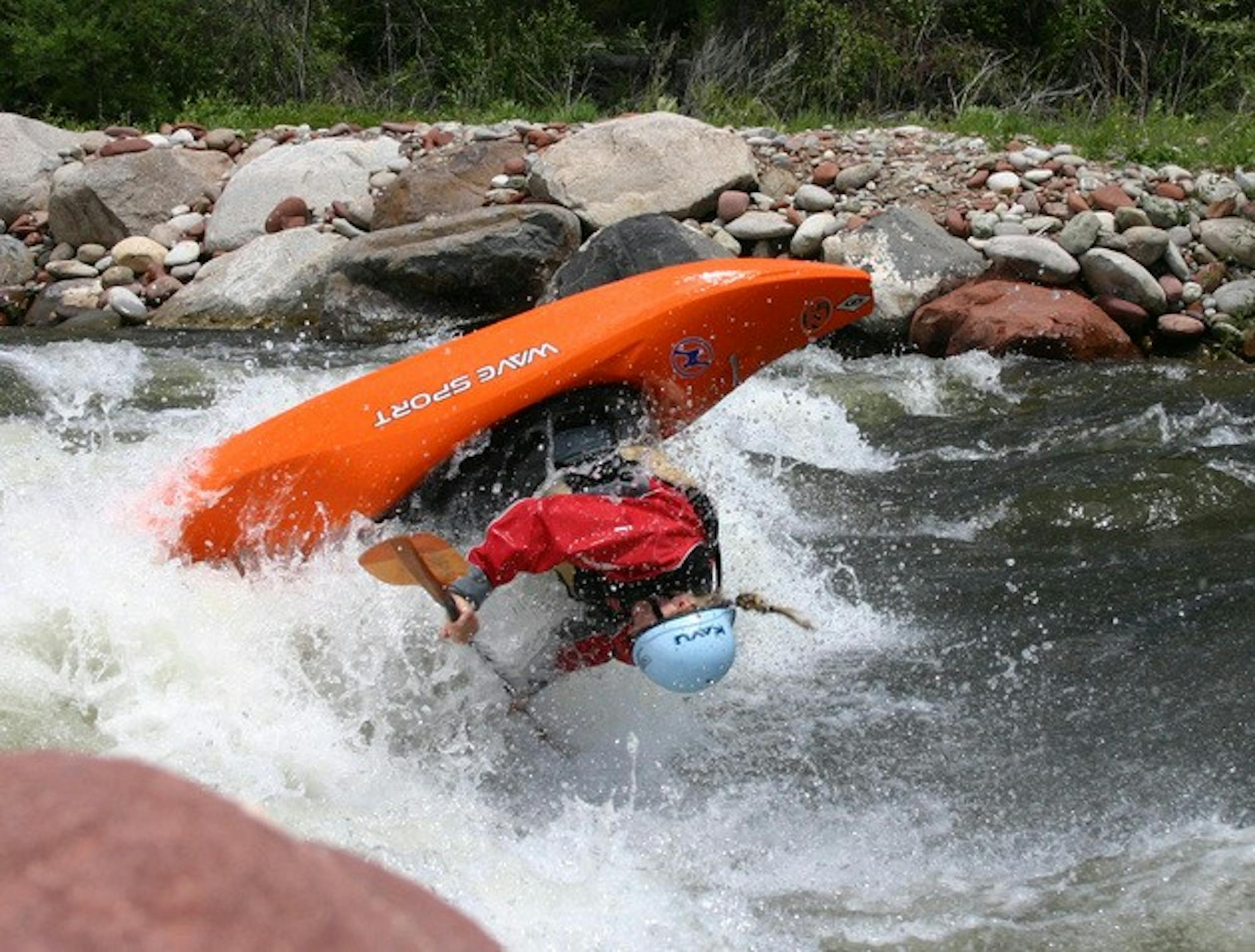
Farrar explained that there are three basic tricks in freestyle kayaking. One is called a flat spin, where the rider executes a 360 degree spin in the kayak while in the water. Another is called a blunt, an airborne 180 degree turn caused by coming down the face of the wave and bouncing off the trough into the air. Lastly is the air screw, a mid-air end-over-end flip.
"The basis of all trips is spinning your kayak around," she said. "From there, you can accelerate and get air."
In competition, Farrar sticks to just a few tricks.
"The majority of my rides consist of a lot of blunts and back blunts, and an air screw every once in a while," she said.
The waves of the Ottawa River -- what Farrar called one of the better kayaking areas for competition -- are standing waves that do not break like beach breaks. The wave forms with both sides curving up to a pointed top.
"The wave is a standing, stationary wave in the middle of the river," Farrar explained. "I would say its 10 to 12 feet tall and about 8 feet wide. You have quite a bit of room, but there's one part of the wave that's green and glassy, and the other part of the wave that's foamy.
The essential motion to freestyle kayaking is basically a continuous loop through the wave. The rider starts at the foamy top, glides down the face to the glassy section and then gets caught back up to the upper portion.
Don't be fooled the name Mini Bus, as the wave was anything but small.
"I'd say it's probably the biggest wave I've ever surfed," Farrar said. "Where the wave was [located] was pretty remote. But the reason they did this was because it's one of the biggest and best river waves in the world."
A native of Colorado, Farrar started freestyle kayaking when she was 12. She said she was drawn to the sport by watching her older brother Matt in several freestyle kayaking competitions.
After trying out the sport on a recreational level, Farrar joined the kayaking team at her high school. Farrar would practice at least four times a week on the water as well as doing some dry land training.
Farrar first qualified for the U.S. national team as a junior.
"They [the U.S. team] hold team tryouts every year," she said. "There are three spots on the senior women's team. Basically you have to place top three. It's called making the team, but it's more of a qualifying competition."
Earning a spot on the U.S. team guarantees a rider a spot in the world championships. While the team travels together to the championships together, the competition itself is solely an individual affair.
"It's totally individual for the competition," Farrar said. "It's kind of how it works in the Olympics, say for snowboarding. You are all there representing the U.S. team, but it's an individual sport. You're not competing for any goal together."
Farrar, who is sponsored by kayaking company Wave Sport, has found it somewhat difficult to train while at Dartmouth. She has two kayaks up in Hanover, but the rivers in the Upper Valley do not provide the conditions that she experienced on the Ottawa River.
"There are a lot of good running rivers [around Hanover], but they don't have a lot of good freestyle features," she said. "Here it's a lot of time in the gym, lifting and getting in shape."
However, the river conditions would not stop Farrar from choosing Dartmouth.
"I would have been able to give up any proximity to kayaking to go to a place like this," she said.
While the U.S. team does not currently have a coach, Farrar has created her own training regime thanks in part to some of her kayaking teammates on the national team.
"A lot of the men's kayakers act as coaches for me," she said. "It's a really close community, and we all help each other."
The reason the national team lacks a coach is a result of changing the sport's organizing body in an effort to better advertise freestyle kayaking and make the sport an Olympic event.
Farrar admits that a chance at Olympic gold would be great, but she knows that kayaking can only take her so far after college.
"I definitely want to continue to push the sport and continue competing, but I want to become a doctor," she said. "I don't know for sure where kayaking will end up in my life, but I'm happy with where it's taken me so far. I don't think it will be a career thing, although I would love that."