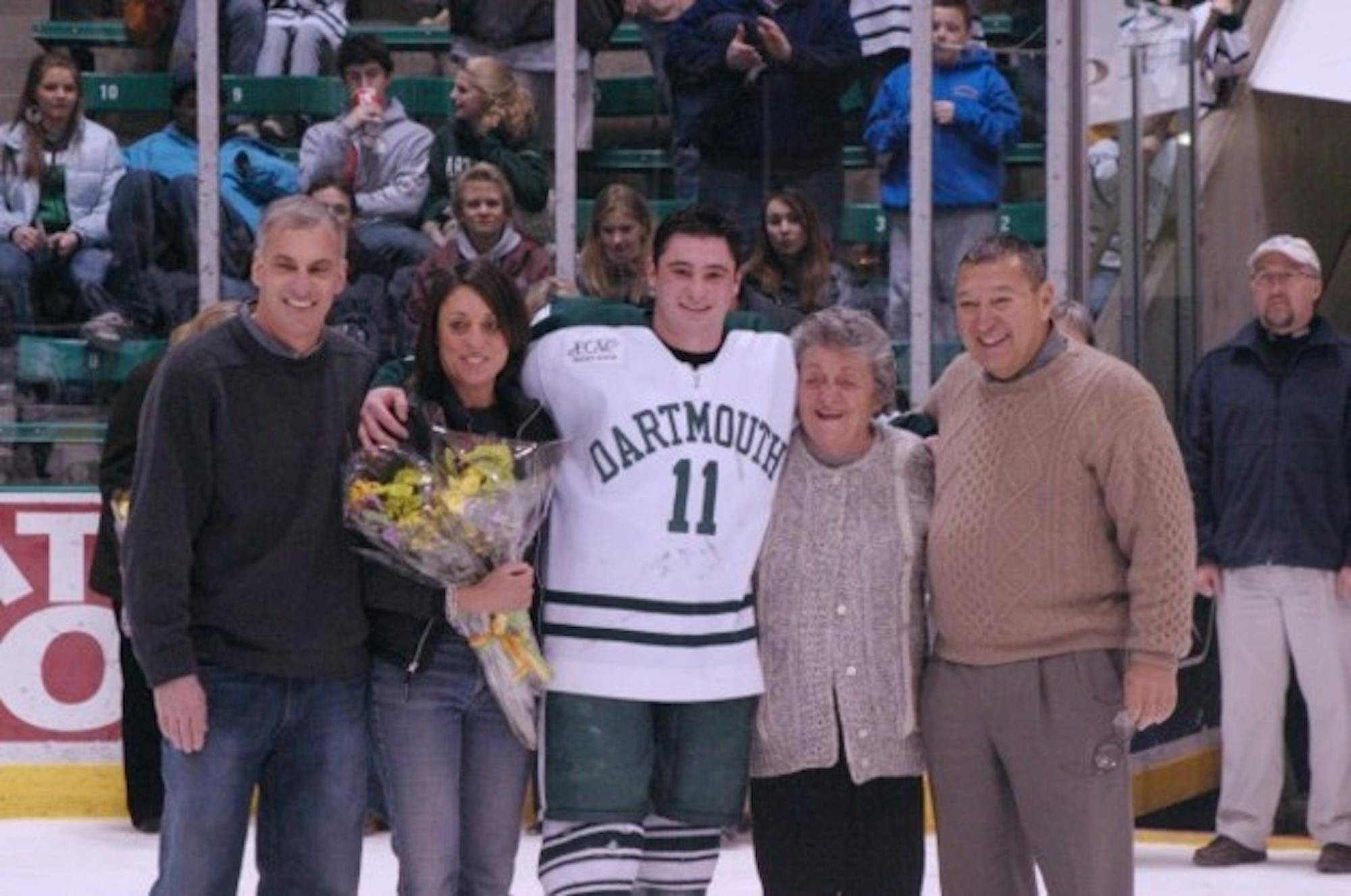
The award is named after former Army hockey captain Derek Hines, who died while serving in Afghanistan in September 2005, and it was voted on by sports information directors from the six major Division I hockey conferences, along with representatives from Army hockey and the Hines family. Shribman was announced as the winner during this year's NCAA Frozen Four tournament.
The award recognizes "a fearless leader and beloved fan favorite who places his team first," according to the Dartmouth athletics website. Additionally, "the winner should display exemplary sportsmanship, be supremely competitive, intelligent and extraordinary conditioned with an unmatched work ethic."
Steve Hines, Derek's father, said that the creation of the award was started by the hockey community, but that Robert DeGregorio, the commissioner of the Atlantic Hockey conference that includes Army, called the Hines family to get its approval for the award.
"They called me back in January to tell me they had approved it and they wanted the family's approval before they went through it," Steve said. "We were humbled and honored. It didn't turn the clock back, but it will help Derek's legacy live on."
In addition to his contributions as a third and fourth-line forward for the Big Green, the award recognized Shribman, a four-year letter winner on the varsity hockey squad, for his time spent volunteering in South Africa in the spring of 2006.
"It's very humbling, because it's named after a great person who sacrificed so much," said Shribman, a two-year winner of Dartmouth's Smoyer Unsung Hero Award.
Ashley Hines '09, Derek's younger sister and a member of the Big Green field hockey and women's lacrosse teams, sees several similarities between her late sibling and Shribman.
"First of all, Dan reached out and helped kids, and that's something my brother would do," Hines said. "He's also the type of athlete like my brother and me. They're not the most skilled or the biggest kids out there, but they work the hardest."
Not only is Shribman a fellow Big Green athlete, but the senior had prior connections to the Hines family. He played youth hockey with Derek's brother Mike Hines and the two families live close to each other in Massachusetts.
"Derek's brother Mike was on one of my hockey teams when I was younger, and I am friendly with Ashley at Dartmouth," Shribman said. "I remember when Derek was killed. It was a huge story around here [in Massachusetts]. I followed him when he was younger. It wasn't an anonymous name to me."
Although he was a shorter forward than the prototypical Division I hockey recruit, Hines earned four varsity letters on the Army hockey team and was co-captain of the team during his senior year in 2003. On September 1, 2005, Hines, a first lieutenant assigned to the 319th Airborne Field Artillery Regiment, was killed by small arms fire in the district of Daychopan during a mission to capture or kill a suspected Taliban leader. He was 25.
"He did everything for his team," Ashley said. "He never backed down from the guys that were so much bigger. Dan's the same way. He never backs down from a hit, he'll get knocked down and get right back up."
Shribman defined his role on the Big Green hockey team with a team-first attitude. He had 11 goals and 16 assists in 118 career games with Dartmouth, was a three-time selection to the ECACHL All-Academic team and a one-time pick as Academic All-Ivy.
"I was a third line forward, so my goal wasn't to put up points but to help the team in any way possible," he said.
According to Steve Hines, who had the chance to look at the potential recipients submitted by each conference, Shribman didn't win the award for athleticism alone -- his off-ice volunteer work set him apart from the pack.
"When Derek was in Afghanistan, he was involved in building a new school and he was always about the kids," Steve Hines said. "He had some quotes in his diary about the kids and how hard they have it there. [Dan's time in South Africa] really hit home for me, and it made the difference for me. Dan's going to be a difference maker in his life."
In spring 2006, Shribman realized his goal of traveling abroad when he discussed a trip with a high school friend from Deerfield Academy. After a bit of research, Shribman found a program that allowed him to teach and coach sports in different local schools in several provinces in South Africa. According to Shribman, the exposure to this culture changed his perspectives about issues like poverty and accessible education.
"It was a great experience. You definitely see the world very differently. It was pretty eye-opening," he said.