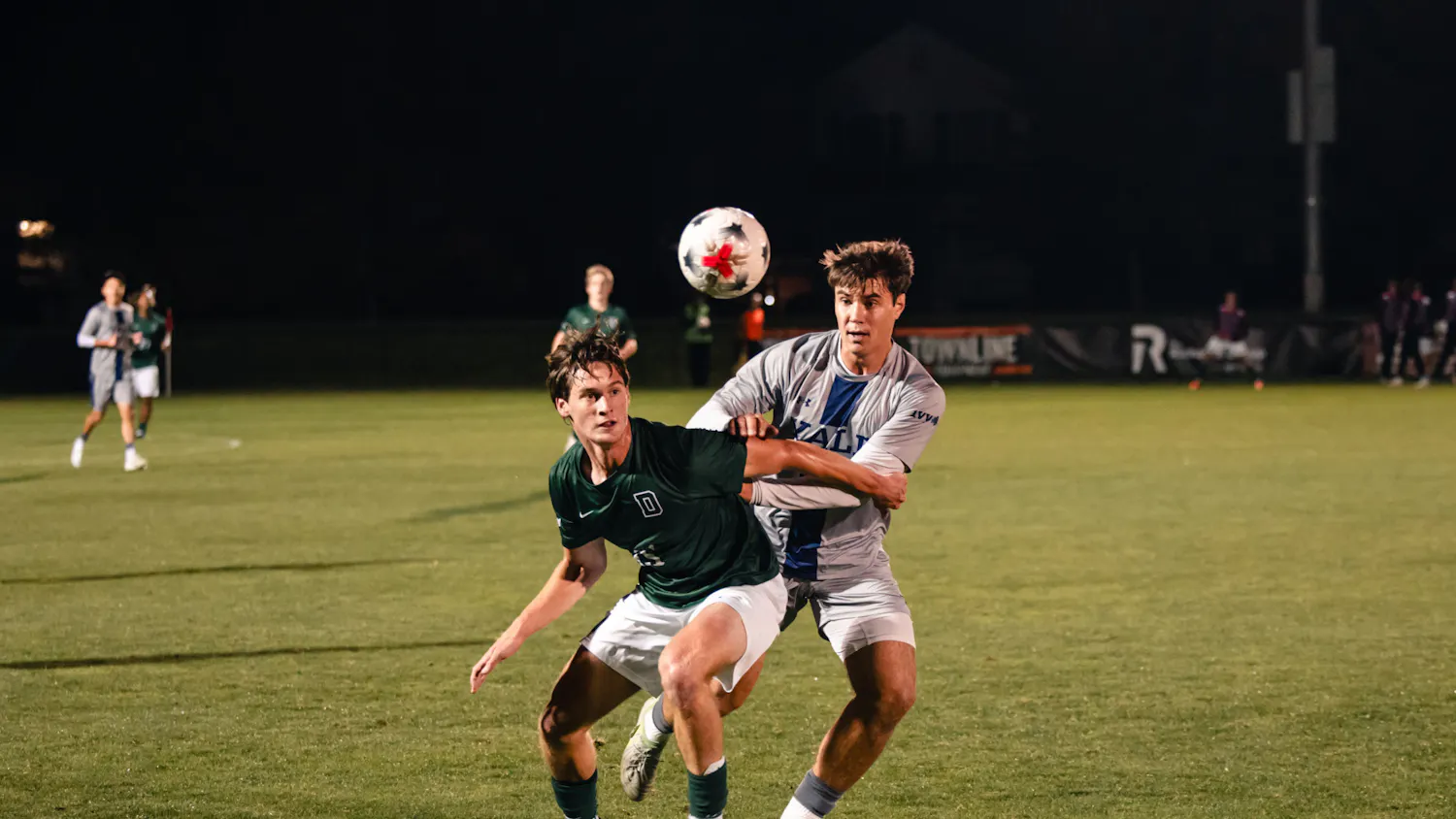
Every fall, talented freshmen athletes come to Dartmouth with the ambitions of playing their chosen sport at the collegiate level. Many of these athletes do exactly that, participating for four years on the team they began their freshman year on.
However, there are others who, for one reason or another choose to only play their sport for one, two or three years, leaving the team behind before senior year.
Comparing rosters of 12 teams from the 1992-1993 seasons to the 1995-1996 seasons, The Dartmouth sports staff compiled numbers of members of the Class of 1996 on each of these 12 randomly chosen teams. These numbers include 1996 recruits and walk-ons from each team.
Between 1992-93 and 1995-96, 26 of 63 '96 athletes (41.3%) dropped from their respective team roster.
"I don't think it's an abnormal problem or a huge problem around here," Athletic Director Dick Jaeger said.
These athletes have many reasons for dropping their sport and the loss the team feels from their departure can vary greatly.
Reasons
Former athletes give a whole host of reasons for discontinuing their sport. The most blatant reason, however, seems to stem from the time commitment playing on a team requires.
Arriving at college, many students, both athletes and non-athletes, discover activities they had never known existed. Along with your typical school extracurriculars, at Dartmouth, one can learn to rock-climb or take kayaking lessons, play on the rugby team or join the orchestra. And that is only the beginning of the many opportunities that Dartmouth offers its students.
Many times, athletes, when practicing for several hours every day, cannot afford the time to participate in many of these other activities -- things they may not get the chance to do again.
"There are so many other things the College offers," women's soccer Coach Steve Swanson said. "Priorities change. It's part of the natural growing process. There are many things that attract students to this school."
Jaeger said, "That's what life is all about, options, opportunities."
Another factor that affects the time commitment is the athletes academic requirements.
"The institution itself pushes people towards academics and the coaches support that," former men's soccer player Mike Bradley '96 said. "They know where the priorities of the students are."
Baseball Coach Bob Whalen agreed. "The nature of the College that filters down to the players is that of an increasing academic pressure, even if it's a self-imposed perception."
Whalen added that many athletes use their sport as a release from the academic rigors and pressures they might feel, saying that most athletes at Dartmouth "play for the love of the sport," rather than "to finance their education."
Along the same idea, some former athletes need the time to work on job applications and interviews.
Former baseball player Simon Tripp '96 explained he did not have the time for both baseball and corporate recruiting this year and therefore is not playing this coming season.
"I need the time to concentrate on job stuff," he said.
Compounding Tripp's decision was an injury. During his sophomore year, Tripp sustained an injury to his arm, requiring rehabilitation. After playing for half of last season, his arm gave out again. In order to play at all this year, he would have needed rehabilitation again, and even after that it would be uncertain how long his arm would have lasted.
Senior Allison Pell's situation offers yet another explanation. Pell played on both the women's lacrosse and field hockey teams. After one year, Pell found "two sports was going to be way too much."
Pell also knew that she wanted to go on the Foreign Study Program to France during her sophomore winter and wanted to take the next winter off. Because the lacrosse team practices throughout the winter, Pell knew she would have to miss two full seasons of preseason practice.
"I could never have started," she said. "It would have been hard to improve." Pell chose to remain with field hockey and to quit lacrosse.
Yet another reason that several people, both athletes and coaches, mentioned is how well the time that an athlete puts into the sport translates back into playing time.
Tripp explained this situation in terms of baseball. "You only need nine guys, and you're throwing the same nine guys out there for every game," he said. As new talent comes up, Tripp added, the players who used to start may no longer see the time in the field that they used to.
Whalen reiterated Tripp's comments. "The objective for every team is to try to win," he said. "You have to know what [the players] do well. When you manage a game you have to put the right kids in the right position to win. We play the guys that give us the best chance to win."
Finally, many incoming athletes have higher expectations in playing college sports than is a reality.
"Often times you have a certain idea of what college athletics are going to be like," Swanson said. "It's different in high school when you're on the outside looking in."
For instance, the athlete may not like the coaching style. "It's just like with professors in classes," Jaeger said. "You may have one you like who someone else doesn't like."
Bradley said, "In every sport you see people coming in from high school and expecting to play. They are talented but not experienced."
"The coaches have to line up more than the starting positions. If kids are surprised by that . . ." Jaeger said. "It's been that way since pee-wee hockey or summer soccer."
According to Jaeger, few athletes transfer out of the college to play at other schools. To avoid piracy, NCAA rules force transferring athletes to sit out a full year of sports when switching to an equal or higher level school.
Effect on the team
With this turnover that many teams face over the years, the question of continuity and leadership arises. Overall, athletes and coaches seem split in whether these aspects of the team are a problem.
Whalen cited to Winston Churchill's quotation, referring to leadership being "thrust upon" people. "There are some kids with innate leadership skills. Some become good leaders because of the way they approach their job," Whalen said. This "job" includes practice drills as well as studying and other outside actions.
Whalen also said he had seen many athletes come through and fill the leadership position when needed.
Swanson sees the discontinuity as not creating but rather adding to an existing problem. "Even when you get the same players back, there can be a different mind-set," he said.
"The dynamics have to change. You have to hope that leaders are going to rise up," Swanson added. "Obviously, the more continuity a team has, the better it is down the line."
Bradley felt that this lack of continuity over the years can be a problem. "You don't have many people to look up to, to know how to win the Ivies. A new group of faces dominating every year makes it very difficult."
While athletes must encounter new faces each year, it does appear that Dartmouth athletes have found a way to fulfill the leadership roles that may have otherwise been missing. As players step up into roles naturally-defined or "thrusted upon" them, they create a bond between the team members.
Differences between teams
While some teams lose players each year, others seem to not experience this phenomenon. Men's basketball still has all three '96 players that began in 1992.
Men's basketball co-Captain Jacob Capps '96 attributes this continuity to the "special integrity of the coaches. When I was being recruited, Coach [Dave] Faucher told me I was the only one being recruited for my position. He didn't over-recruit."
According to Capps, other Ivy League schools recruit more than one person for each position creating a "cut-throat attitude." He added, "Coach Faucher says, 'I'll bring in who I want and then I'll stop [recruiting].'"
Without this competitive nature within the team, the players can create a camaraderie amongst themselves.
"There is a cohesion even with the players who haven't had hardly any playing time," Capps said. "We're a team. Everyone is equal and has a place on the team. There's a real sense of belonging."
Whether this "sense of belonging" is present in all teams is uncertain. However, it does seem that the more people there are vying for a single position, the more likely competition within the team will develop.
Another difference could be in the structure of the sport. For instance, in hockey, offensive and defensive lines go out in shifts, allowing for more players to get playing time. This can be compared to a sport like baseball where rotations in the lineup are not very common.
Whatever the reasons and the effects on the team, coaches are understanding and do realize that, at Dartmouth, there has to be more to an athlete's life than just his or her sport.
"The coach will usually have a talk about it, but they're not going to twist their arm," Jaeger said. "The coaches know that someone who isn't interested from deep down inside isn't going to perform too well."
"It's their decision," Swanson said. "The important thing is that it's been a positive experience whether for one, two or four years."