Harrison: Save Yourself The Stress
(09/07/21 8:20am)
This column is featured in the 2021 Freshman special issue.

Use the fields below to perform an advanced search of The Dartmouth's archives. This will return articles, images, and multimedia relevant to your query.
1000 items found for your search. If no results were found please broaden your search.
This column is featured in the 2021 Freshman special issue.
Following the College’s announcement last week that the indoor mask mandate would be reestablished on campus, members of the on-campus community have expressed mixed feelings, but were not surprised, at the return of the policy.
The College officially reinstated its indoor mask mandate Thursday, following new recommendations by the Centers for Disease Control and Prevention and similar measures adopted by the town of Hanover due to the spread of the COVID-19 Delta variant. However, as of now, physical distancing and restrictions on gathering size will not be imposed, nor will the outdoor masking requirement be reinstated, according to interim provost David Kotz.
As Dartmouth prepares to return to full campus access by Aug. 1, Dartmouth Dining is working to expand hours and venue options for the upcoming academic year. After closing for over a year due to the pandemic, Courtyard Cafe in the Hopkins Center for the Arts — often referred to as “The Hop” — and the snack bars located in residential halls will reopen for the fall, according to Dartmouth Dining director Jon Plodzik and Novack Cafe and residential snack bar manager Chris Robbins. Plodzik also said that there will be a new cafe in Baker-Berry library by Sept. 2 and a bubble tea station at Collis Cafe “sometime soon.”
Following a notice by the Office of Greek Life that the “Masters” pong tournament could not take place this year due to safety and liability concerns and multiple violations of the hazing and drug and alcohol policies, Epsilon Kappa Theta sorority received a threat against the house, which summer president Lila Hovey ’23 reported to Safety and Security.
At 10 p.m. most nights this summer, students studying in Baker-Berry Library scramble to leave the building before it closes for the night. But for most of them, 10 p.m. only marks a midpoint in their night of studying, not an end.
On July 15, the Hood Museum of Art sponsored a workshop on expressive writing, the sixth installment of the virtual series. The event was co-facilitated by the founder of the Writer’s Center of White River Junction Joni Cole and Hood teaching specialist Vivian Ladd. The event, which took place Thursday evening over Zoom, was free and open to the public.
This summer, students are enjoying a return to campus with fewer COVID-19 guidelines following an announcement last Wednesday that rescinded the mask mandate on campus for those who are fully vaccinated.
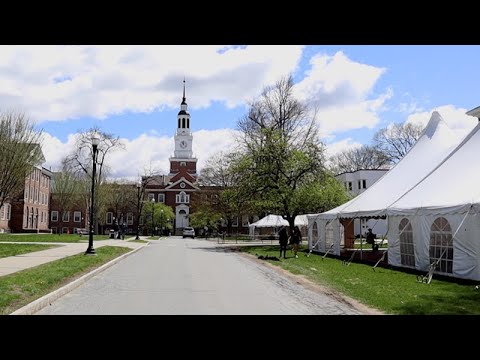
Dartmouth College is pushing forward with its reopening plan, but many COVID-19 restrictions are here to stay this upcoming summer term. Students express their feelings and worries surrounding these enduring regulations. Credits: Executive Producers — George Gerber '23 and Charlie Ciporin '23 Video Editors — Abigail Emsden '23 and Nellie Ryan '24 Narration — Mia Seymour '23 Featuring — Peyton Gordon '23, Andrew Bricklin '23, and Max Feingold '22
On a morning in early February of this year, I walked into Baker Library at 9:17 a.m. I entered from the west, and I paused to take in the scene. Checkered tiles receded hypnotically into space; low winter sun slanted in from the windows. Blobby was quiet, serene. I hadn’t been inside any of Dartmouth’s libraries since sophomore summer, and suddenly, I had my favorite study spot all to myself. I experienced such intense joy, coupled with such poignant grief, at returning to a place I had loved throughout my first two years at Dartmouth, that I immediately stored the memory of that moment as a quasi-religious experience.
The fallout of recent allegations of cheating at the Geisel School of Medicine is not likely to alter the school’s selective admissions or national ranking, though it may impact applicant perception and affect the ability of students who are involved in the cases to secure clinical residencies, according to multiple medical school admission consultants.
On Tuesday evening, over 1,000 Dartmouth community members attended Dartmouth Remembers, a candlelight vigil commemorating the lives of the four undergraduate students who have died this academic year: Beau DuBray ’24, Connor Tiffany ’24, Lamees Kareem ’22 and Elizabeth Reimer ’24. The event, held on the Green, was recorded and posted on the College’s YouTube channel.
Gap years, graduating late, switching around our D plans: My friends and I have all thrown around these ideas casually since COVID-19 altered the college experience. What once seemed like a neat and orderly four-year timeline has since become far more individual, ad-hoc and ever-changing. More interesting, though, is the way that this situation has impacted the senior class. In order to make the most of their remaining time and personal goals, some seniors have decided to take the leap of faith and graduate late.
We are a group of alumni-affiliated group leaders, many with a decade of experience leading diverse alumni communities including the Dartmouth Asian Pacific American Alumni Association, Dartmouth’s LGBTQIA+ Alumni Association and Women of Dartmouth. But our Dartmouth education did not leave us prepared to address what we’ve seen in the last two months alone: the mass murder of eight people at a FedEx facility, four of them Sikh; the killings of eight in Atlanta, six of them Asian women; the police shootings of Mah’Khia Bryant, Daunte Wright and Adam Toledo; voter suppression and anti-transgender youth bills; and the murders of trans women of color. The problems we as a society face are interconnected, inseparable and built into the foundations of this country. Yet, Dartmouth treats anti-racist, decolonial teaching and queer studies as siloed and optional fields of study, allowing students to graduate without ever having exposure to these essential educational tenets.
This article is featured in the 2021 Spring special issue.
This article is featured in the 2021 Spring special issue.
Until recently, Annie Clark’s — who goes by the stage name St. Vincent — most personal album was “Marry Me,” her debut album, which came out in 2007. Since then, she’s leaned more and more into her St. Vincent persona. Even songs that explored her personal struggles, like “Marrow” or “Strange Mercy,” feel detached from the real Annie Clark, distorted through the filter of St. Vincent. For a long time, this strategy worked well, as much of her best work can be found on albums like “Actor,” “Strange Mercy'' and “St. Vincent.” However, the culmination of this style was 2017’s “Masseduction,” a deeply impersonal album that felt sanitized and cold, both lyrically and musically. However, St. Vincent reverses course with her most recent album “Daddy’s Home,” that features much more personal lyrics.
“As Dartmouth approaches the end of a full academic year online, it is important that the Dartmouth community reflects on the successes and failures of the past year. While some of the changes and policies the College has implemented in response to the pandemic have been successful, others have not been. Of the numerous pandemic-related changes that Dartmouth has made this past year, are there any you found to be particularly successful or unsuccessful? Why did you perceive them this way and what changes should be implemented as Dartmouth transitions back to “normal” in the coming months?”
In mid-March, an alarming email arrived in the inboxes of 17 students at the Geisel School of Medicine: The school had found evidence of the students cheating, the message alleged. The accused students were to attend a hearing, and if found guilty, they could be suspended or expelled.
The Geisel School of Medicine made national headlines last Sunday when the New York Times reported on the medical school’s cheating allegations against seventeen of its students. The Dartmouth has followed up with our own reporting today, shedding light on the worrying conditions at the north end of campus.