On April 18, the Institute for Black Intellectual and Cultural Life hosted “A Celebration of ‘Sinners’” in honor of the one-year anniversary of director Ryan Coogler’s critically acclaimed film. Instead of hosting a traditional screening, the IBICL, in collaboration with the Hopkins Center for the Arts, presented a multi-part program featuring dance, discussion and music inspired by the film.
Hopkins Center programming initiatives director Johanna Evans said the celebration was “like a festival contained in one event,” noting that the scale of the program reflected the ambition of “Sinners,” which follows twin brothers Smoke and Stack as they attempt to open a juke joint in 1930s Mississippi, only to face mounting supernatural threats.
“The film deserves this kind of creative, ambitious celebration,” Evans said.
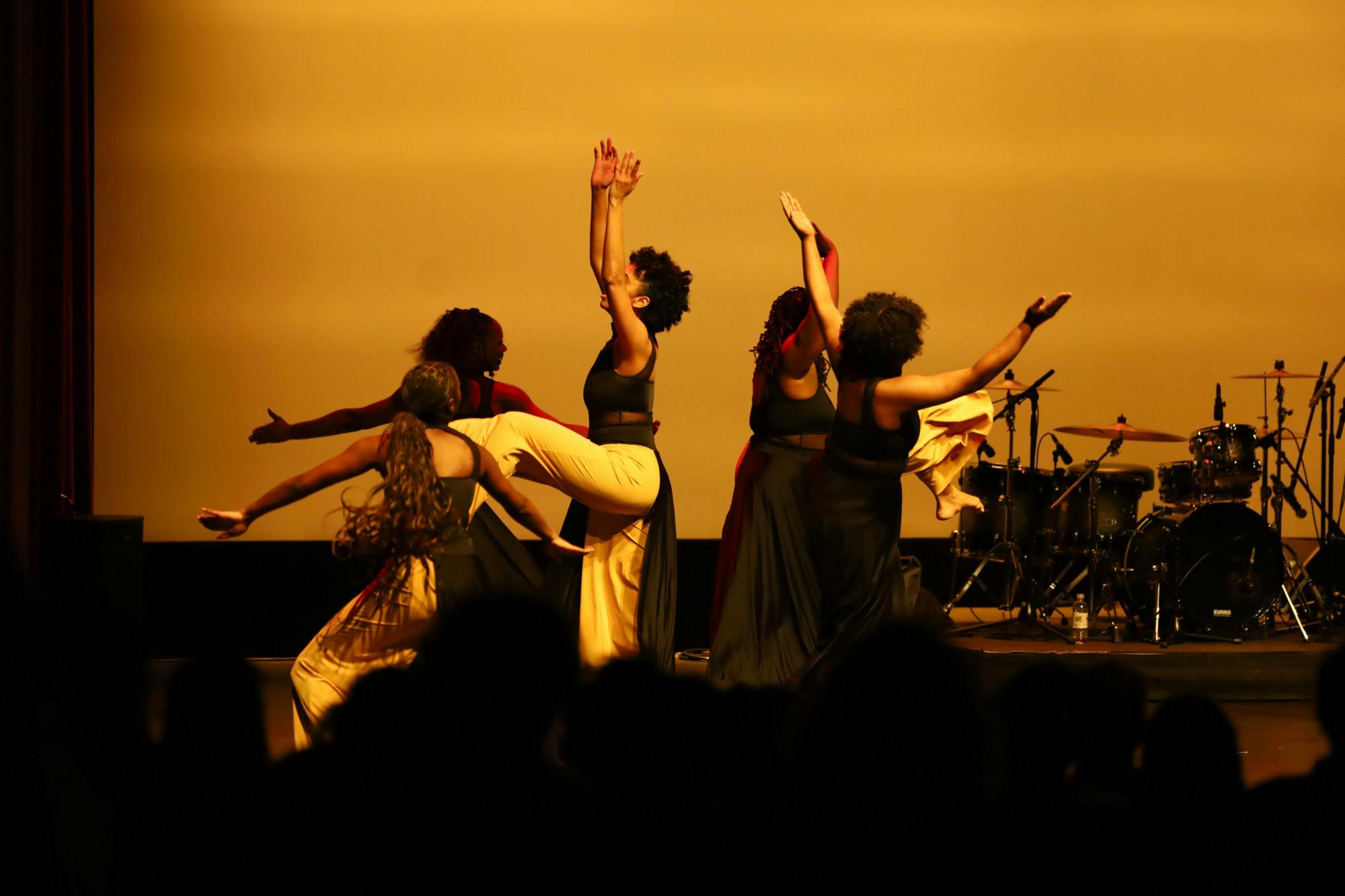
The evening opened with a performance by dancers from the Eden Brooklyn Dance Theater, whose synchronized choreography and solo performances were set to tracks from the “Sinners” soundtrack. The dancers moved from group formations into jumps and gestures that recalled the film’s emphasis on movement and collective experience.
Following the opening performance, the program transitioned into a video compilation produced by members of the IBICL in which faculty and students reflected on what “Sinners” meant to them. The piece highlighted a wide range of personal, academic and cultural perspectives — a multiplicity that IBICL associate director Christopher Chambers said was central to the film’s widespread impact.
Chambers said in an interview with The Dartmouth that the film “tells a really sophisticated story about culture, Black music and themes about race historically and in the contemporary period,” functioning as both an entertaining supernatural film and a deeply layered exploration of race and history. He said that balance helps distinguish the film from other mainstream blockbusters, particularly because “highlighting Black perspectives in a blockbuster format is still rare,” according to Chambers.
The video presentation was followed by a Q&A featuring actress Wunmi Mosaku and Dartmouth film professor Iyabo Kwayana and New York University film professor Michael Boyce Gillespie. Mosaku, who earned an Academy Award nomination for her role as Annie in “Sinners,” spoke about inhabiting a character deeply tied to ancestry and spirituality.
“I felt like she was burrowing into me rather than me having to dig into her,” Mosaku said.
Reflecting on her preparation for the role, Mosaku said the film “opened up a door for me to learn more about my culture, my history and my ancestry,” a process that required “a lot of decolonization within myself” as she moved beyond inherited assumptions to develop a more grounded understanding of her character.
The evening concluded with a live blues performance by Steven Johnson and his band, bringing the Delta blues tradition that shaped “Sinners” directly onto the stage. As the grandson of legendary musician Robert Johnson, the “King of the Delta Blues” and inspiration for the character of Sammie, the younger Johnson connected the film’s mythology to the real history of early 20th century blues.
In an interview with The Dartmouth, Johnson noted that “although a lot of ‘Sinners’ is mythical, it still helps carry on the legacy of Robert Johnson.” At the same time, he highlighted the tension between a widely embraced myth and the lived realities of Black experience that defined both his grandfather’s life and the film itself.
“People around the world know the myth more than the truth,” he said. “But if it takes them hearing the myth for me to tell the truth, then that’s my mission.”
Although part of “Sinners” is inspired by the fictitious legends surrounding Robert Johnson — particularly the belief that he traded his soul to the devil at a Mississippi crossroads in exchange for talent — Johnson offered a different, more grounded account of his grandfather’s gift.
“He learned it so fast that people said, ‘Robert, you must have sold your soul to the devil,’” he said. “No — it came from practice.”
Rather than something supernatural, Johnson framed the idea of the “crossroads” as a reflection of real-life choices and turning points. “Just like in ‘Sinners,’ people are at crossroads in their lives, making decisions,” he said.
Across several mediums, “A Celebration of ‘Sinners’” examined the film as both a cultural and artistic work while inviting multiple interpretations. Evans said the event’s multi-part structure allowed the audience to more fully engage with the film, “like turning a Rubik’s cube and seeing something new every time.”
Chambers said the event’s significance depended in part on what attendees took away from it.
“Cinema is art,” he said. “It’s meant to say something, maybe even make people think. I hope people walked away asking, ‘What does “Sinners” say to me?’”