
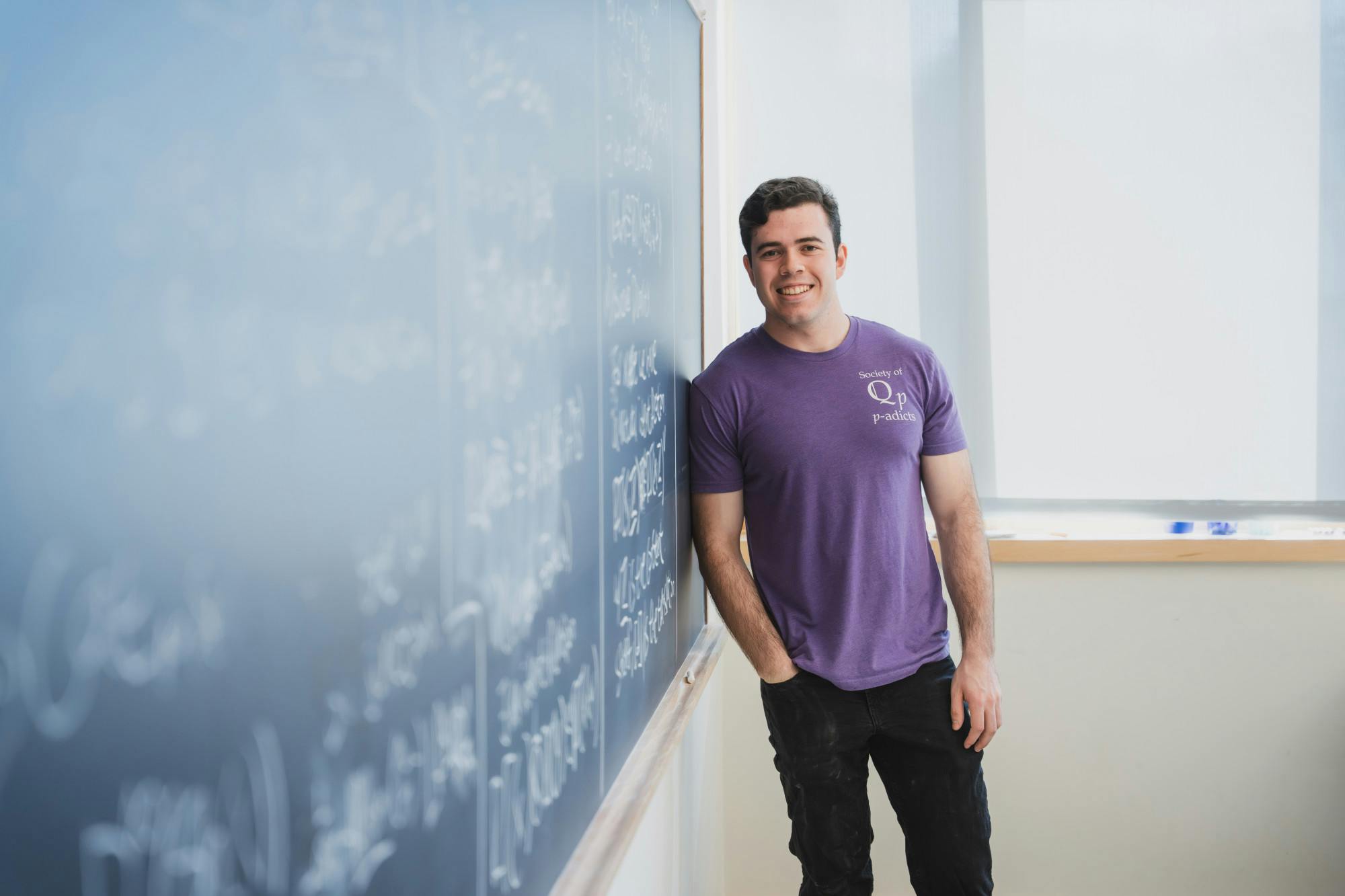
On March 27, Benjamin Singer ’27 was awarded the Goldwater Scholarship by the Barry Goldwater Scholarship and Excellence in Education Foundation for his research in mathematics. The scholarship recognizes college sophomores and juniors who “aspire to become this nation’s next generation of researchers in science, engineering and mathematics.”
This year, the Goldwater Foundation awarded the scholarship to 454 students nationwide. Singer, a math and music major at the College, will receive $7,500 for tuition and research expenses from the scholarship. The Dartmouth spoke to Singer about his reactions to winning the scholarship, his mathematics work and his advice for other math students.
Where were you when you learned that you were awarded a Goldwater Scholarship?
BS: I was actually having breakfast with my grandma. We were just eating and talking and I checked my email. I saw that I won the award, and the biggest thing I was thinking about was how excited I was to tell my family about it — especially my grandma, who is my biggest fan. That was a really great experience. I love her a lot, and she is a huge supporter of what I do.
When did you first realize your passion for math?
BS: I think it was something that happened in phases. It was something that I was always very good at and interested in. My parents tell me stories about how, when I was like two years old, I would jump in their bed in the morning and recite arithmetic tables. Growing up, I got advanced in math pretty quickly. I got through middle school mathematics by the age of five or six. I took calculus from the ages of 10 to 11 and then started taking undergraduate classes at University of California San Diego at 12.
At UCSD, I took their year-long abstract algebra sequence, and then an introductory course in algebraic geometry, which is an area in and around what I do now. I remember that was really the first time that math really tantalized me and really stumped me. A lot of algebraic geometry as a field is known infamously for how incredibly abstract it is and how difficult its constructions are to comprehend.
Could you explain the research that you do in arithmetic geometry?
BS: We have, for a very long time, been fascinated by polynomial equations, right? Think about the Pythagorean theorem. What is it? That equation is just “x squared plus y squared equals z squared.” But when you start adding variables and start adding complexity, this becomes a problem that’s really hard to understand. Arithmetic geometry is the study of how you can take that geometry that is associated with these equations and use that to then wrap back around and say things about integer or rational solutions in particular. As of late, there have been some really great connections to theoretical physics, as well as end-to-end encryption and cybersecurity.
How do you foresee artificial intelligence impacting math research?
BS: The thing that AI has gotten quite good at is problem solving. But problem solving is only one part of math. Math has a very strong creative process to it. Oftentimes, these problems are solved by introducing new techniques by thinking about things from a much bigger picture, bird’s-eye point of view.
AI in mathematics can really help with the problem solving aspect, but oftentimes it still very strongly needs human guidance. It needs human creative input. At least with how it’s modeled right now, AI is never going to be able to give a wonderful talk; AI is never going to be able to sit with a student and truly explain to them the intuition behind an ingenious idea.
What advice would you have to current math majors, or other students in math classes, about how to approach the subject?
BS: Be driven by curiosity. Don’t be scared of hard things. I think a lot of people get intimidated by areas of math that are infamously abstruse and hard to tackle, and something that can be really productive is really letting yourself enjoy that confusion. Sitting there with the material, letting yourself be frustrated with something, can lead to immense dividends when you finally figure it out and it finally all clicks into place.
Sometimes the undergraduate math experience can feel a little bit lonely. You go to lecture, you do your problem set, you do your exam and that’s it. But continue to engage with other people in mathematics, whether it’s through making study groups, whether it’s through coming to research seminars, whether it’s through talking to your professors and office hours, et cetera. Math has such an amazing potential to be a community builder.
The interview has been edited for clarity and length.
Jeremiah Rayban is a reporter and editor for The Dartmouth from Wilmington, Del., majoring in economics. Outside of The D, he enjoys reading, art and trivia.


