Teevens has been praised for his aggressive recruiting, his strict adherence to key values, his leadership and his former connections to Dartmouth football. Critics, however, point to the miniscule two-game increase in Big Green victories over Teevens' current run as head coach.
Teevens, a star football player for Dartmouth in the 1970s, led Big Green football to back-to-back Ivy League championships in 1990 and 1991 as a coach.
He returned to the College in 2005 after several stints with different college football programs, including positions at Tulane University and Stanford University.
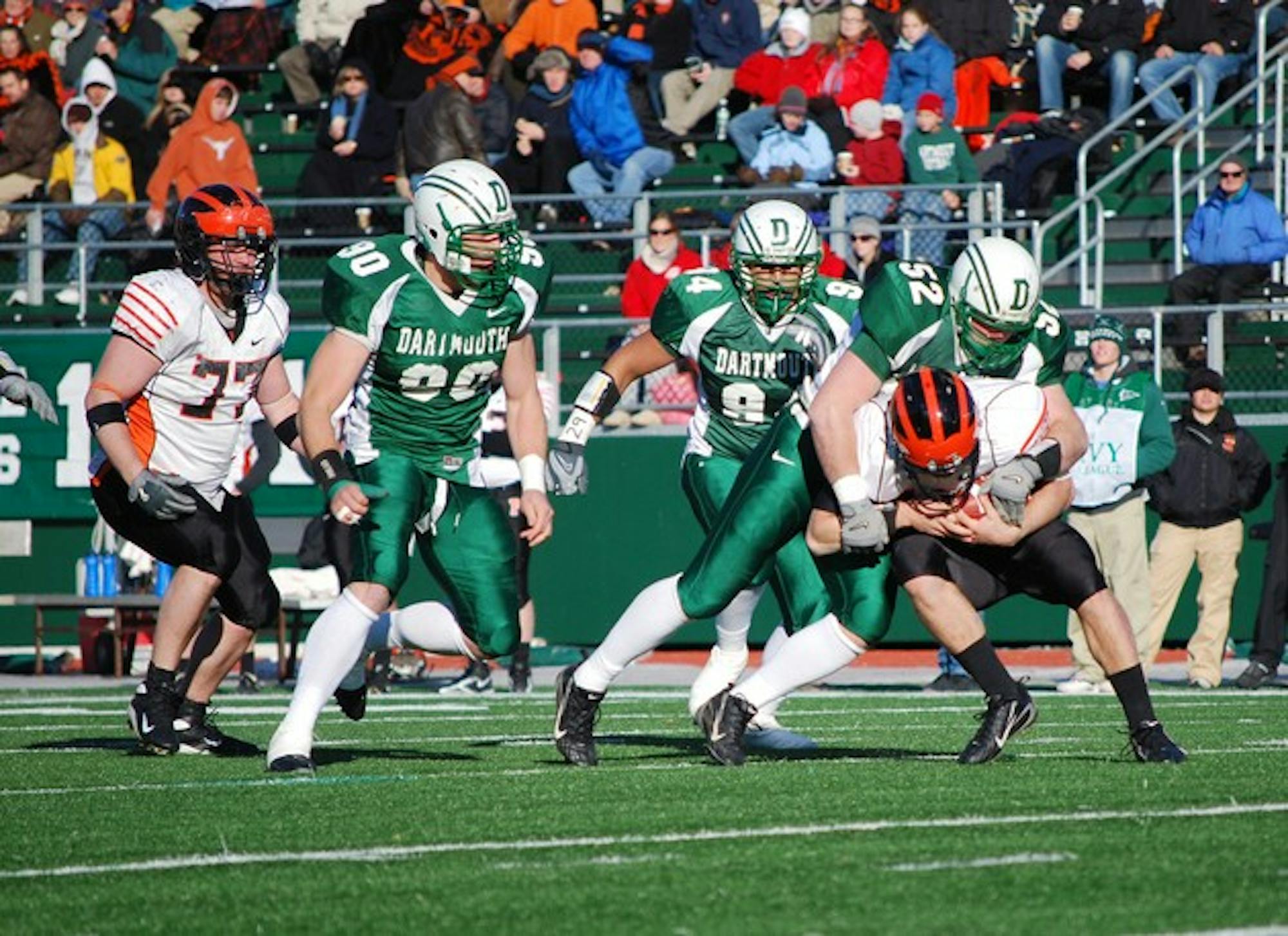
When he returned to Hanover four years ago, Teevens pledged to rebuild and reorganize Dartmouth's football program. Collegiate football coaches are viewed and judged through a strict lens, however, and since the start of Teevens' tenure, Dartmouth has gone from a dismal one-win team in 2005 to a slightly more mediocre three-win team in 2007.
Dartmouth ended 2007 with a 3-7, 3-4 Ivy record and was tied for fourth place in the league with Princeton and the University of Pennsylvania.
"It's a rebuilding process, which I knew coming in," Teevens said. "It's a solid league, it's well coached, there is a lot of changing around, and Dartmouth needed to bring about some change."
Teevens understands the magnitude of the task of turning around a bottom-of-the-barrel team, and said it will take effort, but also time.
Teevens plan to continue to focus on attitude and actions rather than wins and losses, in the hope that a strong record will follow positive team dynamics.
"As you change your program, the biggest thing that you seek to develop is confidence, and it's kind of a chicken-and-egg type of thing," Teevens said. "If you don't have any success to draw from, where does the confidence come from? And when you have success, then you have a great level of confidence in what you do. So we're right at that crux at this point."
Teevens aims to develop players who are confident and proud of their team.
He believes that changes in the team's dynamic are the most important contributions he has made to the program thus far.
"Just the culture of our program and the way that guys conduct themselves, the sense they have, the pride they have in being a member of the football program and representing the College athletically," Teevens said. "I extend that to all aspects of their lives. I think the effort and emphasis that they place on success is something that I've seen."
Teevens has also placed a heavy emphasis on recruiting. He has sought to gain depth and competitiveness at every position on the field and tried to increase the team's overall speed.
Teevens cited a number of players who have changed to stereotypically slower positions -- such as the switch from free safety to outside linebacker and outside linebacker to inside linebacker. These changes reflect Teevens' efforts to increase the team's athleticism.
"Having people making plays in space is a real key for us on the defensive side of the football," he said. "We're kind of morphing into a more athletic defensive group through the recruiting process."
Teevens' finest recruiting classes are just now taking on bigger roles on the team. As the talented players in the Class of 2011 begin to develop, the results should translate to on-field success.
But aside from his recruitment strategy and ideals of a culture of leadership, Teevens has set an uncharacteristically simplistic goal.
"I believe we have the talent to be competitive with everyone on our schedule," he said. "The key is continued improvement. I spoke with the team ... and told them our goals are quite simple: get better today."
Teevens himself readily admits that he was unsatisfied with the Big Green's record last year, but notes that at this point there are more important things for Dartmouth in the long run.
"In terms of wins and losses, I'm certainly not satisfied with where we are," he said.
"But again, we knew that it was going to be a longer process. I would say that we've gone from a noncompetitive team to a competitive situation."
For Teevens, that transition is the most important thing. Under his leadership, the team has gone from a bottom feeder to a competitive opponent in the Ivy League.
This season Teevens hopes to lead with a purpose -- he is seeking not only to change the Dartmouth football team's record but also its attitude, its actions and the way the Big Green is perceived in the Ivy League.
While the past few seasons have not gone in Dartmouth's favor, Teevens has carefully placed Dartmouth in a position to succeed.
But whether or not Teevens' philosophies lead to the Big Green's success in the 2008 season remains to be seen.